Bhagwan Ganesha murti kicked, Naga murti thrown into drain by Muslim youths in Shivamogga park
 Shimoga, Karnataka, India
  2 July, 2025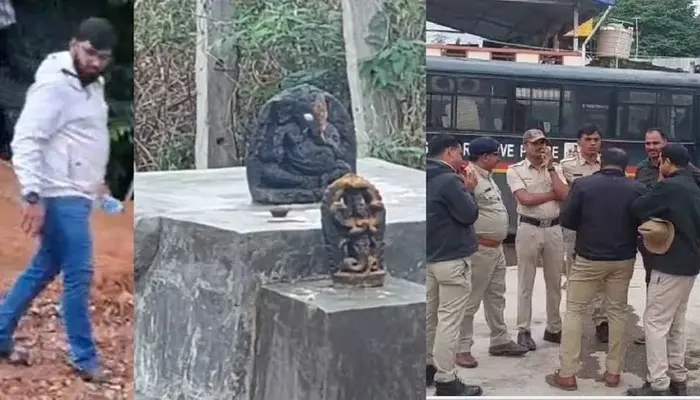
Case Summary
In Bangarappa Barangay near Ragigudda, Shivamogga district, two individuals—Rehmatullah and Saddam—desecrated sacred Hindu murtis placed in a local park. The murtis of Bhagwan Ganesha and Naga Devata were dishonoured. The accused kicked the Ganesha murti and flung the Naga murti into a nearby drain before fleeing the scene. Local Hindu residents, who witnessed the incident, confronted the culprits and recorded video evidence. The police were informed immediately. Swift action by Shivamogga Rural Police led to the arrest of both accused within hours. The desecrated murtis were recovered and respectfully restored to their original place in the park. The incident triggered widespread anger among the Hindu community and religious organisations, who demanded harsh legal punishment for the insult to their deities and the deliberate targeting of the Hindu faith. Senior police officials, including Superintendent of Police Mithun Kumar, visited the area and assured residents that law and order would be maintained. The SP stated that the investigation was ongoing and that strict action would be taken against anyone attempting to disrupt communal harmony. Heavy police presence was deployed in Ragigudda and surrounding sensitive areas, with additional patrolling ordered to prevent any further escalation. BJP MLA from Shivamogga City, Channabasappa, visited the site and met with the affected community. He demanded a strong chargesheet be filed and urged the police to investigate whether the accused were involved in other illegal activities in the area. He emphasised that no insult to Hindu deities would be tolerated and called for action that would serve as a deterrent. BJP state president B.Y. Vijayendra strongly condemned the desecration and accused the Congress-led state government of emboldening anti-Hindu elements through its inaction. He warned that any failure to ensure strict punishment would make the government directly responsible for deteriorating peace. He also underlined that acts against Bhagwan Ganapati and Naga Devata were assaults on the core of Hindu faith and that the Hindu community of Shivamogga would not remain silent in the face of such provocation.
Why it is Hate Crime ?
This case has been added to the tracker under the primary category of: - Attack on Hindu religious representations. Within it the sub-category selected is: - Desecration of Hindu religious symbol. Icons and symbols or a religious representation of a spiritual ideal are widely revered in Hinduism. Iconography is of vital significance in the Hindu milieu. It helps connect people’s spiritual beliefs with the real world. Iconography within the Hindu faith takes several shapes and forms. Murtis are of most significance to Hindus, to which daily rituals, prayers and offerings are done. Besides the murtis, there are several other symbols which have deep significance in the Hindu faith – the Om and Swastika for example. Since these Hindu religious symbols hold paramount importance in Hinduism, any desecration of symbols, icons, murtis, religious representations and manifestations, is driven by animosity towards the faith itself which manifests itself through these murtis, icons and symbols. Therefore, any desecration of these Hindu religious symbols and representations is considered religiously motivated hate crimes under this category. In this case, the murtis were desecrated by two Muslim men. In Hinduism, sacred murtis are not merely symbolic objects, but divine embodiments that occupy a central place in religious worship, daily rituals, and spiritual connection. The deliberate act of kicking the murti of Bhagwan Ganesha and throwing the Naga murti into a drain in Shivamogga was a direct and conscious attack on the sacred manifestations of the Hindu faith. This was not a random or misguided act, but a calculated and ideologically rooted expression of religious hatred. In Islamic theology, idol worship—referred to as shirk—is considered the gravest sin, condemned in the Quran and repeatedly denounced in traditional Islamic teachings. From a young age, many Muslims are taught to view idolatry as impure, offensive, and unforgivable. While such doctrinal beliefs are central to Islam, they have historically—and continue to—contribute to deep-seated intolerance toward idol-worshipping traditions, particularly Hinduism. When acts such as desecration of Hindu deities occur, they are not isolated instances of disrespect but often reflect theological contempt that views Hindu practices as unacceptable. The act of physically attacking a murti is a violent manifestation of this contempt, aimed not merely at the object but at the identity, beliefs, and dignity of the Hindu community. Such actions are expressions of hostility rooted in a supremacist religious ideology that devalues the legitimacy of Hindu worship and religious life. In the Shivamogga case, the murtis desecrated were those of Bhagwan Ganesha and Naga Devata, both of whom hold immense spiritual significance. To defile them in a public park in a Hindu-majority area was clearly intended to provoke, humiliate, and hurt the Hindu community. For these reasons, the incident is not only an act of vandalism but a hate crime. Hence, it is documented in the hate crime database.


Case Status
Arrested


Perpetrators Details
Perpetrators
Muslim Extremists
Perpetrators Range
From 2 To 5
Perpetrators Gender
male
 Sources




