Pro-Pakistan slogans raised amid Muharram violence in Bareilly; Hindu shop vandalised, traders threatened with loot
 Faridpur, Uttar Pradesh, India
  5 July, 2025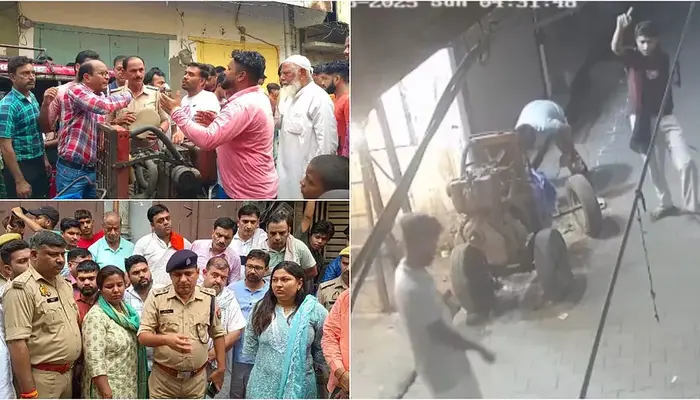
Case Summary
Communal tension erupted in Bareilly’s Faridpur area during Muharram after a group of Muslims vandalised the shop of a Hindu cloth merchant near the Taziya route, damaging its shutter and slab. The accused threatened to loot shops and raised pro-Pakistan slogans. Traditionally, Taziyas had been placed late Saturday night outside the house of the CAS Inter College manager. Until Sunday morning, the atmosphere remained peaceful. But a group of Muslims vandalised the shop of a Hindu cloth merchant. Stones were pelted at the shutter, and the shop’s slab and signage were damaged. The entire act was captured on nearby CCTV cameras, clearly showing a youth breaking the slab. Following the incident, local traders shut down the market in protest. Members of Hindu organisations also arrived and began a sit-in demonstration on the road. In the presence of police, one of the accused threatened to loot the market and warned shopkeepers of dire consequences if any complaints were filed. The accused raised pro-Pakistan slogans, which further heightened communal tension. Finally, FIR was filed against Anas, Altamas, the younger son of Salim, the commission agent, Mobina alias Chhoti Behen, and five unidentified individuals. Among them, Mobina, Anas, and Nazim were arrested. Notably, Mobina, who was previously a candidate in municipal elections and is locally known for facilitating ration cards, housing, and pension schemes, has faced prior allegations of extortion. Hindu traders reported that had the shutter been broken, the shop would have been ransacked. Police presence in the area was significantly increased following the incident. SP South Anshika Verma conducted foot patrols in the market area, even setting up camp at the Faridpur police station. Earlier, the Aggarwal community had expressed outrage, calling the incident a deliberate attempt to disturb communal harmony. The president of the local traders' association met with the victim and demanded immediate arrests based on the CCTV evidence. The community refused to engage in peace talks until action was taken against the perpetrators. Eventually, after the FIR was registered and arrests were made, the protest was called off. The administration appealed to all residents to maintain peace and avoid rumours. Investigations were ongoing, and further arrests were expected soon based on CCTV footage.
Why it is Hate Crime ?
This case has been added to the tracker un the primary category of - Hate speech against Hindus. The sub-category selected here is - Anti-Hindu slurs, mocking faith. Anti-Hindu slurs and the deliberate mocking of the Hindu faith owing to religious animosity involve the usage of derogatory terms, stereotypes, or offensive references to religious practices, symbols, or figures. One of the common anti-Hindu slurs used against Hindus is “cow-worshipper” and “cow piss drinker”. The intention of using this term is to demean and mock Hindus as a group and their religious beliefs since Hindus consider the cow holy. Additionally, some symbols and the slurs attached to them have a historical context that exacerbates the insult, hate, stereotyping, dehumanisation and oppression against Hindus. Cow worship has been used for centuries to denigrate Hindus, insult their faith and oppress Hindus specifically as a religious group. There has been overwhelming documentation about how cow slaughter has been used to persecute Hindus with cow meat being thrown in temples and places of worship. There has also been overwhelming documentation where cow meat (beef) has been force-fed to Hindus to either forcefully convert them to Islam or denigrate their faith. Apart from cow worship, the Swastika – which holds deep religious significance for the Hindus – has also been misinterpreted and distorted to use as a slur against Hindus. Similarly, the worship of the Shivling has been used by supremacist ideologies and religions to denigrate Hindus owing to religious animosity. Such slurs and denigration stem out of inherent animosity and hate towards Hindus and their faith, therefore, it is categorised as hate speech targeted at Hindus specifically owing to their religious identity. In this case, the raising of pro-Pakistan slogans by Muslim individuals involved in an act of vandalism and intimidation against a Hindu shopkeeper during Muharram observances constitutes not merely a display of pro-Pakistan sentiment but a clear act of anti-Hindu hate speech. While at surface level, such slogans may appear to be only anti-India, their use in a targeted communal context—where Hindu traders were threatened with looting and physical harm—reveals deeper hostility. It is pertinent to note that Muslim extremists harbour specific animosity towards Hindus and their faith and also view India as a Hindu collectivity. The very basis of the partition of India was that the Muslims believed that Islam was a nation unto itself, which could not survive with a Hindu collectivity like India. Further, Muslims often believe in transnational unity - or the Ummah - which is a belief that all Muslims across the world are a nation unto themselves and therefore, loyalty as far as the nation-state is concerned lies with the Muslim collectivity and not with a Hindu collectivity like India. This would also mean that the pro-Pakistan slogan is about hailing a Muslim collectivity and an expression of transnational loyalty and anti-Hindu sentiments. For that reason, any slogan which expresses transnational loyalty, faith in the Ummah, is automatically a slogan against Hindus and the Hindu collectivity. Thus, this case is added to the hate crime database.


Case Status
Case sub-judice


Perpetrators Details
Perpetrators
Muslim Extremists
Perpetrators Range
From 5 to 10
Perpetrators Gender
both
 Sources




