Hindu students compelled to recite the Islamic Kalma during a morning prayer session by the school authorities
 Kota, Rajasthan, India
  2 July, 2025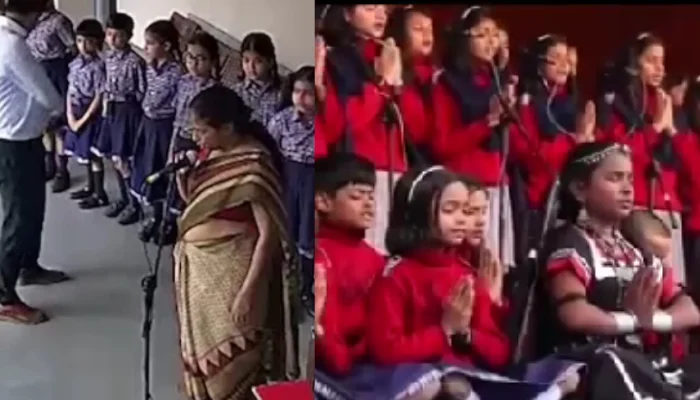
Case Summary
In Kota, Rajasthan, minor Hindu students were compelled to recite the Islamic Kalma during their school prayers. A video of this incident went viral on social media and sparked widespread outrage. According to media reports, after the video circulated online, it provoked massive outrage across the region. The Hindu organisations stated that the school management was imposing prayers of the Islamic faith on Hindu students. They also stated that they would carry out demonstrations if strict action was not taken by the authorities in this matter. The viral video showed students at the school’s morning assembly reciting the Kalma, the Islamic declaration of faith, which caused anger among Hindu parents and groups. As per the locals and Hindu activists, more than 95 per cent of the students at the school were Hindu, which raised serious concerns about religious indoctrination and the violation of cultural sensitivities. A member of the Vishva Hindu Parishad commented on the controversy, stating, “This is not inclusion. This is coercion. You cannot force Hindu children to recite a verse that is a declaration of Islamic faith. It crosses all constitutional and moral lines.” Amidst mounting backlash, the school authorities claimed that the video was “several years old” and had been recorded during an annual function as part of their decades-old tradition of Sarva Dharma Prarthana, a multi-faith prayer ceremony. The school director also claimed, “We have been following Sarva Dharma Prarthana for the past 30 years. Education has no religion. We recite prayers from all religions to promote unity and mutual respect.” Following the outrage, the district education department launched an investigation. An inquiry team, led by the Chief Block Education Officer of Kota, visited the school, reviewed the prayer recordings, and spoke with students and staff. District Education Officer Krishna Kumar Sharma stated, “We received the video showing a specific religious prayer being recited at a school. We have formed an inquiry committee, and a detailed report is awaited. Appropriate action will be taken as per departmental norms. Since the school is CBSE-affiliated, the report will also be forwarded to the Board.” The Kota Police also claimed that the event was a multi-faith prayer ceremony. However, this incident raised concerns among Hindu activists and locals about religious imposition on minor Hindu students. The Hindu activists and the locals demanded strict action against the school authorities. A local Hindu group stated, “This is not secularism. This is indoctrination under the guise of interfaith unity. If swift action is not taken, we will launch a statewide protest. Hindu sentiments have been hurt, and this cannot be allowed to pass unchallenged.”
Why it is Hate Crime ?
This case has been added to the tracker under the primary category- Predatory Proselytisation. Within this, the subcategory selected is- Proselytisation by grooming, brainwashing, manipulation or subtle indoctrination. The tertiary category selected is- Conversion of Minor. Religious brainwashing essentially means the often subtle and forcible indoctrination to induce someone to give up their religious beliefs to accept contrasting regimented ideas. Religious grooming or brainwashing also involves propaganda and manipulation. It involves the systematic effort, driven by religious malice and indoctrination, to persuade “non-believers’ to accept allegiance, command, or doctrine to and of a contrasting faith. Cases of such grooming or brainwashing are far more nuanced than direct threats, coercion, inducement and violence. In such cases, it is often seen that there is repeated, subtle and continual manipulation of the victim to induce disaffection towards their own faith and acceptance of the contrasting faith of the perpetrator. While subtle indoctrination is widely acknowledged as predatory, an element which is often understated in such conversions or the attempts of such conversion is the role of loyalty and trust which might develop between the perpetrator and the victim. Fiduciary relationships are often abused to affect such religious conversion. For example, an educator transmitting religious doctrine of a competing faith to a Hindu student. The Hindu student is likely to accept what the teacher is transmitting owing to existence of the fiduciary relationship. The exploitation of the fiduciary relationship to religiously indoctrinate victims would also be included in this category. Since the underlying animosity towards the victim’s faith forms the basis of predatory proselytization, such cases are considered religiously motivated hate crimes. In this case, it is important to highlight that the victims are Hindu children who were compelled to recite the Islamic Kalma, a declaration of the Islamic faith. Since the victims are minors, the element of consent and genuine change of conscience was missing ab initio. Minors, due to their young age, lack of maturity and are particularly vulnerable to manipulation and coercion. They may not have the ability to fully understand the implications of converting to another religion or chanting the prayers of another faith. Moreover, subtle manipulation tactics can be difficult to detect, especially when employed by trusted authority figures in positions of influence. This makes it challenging for parents to identify and address instances of religious manipulation in schools. The school authorities used their position of authority and exploited the vulnerability of the minor Hindu victims. Forcing young Hindu children to recite the Islamic Kalma during school prayers is not a neutral act of interfaith harmony; it is a deliberate imposition of the Islamic faith over their own Hindu beliefs. Such coercion and imposition infringe upon the children’s right to freely practice their own faith and violate their cultural and religious identity. When Hindu individuals are subjected to such compulsion, it amounts to psychological and emotional harm, as they are compelled to participate in religious prayers that contradict their beliefs, causing confusion, distress, and a sense of alienation. Despite what the school authorities claim, this act cannot be dismissed as a mere tradition or a multi-faith ceremony. The context matters; over 95% of the students are Hindu, making the forced recitation of an Islamic declaration of faith a clear instance of religious indoctrination rather than an inclusive practice. This is a targeted attempt to impose Islam on Hindu children, which is a form of proselytisation that exploits the school environment and targets Hindu students due to their faith. Such actions are a result of bias and disdain for Hindu students due to their religious identity. The response of the police and authorities to downplay the issue as “multi-faith prayer” or an old tradition is deeply troubling. It reflects a failure to recognise the gravity of religious imposition and the emotional harm inflicted on minor Hindu students. By dismissing the concerns of Hindu parents, locals, and activists, the authorities showed insensitivity to the religious beliefs and sentiments of the Hindu community. This approach not only emboldens those responsible but also creates an environment of fear among Hindu students and the wider Hindu community, making this a crime motivated by animosity towards the Hindu community and their faith. The police, in many such cases, where the motive behind the crime is obvious but not explicitly mentioned, deny that the crime committed was in any way motivated by a religious bias or say that there was ‘no communal angle’ to the crime. Several factors are generally at play here. Many a time the police downplay incidents of low-level communal crime because it is their jurisdiction that comes under question. The police also often say that there was ‘no communal angle’ to a crime when there was one because they wish to ensure that owing to the crime already committed, there is no further flare up in the area. Likewise, the Left media and the leftist elite are also inclined to emphasise this "no communal angle" trope, especially wherever the victim of the crime is a Hindu. However, only a police statement or a media report, for instance, cannot be enough to determine whether there is a communal angle present in the crime that has been committed. In fact, to determine whether the crime is communal in nature or not, we need to give emphasis to the ground realities. For example in the case of Rinku Sharma, the Bajrang Dal activist who was mercilessly stabbed in his house in front of his family members in Delhi’s Mangolpuri area in the year 2021, the leftist media and the leftist ecosystem had tried to peddle that there was no communal angle to the crime. Even the police denied that the crime was communal in nature. However, Opindia spoke to several people who are on the ground with the family of Rinku Sharma and we were told that the communal tension in the area is palpable. The family of Rinku Sharma has said that the Muslims of the area held a grudge against Rinku ever since he celebrated the Ram Mandir verdict Like the case of Rinku Sharma, those cases where even if the police have denied a communal angle or the leftist media have gone on an overdrive to peddle the ‘no communal angle’ trope, the ground reality, like the victim’s family or relative's testimonies, make it clear that there was an obvious religious bias that led to the crime, will be documented in this tracker. Going by the same logic, since the Hindu parents testified that their children were compelled to recite the Islamic Kalma during their school prayers was deliberate and not accidental, this case has also been included in the hate tracker. In summary, forcing minor Hindu students to recite the Islamic Kalma is a clear case of hate-driven proselytisation and religious coercion. It violates the children’s rights and disrespects their faith.


Case Status
Unknown


Perpetrators Details
Perpetrators
Others
Perpetrators Range
Unknown
Perpetrators Gender
unknown
 Sources




