Revered Hindu temple targeted: Muslims in Pakistan call for destruction of Ram Janmabhoomi; spread lies about Hindu groups
 Pakistan
  30 June, 2025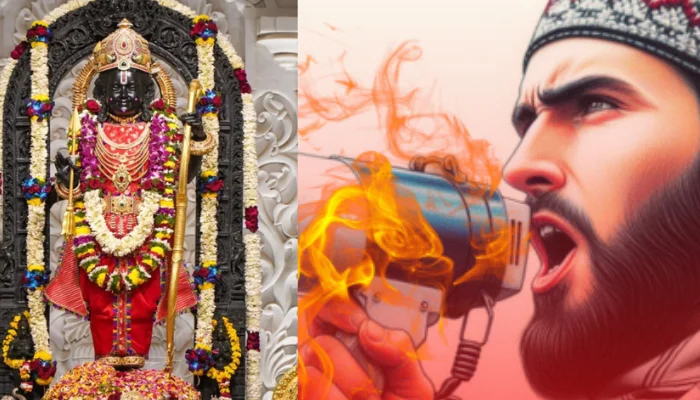
Case Summary
In Pakistan, violent calls were made to destroy the Ram Janmabhoomi temple, a sacred Hindu temple, in Ayodhya during a Muslim public gathering. The Muslim speaker who made these violent calls also targeted Hindu organisations like the Bajrang Dal and RSS. According to reports, a video showing these calls for violence went viral on social media. At the gathering, a Muslim individual was heard urging Pakistan Army chief Asim Munir to destroy the Ram Janmabhoomi temple. The speaker claimed that the Indian Army had targeted mosques and destroyed them in Pakistan during Operation Sindoor, a statement that is untrue. Operation Sindoor was a military operation launched by the Indian Army on May 7, 2025, destroying nine terrorist camps in Pakistan in response to the Pahalgam terror attack. The Pahalgam Hindu massacre was a deadly Islamic terrorist attack that took place on April 22, 2025, in the Pahalgam region of Jammu and Kashmir, where Islamic terrorists specifically targeted Hindu tourists, asking their religion before executing them. India strongly condemned this act of Islamic terrorism, particularly emphasising the brutality of targeting people solely based on their religious identity. This was a firm retaliation aimed at dismantling the terror camps in Pakistan harbouring and training Islamic terrorists responsible for the Pahalgam Hindu massacre. Despite this, he claimed that since mosques had been targeted, Asim Munir, the Pakistani Army chief, should retaliate by destroying the Ram Janmabhoomi temple in Ayodhya, India. The Muslim speaker further tried to paint Hindus as the aggressors and said that the Ram Janmabhoomi was built by destroying the Babri Masjid. However, in reality, the Babri Masjid was not an original Islamic structure erected on neutral ground, but rather a mosque constructed in the 16th century by the Mughal invader Babur, after the destruction of a pre-existing and highly revered Hindu temple marking the birthplace of Lord Ram, one of the most sacred deities in Hindu dharma. This was not just an architectural change, but a deliberate act of religious and cultural aggression.
Why it is Hate Crime ?
This case has been added to the tracker under the primary category- Hate Speech against Hindus. Within this, the subcategory selected is- Violent Threats. Violent threats, explicit, implicit or implied, is the most dangerous form of hate speech since it goes beyond discriminatory and prejudicial language to express the intent of causing harm to an individual or a group of people based on their religious identity and faith. There could be several different kinds of threats that are issued to Hindus based on religious animosity. An explicit threat would mean the direct threat of violence towards an individual Hindu, a group of Hindus or Hindus at large. Physical violence, death threats, threats of destruction of property belonging to Hindus and threats of genocide would mean explicit threats against Hindus for their religious identity. Implicit threats may not be a direct threat but implied through the use of symbols of actions – for example – in the Nupur Sharma case, other than explicit threats, there were also implicit threats when Islamists took to the streets to burn and beat her effigies. It implies that they want to do the same to Nupur Sharma – thereby is considered an implicit threat. Violent threats can be delivered in person, through letters, phone calls, graffiti, or increasingly through social media and other online platforms. It would be important to understand that a threat – explicit or implicit, online or offline – to an individual who happens to be a Hindu does not qualify as a religiously motivated threat. Such a threat, while vile and dangerous, could be owing to non-religious reasons and/or personal animosity. To qualify as a religiously motivated threat, it would need to exhibit an indication that the individual is being targeted for religious reasons and/or owing to his/her religious identity as a Hindu. The other subcategory selected is- Anti-Hindu slurs, mocking faith. Anti-Hindu slurs and the deliberate mocking of the Hindu faith owing to religious animosity involve the usage of derogatory terms, stereotypes, or offensive references to religious practices, symbols, or figures. One of the common anti-Hindu slurs used against Hindus is “cow-worshipper” and “cow piss drinker”. The intention of using this term is to demean and mock Hindus as a group and their religious beliefs since Hindus consider the cow holy. Additionally, some symbols and the slurs attached to them have a historical context that exacerbates the insult, hate, stereotyping, dehumanisation and oppression against Hindus. Cow worship has been used for centuries to denigrate Hindus, insult their faith and oppress Hindus specifically as a religious group. There has been overwhelming documentation about how cow slaughter has been used to persecute Hindus with cow meat being thrown in temples and places of worship. There has also been overwhelming documentation where cow meat (beef) has been force-fed to Hindus to either forcefully convert them to Islam or denigrate their faith. Apart from cow worship, the Swastika – which holds deep religious significance for the Hindus – has also been misinterpreted and distorted to use as a slur against Hindus. Similarly, the worship of the Shivling has been used by supremacist ideologies and religions to denigrate Hindus owing to religious animosity. Such slurs and denigration stem from inherent animosity and hate towards Hindus and their faith, therefore, it is categorised as hate speech targeted at Hindus specifically owing to their religious identity. This case is a clear instance of religiously motivated hate speech against Hindus, as the Muslim speaker called for violence against the sacred Ram Janmabhoomi temple in Ayodhya, a site of immense historical and spiritual significance for the Hindu community. Hindu temples are not merely physical structures; they are regarded as divine abodes where the presence and grace of deities are believed to reside. Calls for the destruction of such temples are deeply offensive and cause genuine hurt to the sentiments of the Hindu community. Such hateful and bigoted rhetoric is a direct affront to Hindu beliefs and reflects deep-rooted religious hostility towards adherents of the Hindu faith. Furthermore, the Muslim speaker made derogatory remarks about Hindu temples and Hindu organisations, claiming that groups such as the Bajrang Dal and RSS teach Hindus to make bombs inside temples to attack Muslims. These unsubstantiated and false claims reveal the religious bias and prejudice held by the Muslim perpetrator against Hindus and their faith. Spreading such baseless accusations only serves to create negative stereotypes about the Hindu community and normalises hatred, prejudice, and violence against them. This incident again highlights the extent of religious hostility harboured by the Muslim perpetrator towards Hindus and their faith. It is also important to address the speaker's attempt to distort history by falsely claiming that the Ram Janmabhoomi temple was built by destroying the Babri Masjid. In reality, the Babri Masjid was constructed in the 16th century on the ruins of the original Ram Janmabhoomi temple, after it was forcibly destroyed by the Islamic invader Babur or his commander Mir Baqi. This was not merely an act of architecture—it was an act of deliberate desecration, carried out as a symbol of conquest and religious domination. The demolition of the temple at the birthplace of Lord Ram, one of the most revered deities in Hinduism, was a civilisational wound that struck at the spiritual and cultural core of the Hindu people. For centuries, Hindus regarded this destruction not only as an injustice to their faith but also as a symbol of historical humiliation under Islamic rule. The site remained a point of deep emotional and religious significance, with Hindus continuing to worship at the spot despite restrictions and repeated conflicts. The Babri structure was not a legitimate or sacred space for Hindus, but rather a reminder of Islamic oppression and the erasure of their sacred heritage. The long-standing demand for the restoration of the Ram temple at his birthplace was thus not just about reclaiming land, but about restoring dignity, correcting historical wrongs, and reviving a vital part of Hindu identity and civilisation. Attempts to distort history with the intent to whitewash the persecution of Hindus, destruction of their sacred shrines, and portray the Hindu victims as aggressors only further demonstrate the prejudice and animosity that the Muslim perpetrator held towards Hindus. Such actions are a direct manifestation of religious animosity towards Hinduism. Since this case is an instance of religiously motivated hate speech against Hindus and their sacred temple, therefore, this case is being added to the hate crime database.


Case Status
Unknown


Perpetrators Details
Perpetrators
Muslim Extremists
Perpetrators Range
One Person
Perpetrators Gender
male
 Sources




