Hindu student faces corporal punishment for wearing Tilak to school by Christian teacher
 Hyderabad, Telangana, India
  3 March, 2025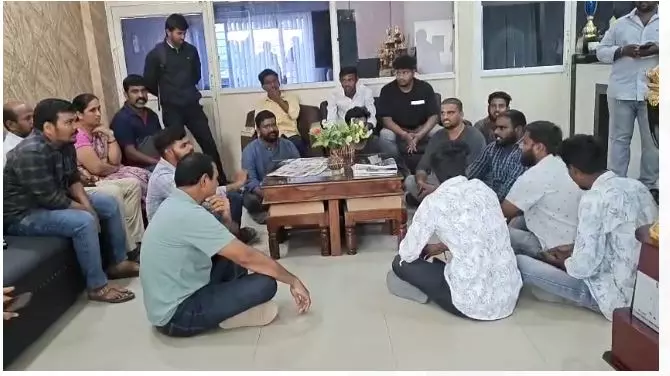
Case Summary
Controversy erupted at Candor Shrine School, Hayathnagar, Hyderabad, after the school principal enforced corporal punishment and forced a student to wipe off a tilak from his forehead. Upon learning of the incident, furious parents gathered at the school, staging a protest and condemning the principal’s actions. They raised slogans demanding strict action against him. Following the backlash, the principal, K. Laxmaiah was permanently suspended from the school. In the suspension notice, School Chairman E. Malla Reddy stated that Laxmaiah’s employment had been permanently terminated with immediate effect due to his misconduct, which included corporal punishment, offending students’ sentiments, and failing to uphold the school’s standards. “The decision to suspend your employment has been taken due to your actions, which have harmed the school's reputation and disrupted its smooth functioning,” the notice read. The notice also clarified that Laxmaiah would no longer be required to report to work or carry out any job-related duties, and his compensation and benefits would be adjusted accordingly. “We apologize for any inconvenience caused,” the chairman added, stating that further details regarding the suspension would be communicated as necessary.
Why it is Hate Crime ?
The case has been added as a religiously motivated hate crime under three main categories of the tracker. The first is- Attack not resulting in death, within which, the sub-category selected is- Attacked for Hindu identity. In several cases, Hindus are attacked merely for their Hindu identity without any perceived provocation. A classic example of this category of religiously motivated hate crime is a murder in 2016. 7 ISIS terrorists were convicted for shooting a school principal in Kanpur because they got ‘triggered’ seeing the Kalava on his wrist and tilak that he had put. In this, the Hindu victim had offered no provocation except for his Hindu religious identity. The motivation for the murder was purely religious, driven by religious supremacy. Such cases where Hindus are targeted merely for their religious identity would be documented as a hate crime under this category. The second category under which this case has been placed, based on case details, is- Restriction/ban on Hindu practices. Within this, two sub-categories have been selected. The first is- Restriction on expression of Hindu identity. An example of the state-affected prejudicial and targeted orders against the Hindu community would be a government denying the right of a Hindu or a group of Hindus to hold a religious procession owing to the animosity of non-Hindu groups. Denial of the religious right of the Hindus to assuage the non-Hindu group which harbours animosity to a point where it could lead to violence against Hindus is not only a failure of law and order but is a prejudicial order against Hindus, denying them their fundamental rights to express their religious identity. An example of a hate crime against Hindus by a non-Hindu would be a non-Hindu institution forcing its Hindu employees to abandon religious symbols that a Hindu would wear as an expression of faith owing to inherent prejudice against the faith professed by the victim or a non-Hindu group of people restricting a Hindu group from constructing a place of worship simply because the demography of the area in which the temple is being built is dominated by non-Hindus. Such actions are driven by religious animosity and/or prejudice against Hindus and their faith and would therefore be categorized as a hate crime. The second sub-category under the above-mentioned main category selected here is- Administration restricting religious practice. In several cases, it is seen that the administration/state disallows a religious practice owing to prejudicial orders and concerns, targeted specifically against the Hindu community. Such restriction/prohibition would be considered documented as a hate crime because the orders are often a result of pressure by groups that harbour animosity towards Hinduism and Hindus. Often, the restriction by the authorities is driven by bias, hostility, or prejudice against the specific community being stopped from holding a religious practice, by pressure groups that harbour animosity towards Hindus, intrinsic to their faith. Since practices are intrinsic to the faith of the Hindus, such prejudicial restriction is considered a curtailing of the fundamental rights of the Hindu community. In several cases, for example, the authorities ban a Hindu religious practice due to pressure from groups opposed to the religion. In other instances the prohibition is selectively enforced against one religious group (Hindus) while others are allowed to proceed. There are still other cases where the authorities preemptively restrict a religious practice by Hindus because those who hold animosity towards Hindus may get “provoked” leading to them being violent, thereby assuaging the sentiments of those who hold animosity towards Hindus by curtailing the religious rights of Hindus. Such acts and orders are prejudiced, indicating discriminatory motives owing to the capitulation to groups that harbour animosity towards Hindus and therefore, would be categorized as a religiously motivated hate crime since the original pressure leading to the order itself is a result of hatred/bias/prejudice/religious hate against Hindus. The third main category relevant here is- Predatory Proselytisation and within this, the sub-category selected is- Proselytisation by grooming, brainwashing, manipulation or subtle indoctrination. Religious brainwashing essentially means the often subtle and forcible indoctrination to induce someone to give up their religious beliefs to accept contrasting regimented ideas. Religious grooming or brainwashing also involves propaganda and manipulation. It involves the systematic effort, driven by religious malice and indoctrination, to persuade “non-believers’ to accept allegiance, command, or doctrine to and of a contrasting faith. Cases of such grooming or brainwashing are far more nuanced than direct threats, coercion, inducement and violence. In such cases, it is often seen that there is repeated, subtle and continual manipulation of the victim to induce disaffection towards their own faith and acceptance of the contrasting faith of the perpetrator. While subtle indoctrination is widely acknowledged as predatory, an element which is often understated in such conversions or the attempts of such conversion is the role of loyalty and trust which might develop between the perpetrator and the victim. Fiduciary relationships are often abused to affect such religious conversion. For example, an educator transmitting religious doctrine of a competing faith to a Hindu student. The Hindu student is likely to accept what the teacher is transmitting owing to existence of the fiduciary relationship. The exploitation of the fiduciary relationship to religiously indoctrinate victims would also be included in this category. Since the underlying animosity towards the victim’s faith forms the basis of predatory proselytization, such cases are considered religiously motivated hate crimes. In this case, the school principal displayed deep disdain for the Hindu faith by forcefully removing the tilak from a Hindu student's forehead. In Hinduism, the Tilak holds deep religious, cultural, and spiritual significance. It symbolises protection, blessings, unity, and commitment to spiritual and ethical principles. Its use across various rituals and ceremonies underscores its importance in the Hindu way of life, and by forcefully removing the tilak, the teachers insulted the Hindu faith and displayed their deep disdain towards the religion. Forcing a Hindu student to remove a tilak from his forehead is not an act of enforcing discipline but a direct attempt to alienate the child from their faith. Such actions serve as subtle yet powerful tactics of brainwashing, gradually conditioning young minds to detach from their religious identity. Children, being in a crucial stage of emotional, cognitive, and social development, are highly impressionable and susceptible to manipulation. When an authority figure like a school principal enforces the erasure of a visible religious symbol, it sends a message that practicing one’s faith is unacceptable or undesirable. This not only undermines the child’s confidence in their religious beliefs but also creates a sense of discomfort, shame, or fear associated with their cultural identity. Over time, such coercion can weaken their connection to their faith, making them more vulnerable to external influences that seek to reshape their beliefs. This incident reflects a broader pattern of subtle indoctrination, where children are conditioned to distance themselves from their traditions, often without realising it. By targeting young minds in such a manner, these tactics contribute to a systematic erosion of faith. Though the school did acknowledge the mistake and suspended the teacher after facing protests from the victim's family members and Hindu organisations, the assault was motivated by prejudice against the victim's Hindu identity, indicating a deep-seated intolerance and animosity the school harboured against the Hindu faith. Since the central motivation, in this case, is religion, this case has been added as a hate crime.
Victim Details
Total Victim
1
Deceased
0
Gender
- Male 1
- Female 0
- Third Gender 0
- Unknown 0
Caste
- SC/ST 0
- OBC 0
- General 0
- Unknown 1
Age Group
- Minor 1
- Adult 0
- Senior Citizen 0
- Unknown 0


Case Status
Complaint registered


Perpetrators Details
Perpetrators
Christian Extremists
Perpetrators Range
One Person
Perpetrators Gender
male
 Sources




