Hindus lured with incentives and brainwashed with religious texts to convert to Christianity in Madhya Pradesh
 Singrauli, Madhya Pradesh, India
  15 March, 2025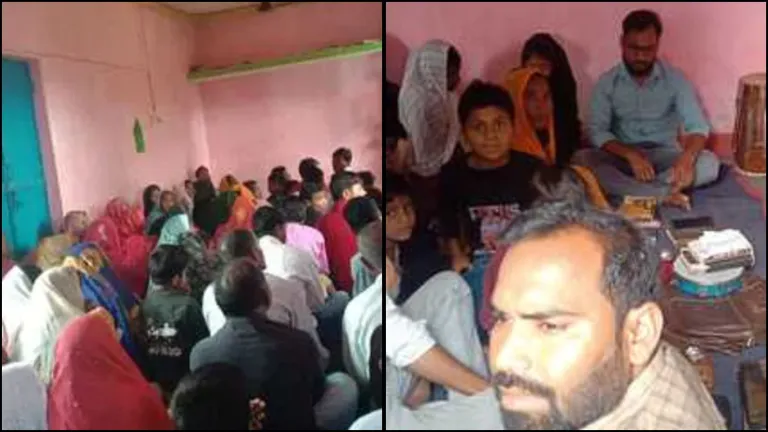
Case Summary
In Karsua village, located in the Singrauli district of Madhya Pradesh, Hindus were lured into converting to Christianity by two Christian men named Kamlesh Saket and Arvind Saket. According to media reports, Kamlesh Saket was a teacher at the government school in Karsua Raja village. Along with his friend Arvind Saket, he was gathering Hindus from around the village and encouraging them to convert to Christianity. Both Kamlesh and Arvind were residents of Kotiya village. The two men had gathered 50 Hindus in a closed room in Karsua village and were attempting to persuade them to convert by offering incentives. Meanwhile, the police were alerted about the conversion attempt. Upon arriving at the scene, they discovered that almost 50 Hindus were part of a Christian meeting conducted by Kamlesh and Arvind. Multiple Bibles and Christian religious materials were also recovered from the site. The police team halted the conversion activities and arrested the two perpetrators. According to the police, the Hindus were being misled and coerced into converting to Christianity. Mada police station in-charge Shivpujan Mishra stated that the police had received information about the religious conversion activities taking place in Karsua Raja village. A large crowd had gathered during the police raid. Two members of the gang involved in the conversion were arrested, and many Bibles were recovered and then seized. The police began an interrogation of the accused to know how many more people were associated with them in carrying out such illegal conversion activities.
Why it is Hate Crime ?
This case has been added to the tracker under the primary category- Predatory Proselytisation. Within this, the subcategory selected is- Conversion/attempts to convert by inducements. Predatory Proselytisation is not just limited to threat, harassment, force and violence, but it also has contours of stealth. In several cases, the Hindu victim is exploited to convert, with non-Hindus taking advantage of their poverty. In such cases, the Hindu victim who is suffering financially is offered monetary benefits, including lucrative offers for jobs, health treatment, education, etc, to induce the victim into changing his/her religion. In such cases, the religious identity of the victim and the aim to disenfranchise him from his faith form the heart of the crime. Also, taking advantage of and exploiting an individual’s economic vulnerabilities is widely acknowledged as exploitation, forms of which are often penalised by law. Such cases therefore are considered religiously motivated hate crimes since the victim’s religious identity forms the very heart of the crime itself. The other subcategory selected in this case is- Proselytisation by grooming, brainwashing, manipulation or subtle indoctrination. The tertiary category selected is- Pattern of targeting Hindus. Religious brainwashing essentially means the often subtle and forcible indoctrination to induce someone to give up their religious beliefs to accept contrasting regimented ideas. Religious grooming or brainwashing also involves propaganda and manipulation. It involves the systematic effort, driven by religious malice and indoctrination, to persuade “non-believers’ to accept allegiance, command, or doctrine to and of a contrasting faith. Cases of such grooming or brainwashing are far more nuanced than direct threats, coercion, inducement and violence. In such cases, it is often seen that there is repeated, subtle and continual manipulation of the victim to induce disaffection towards their own faith and acceptance of the contrasting faith of the perpetrator. While subtle indoctrination is widely acknowledged as predatory, an element which is often understated in such conversions or the attempts of such conversion is the role of loyalty and trust which might develop between the perpetrator and the victim. Fiduciary relationships are often abused to affect such religious conversion. For example, an educator transmitting religious doctrine of a competing faith to a Hindu student. The Hindu student is likely to accept what the teacher is transmitting owing to existence of the fiduciary relationship. The exploitation of the fiduciary relationship to religiously indoctrinate victims would also be included in this category. Since the underlying animosity towards the victim’s faith forms the basis of predatory proselytization, such cases are considered religiously motivated hate crimes. In this case, Hindus were lured with incentives and were manipulated to convert to Christianity by Christian evangelists. Even Christian religious literature and texts were used to brainwash the Hindu victims into conversion. The nature of the conversion efforts and the wider impact on the Hindu community all indicate a targeted action against Hindus as a collectivity. When individuals or groups focus their efforts on converting members of a particular religion, in this case, Hindus, then it demonstrates a fundamental disregard for the Hindu faith. Conversion, especially when not based on personal conviction but rather on external persuasion or pressure, is not simply about sharing a different belief system. It is an attempt to undermine the values, traditions, and identity of the Hindu community. In this context, the Christian perpetrators specifically targeted Hindus, which suggests a lack of respect for Hinduism and its followers. Such actions are carried out to strip Hindu victims of their faith, making it a religiously motivated crime. The use of incentives to encourage Christian conversion clearly demonstrates that these actions were not motivated by kindness or charity. Instead, they were calculated attempts to exploit vulnerable Hindus specifically because of their religion. By providing inducements to Hindus to change their faith, the Christian perpetrators were effectively emotionally blackmailing those vulnerable Hindus who might have been desperate for assistance. Such instances are seen in many cases where members of Christian missionary groups target socially and economically vulnerable Hindus to further their agenda of religious conversions. This form of coercion strips Hindus of their agency and dignity and enforces forced conversions. These are not random or isolated incidents, but rather are premeditated efforts to undermine the Hindu faith, persuade Hindus to discard their own faith, and convert to Christianity. Such acts are deeply rooted in religious animosity towards Hindu victims and their faith, making it a religiously motivated crime. The Christian perpetrators were also actively attempting to indoctrinate the Hindu victims by using Christian religious texts and literature. Using the scriptures or literature of one faith to deliberately target and manipulate members of another, with the clear intention of religious conversion, represents a direct attack on the Hindu faith. Such actions are designed to violate and undermine the beliefs of Hindu victims and are clear indicators of religious hostility towards Hindus and their religious identity. Such actions further demonstrate that this was not an isolated incident of evangelism, but rather part of a broader, organised operation to further religious conversions. When Christian religious material is used to exploit trust, sow doubt, and misrepresent the beliefs of Hindus to coerce conversion, particularly in a systematic manner, it constitutes a religiously motivated offence. Multiple Hindus were targeted for conversion. This showcases a pattern of profiling Hindus, luring them with incentives and subjecting them to psychological manipulation served as a stark example of a religiously motivated crime. Such actions are aimed at undermining the religious and cultural identity of Hindus through coercion, manipulation, and unlawful means. Such incidents highlighted that the conversions were neither isolated nor accidental but formed part of a calculated and targeted strategy to convert Hindus to Christianity. By focusing specifically on Hindus, these Christian evangelists were profiling vulnerable individuals and working systematically to erase their Hindu identity. The repeated nature of these actions revealed a deliberate intent to disrupt the cultural fabric and faith of the community, leaving the victims exposed to ongoing pressure and exploitation. These instances of targeted proselytisation activities stem from inherent hostility towards the victim's professed faith since Abrahamic faiths believe that any non-adherent to their faith is subject to being dehumanised till they convert, making it a religiously motivated crime against Hindus. Since this case meets multiple parameters of a religiously motivated attack against Hindus and their faith; therefore, it is being added to the hate crime database. Disclaimer: The Hinduphobia Tracker records incidents based on when the victim’s ordeal began. However, in this case, the report does not specify when the tribal families were converted. Therefore, for documentation purposes, the date of the incident has been recorded as the date it was reported in the media- 16th March 2025.
Victim Details
Total Victim
50
Deceased
0
Gender
- Male 0
- Female 0
- Third Gender 0
- Unknown 50
Caste
- SC/ST 0
- OBC 0
- General 0
- Unknown 50
Age Group
- Minor 0
- Adult 0
- Senior Citizen 0
- Unknown 50


Case Status
Arrested


Perpetrators Details
Perpetrators
Christian Extremists
Perpetrators Range
From 2 To 5
Perpetrators Gender
male
 Sources




