Hindu tribals targeted for conversion by Christian missionaries; intercepted on train to Punjab
 Chhindwara, Madhya Pradesh, India
  11 March, 2025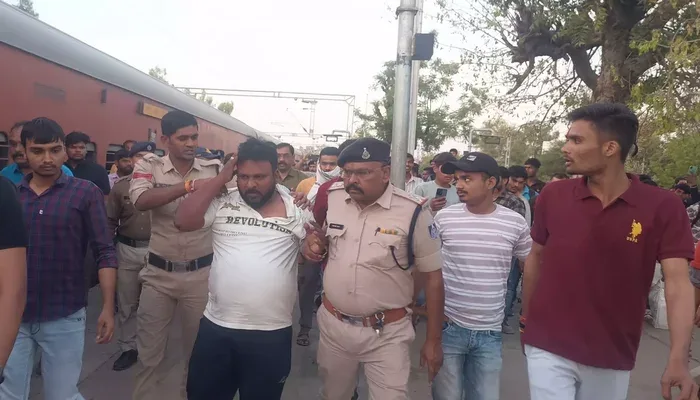
Case Summary
In Chhindwara, Madhya Pradesh, a group of 15–20 tribal Hindus were being taken by train to Firozpur, Punjab, for religious conversion to Christianity by members of a missionary group. The main accused have been identified as Shejnath Suryavanshi and Vijay Tangram. According to media reports, Hindu organisations received intelligence about the attempted conversion and alerted local police and railway authorities at Ganjbasoda railway station. Acting promptly, officials intercepted train number 20423, the Patalkot Superfast Express, and detained 11 individuals, including Shejnath and Vijay. The police arrested the two primary suspects and recovered Christian religious literature and church-related material from their possession. Nilesh Agarwal, a representative of a Hindu organisation, stated that the tip-off came from fellow passengers who noticed suspicious behaviour. With the help of local authorities, the group was intercepted, preventing an illegal attempt at religious conversion. He demanded strict action against all those involved. One of the accused admitted to the media that he began participating in Christian prayers during the COVID-19 pandemic at a church in Punjab. Since then, he has been bringing poor individuals from tribal and Kurmi communities in Chhindwara to churches in Punjab and encouraging them to adopt Christian practices.
Why it is Hate Crime ?
This case has been added to the tracker under the primary category - Predatory Proselytisation. The sub-category selected is - Proselytisation by grooming, brainwashing, manipulation or subtle indoctrination, and within it, the tertiary category selected is - Pattern of targeting Hindus. Religious brainwashing essentially means the often subtle and forcible indoctrination to induce someone to give up their religious beliefs to accept contrasting regimented ideas. Religious grooming or brainwashing also involves propaganda and manipulation. It involves the systematic effort, driven by religious malice and indoctrination, to persuade “non-believers’ to accept allegiance, command, or doctrine to and of a contrasting faith. Cases of such grooming or brainwashing are far more nuanced than direct threats, coercion, inducement and violence. In such cases, it is often seen that there is repeated, subtle and continual manipulation of the victim to induce disaffection towards their own faith and acceptance of the contrasting faith of the perpetrator. While subtle indoctrination is widely acknowledged as predatory, an element which is often understated in such conversions or the attempts of such conversion is the role of loyalty and trust which might develop between the perpetrator and the victim. Fiduciary relationships are often abused to affect such religious conversion. For example, an educator transmitting religious doctrine of a competing faith to a Hindu student. The Hindu student is likely to accept what the teacher is transmitting owing to existence of the fiduciary relationship. The exploitation of the fiduciary relationship to religiously indoctrinate victims would also be included in this category. Since the underlying animosity towards the victim’s faith forms the basis of predatory proselytization, such cases are considered religiously motivated hate crimes. This case has been added to the tracker as a religiously motivated hate crime against Hindus because the facts of the case clearly demonstrate a deliberate and systematic effort to target economically and socially vulnerable Hindu tribal communities for religious conversion. The involvement of individuals who had previously converted and then began guiding others from their community to churches under the pretext of “prayer” sessions indicates a well-established pattern of religious grooming. The use of trust, social proximity, and targeted outreach to convert Hindus, especially tribals, reflects a calculated strategy driven by religious malice. This is not an isolated incident but part of a broader campaign to undermine Hindu beliefs and erode traditional identities in a subtle yet persistent manner. The recurring nature of such attempts, particularly in tribal areas, further strengthens the categorisation of this case as part of a patterned targeting of Hindus. Since the religious identity of the victims is at the very core of the conversion attempt, and the methods used are aimed at severing individuals from their Hindu roots through manipulation and deceit, this case qualifies as a religiously motivated hate crime. Disclaimer: The case mentions that between 15 to 20 individuals were baptised by the accused, but does not provide an exact number. For documentation purposes, we have recorded the maximum count of 20 victims in the database. It is also stated that both men and women were among those baptised, though no specific gender breakdown is provided. Therefore, we have evenly divided the count, recording 10 male and 10 female victims for the sake of consistency in documentation. Disclaimer: It is important to clarify that the report does not specify the exact date when the conversion activity began. Therefore, for documentation purposes, we have recorded the date based on when the incident was reported in the media.
Victim Details
Total Victim
20
Deceased
0
Gender
- Male 10
- Female 10
- Third Gender 0
- Unknown 0
Caste
- SC/ST 20
- OBC 0
- General 0
- Unknown 0
Age Group
- Minor 0
- Adult 0
- Senior Citizen 0
- Unknown 20


Case Status
Case sub-judice


Perpetrators Details
Perpetrators
Christian Extremists
Perpetrators Range
Unknown
Perpetrators Gender
unknown
 Sources




