Revered Hindu deity's idol desecrated by Christian missionaries in Mumbai, Maharashtra
 Chembur, Maharashtra, India
  21 November, 2025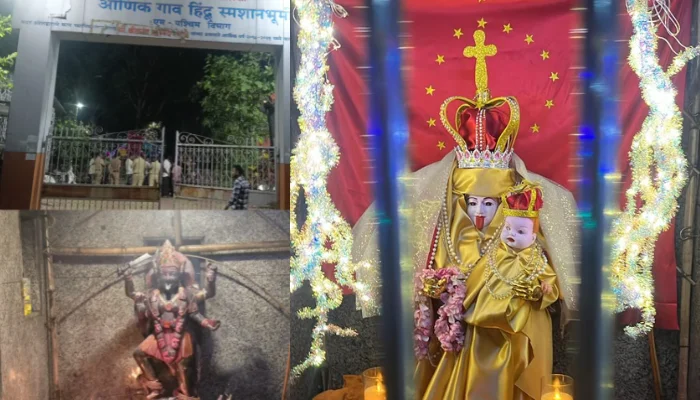
Case Summary
In Chembur, Mumbai, Maharashtra, an idol of Goddess Kali was desecrated by Christian missionaries. The accused dressed the idol of Goddess Kali as Mother Mary. Even the temple priest had been paid by the missionaries to carry out this act. According to local reports, the incident occurred on 22nd November 2025 in the Chembur–Vashi Naka area. The act took place at the Kalimata Temple, where worshippers were shocked to find the idol in the sanctum sanctorum adorned in attire resembling that of Mother Mary. When local residents questioned the temple priest, Ramesh, he stated that the goddess appeared in his dream and instructed him to “give her the form of Mother Mary.” However, several residents said the priest had been paid to perform the act deliberately. A video shared on social media by a local Hindu resident also went viral, in which locals clearly stated that members associated with Christian missionaries were responsible, with Ramesh acting in collusion with them. As the incident came to light, several Hindu groups gathered at the temple and immediately lodged a complaint with the police, demanding strict action. Soon after, a First Information Report was registered at the RCF Police Station. The police detained priest Ramesh and produced him before the court, which remanded him to two days of police custody. At the time of writing this report, the authorities were investigating whether more individuals were involved in orchestrating the desecration incident.
Why it is Hate Crime ?
This case has been added to the tracker under the primary category- Attack on Hindu religious representations. The subcategory selected is- Desecration of Hindu religious symbol. Icons and symbols or a religious representation of a spiritual ideal are widely revered in Hinduism. Iconography is of vital significance in the Hindu milieu. It helps connect people’s spiritual beliefs with the real world. Iconography within the Hindu faith takes several shapes and forms. Murtis are of most significance to Hindus, to which daily rituals, prayers and offerings are done. Besides the murtis, there are several other symbols which have deep significance in the Hindu faith – the Om and Swastika for example. Since these Hindu religious symbols hold paramount importance in Hinduism, any desecration of symbols, icons, murtis, religious representations and manifestations, is driven by animosity towards the faith itself which manifests itself through these murtis, icons and symbols. Therefore, any desecration of these Hindu religious symbols and representations is considered religiously motivated hate crimes under this category. The other subcategory selected is- Attack on Temples. In Hinduism, a temple is the abode of the Deity. The Deity in the Temple is consecrated, thereby, making it a real, breathing entity. Hindus believe that not just the Deity but the temple premises itself are sacred to Hindus since Hindus hold the faith that the entire Temple space is an amalgamation of the divine energy of the deity. Given the central significance of Temples in Hindu Dharma, any attack against a Hindu Temple or its peripheral premises is an attack on the faith itself and is born out of animosity towards the faith, of which, the Temple is a central tenet. Any manner of attack against a Temple and/or its premises would therefore be considered a religiously motivated hate crime. The other subcategory selected is- Iconoclastic representation of Hindu Gods/Goddesses. An icon is a symbol of someone or something that is revered, or a religious representation of a spiritual ideal. Iconography is of vital significance in the Hindu milieu. It helps connect people’s spiritual beliefs with the real world. Iconography within the Hindu faith takes several shapes and forms. Murtis are of most significance to Hindus, to which daily rituals, prayers and offerings are done. Besides the murtis, there are several other symbols which have deep significance in the Hindu faith – the Om and Swastika for example. Any iconoclastic representation of these symbols, images and murtis is an affront to the religious beliefs and faith of the Hindu community itself since the symbols and icons are deeply religious in nature. In this sub-category of crime, we would record hate crimes and iconoclastic representations, in words, art, or any other form of representations of symbols that hold religious significance for the Hindu community. Since these symbols, icons and murtis are central to the Hindu faith, any iconoclastic representation of these symbols is born out of animosity towards the faith itself, manifesting itself through these symbols and therefore, these representations would be considered religiously motivated hated crimes. This case is a clear example of an anti-Hindu hate crime, as it involved Christian missionaries, along with the temple priest whom they compensated, deliberately desecrating the sacred idol of Goddess Kali. Hindu idols hold immense religious and cultural significance as they are considered the physical embodiment of the divine, with the deity believed to reside within. Goddess Kali, in particular, is a fiercely revered figure in Hinduism, embodying both the destructive and protective forces essential for spiritual evolution. She symbolises the cycle of time, death, and rebirth, and is honoured as the Divine Mother who fiercely protects her devotees from evil. Any act that desecrates or alters her form or idols is deeply offensive, motivated by religious animosity aimed at insulting and humiliating the Hindu community by implying their faith is inferior to the Christian faith. The desecration took place within the temple premises, making it an attack not just on the idol, but on the entire temple ecosystem itself. In Hindu belief, the idol is the core of the temple, as it houses the presence of the deity. Thus, damaging or changing the idol constitutes an attack on the temple's sanctity and is by definition a religiously motivated crime. Temples are revered institutions, viewed as the abode of divine forces, so such an attack amounts directly to a hate crime against the Hindu faith and its places of worship. Iconoclastic acts, like morphing the distinct forms of Hindu gods and goddesses, have a special connotation. Kali’s traditional depiction is rich with symbolic meaning—her fearsome form signifies transformative power and protection. To forcibly change her idol’s form into that of Mother Mary not only disregards this religious significance but also overtly humiliates and undermines Hindu religious identity. This transformation is a pointed example of religious animosity and iconoclasm targeting the Hindu community. The priest’s involvement, under the direction and payment from the Christian missionaries, exposes a calculated and coordinated attack rooted in religious hostility. This deliberate collaboration signals that the missionaries were the main orchestrators behind this act of Hinduphobia, using the priest as a tool to execute their agenda of religious insult and dominance. Such actions clearly classify the case as a hate crime motivated by religious animosity directed at the Hindu community. Given these facts, this incident qualifies as a significant instance of anti-Hindu hate crime and is rightly being documented in the hate crime database of the Hinduphobia Tracker. Disclaimer: In this case, even though the perpetrator who converted the idol of Goddess Kali into Mother Mary was the temple priest himself, it cannot be ignored that he was in connection with the Christian missionaries. According to locals, he was paid by them to carry out this act, and the Christian missionaries were behind this incident. Therefore, for the purpose of documentation, the perpetrator’s identity is recorded as 'Christian extremists'. Although the exact number of Christian extremists involved is not specified and only the temple priest has been identified, the perpetrator count will be recorded as '1' for documentation purposes, as the priest was also involved. This approach maintains consistency in categorisation and ensures clarity in data representation without overlooking the involvement of the temple priest.


Case Status
Case sub-judice


Perpetrators Details
Perpetrators
Christian Extremists
Perpetrators Range
One Person
Perpetrators Gender
male
 Sources




