Revered Hindu epics mocked and denigrated in Kerala government school play directed by Muslim man
 Malappuram, Kerala, India
  23 November, 2025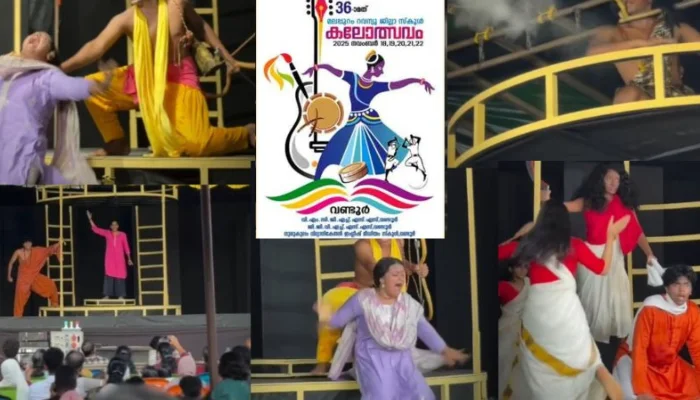
Case Summary
In Malappuram, Kerala, Hindu epics such as the Ramayana and Mahabharata were mocked through a stage play performed at a government school. The play was directed by a Muslim man named Rafeeq Mangalakkery. The accused had made Hindu children portray the Mahabharata and Ramayana as anti-women and sought to depict Hinduism as a misogynistic and regressive faith. According to media reports, the derogatory play won first prize at the Malappuram Revenue School District Kalolsavam held in Wandoor. The play, titled “Veerannattyam” and performed by students of AKM Higher Secondary School, was awarded the top prize in the High School Drama category. The content of the play sparked widespread protests from Hindu organisations, which said that it portrayed Hindu culture as inherently anti-women. Protesters stated that the drama’s central theme suggested that Hindu culture oppressed women and contained dialogues implying that the Ramayana and Mahabharata were “anti-women” texts. Characters such as Urmila, Draupadi, Gandhari, and other women from the Hindu epics were portrayed as powerless, marginalised, and oppressed. The play encouraged school children to declare Hindu culture as regressive. Some video clips circulated from the performance included lines questioning the value of Hindu epics and asserting that “there are no irreplaceable female heroes among us,” further fuelling the backlash. Hindu Aikyavedi, a Hindu organisation, and other cultural groups launched strong protests, stating that the organisers were promoting anti-Hindu sentiments in a government-run school festival. Social media discussions amplified concerns, with cultural leaders describing the award as “a deliberate endorsement of anti-Hindu narratives in the education system.” Local sources reiterated that the drama had been directed by a Muslim man, Rafeeq Mangalakkery, and that hundreds of people had watched the performance during the festival. The controversy intensified after several Hindu activists highlighted inconsistencies in the Kerala Education Department’s response to religiously sensitive content. They drew parallels to the case of “Kithab”, a play advocating Muslim women’s rights, including the right to give the call to prayer, which was blocked from being performed at a state-level event following government intervention. Hindu groups argued that while content referencing the Quran or the Bible was quickly restricted, performances mocking Hindu texts appeared to face no institutional resistance. They also cited past incidents, such as the controversy at St. Teresa’s Church, Ernakulam, where the Education Department intervened after a student’s hijab sparked disputes, to question what they viewed as selective enforcement. The Hindu protesters also referred to earlier instances where works containing anti-Hindu sentiment had received state-level recognition. For example, the novel “Meesha”, which portrayed Hindu customs negatively, received a literary award. The film “Vedane”, criticised for being against Indian culture, won the State Film Award for Best Lyricist.
Why it is Hate Crime ?
This case has been added to the tracker under the primary category- Hate Speech against Hindus. The subcategory selected is- Anti-Hindu slurs, mocking faith. Anti-Hindu slurs and the deliberate mocking of the Hindu faith owing to religious animosity involve the usage of derogatory terms, stereotypes, or offensive references to religious practices, symbols, or figures. One of the common anti-Hindu slurs used against Hindus is “cow-worshipper” and “cow piss drinker”. The intention of using this term is to demean and mock Hindus as a group and their religious beliefs since Hindus consider the cow holy. Additionally, some symbols and the slurs attached to them have a historical context that exacerbates the insult, hate, stereotyping, dehumanisation and oppression against Hindus. Cow worship has been used for centuries to denigrate Hindus, insult their faith and oppress Hindus specifically as a religious group. There has been overwhelming documentation about how cow slaughter has been used to persecute Hindus with cow meat being thrown in temples and places of worship. There has also been overwhelming documentation where cow meat (beef) has been force-fed to Hindus to either forcefully convert them to Islam or denigrate their faith. Apart from cow worship, the Swastika – which holds deep religious significance for the Hindus – has also been misinterpreted and distorted to use as a slur against Hindus. Similarly, the worship of the Shivling has been used by supremacist ideologies and religions to denigrate Hindus owing to religious animosity. Such slurs and denigration stem out of inherent animosity and hate towards Hindus and their faith, therefore, it is categorised as hate speech targeted at Hindus specifically owing to their religious identity. The other subcategory selected is- Subversion of scriptures. Subverting the religious scriptures of Hindus has particularly devastating consequences. Subversion of the scriptures of Hindus is often done to justify or promote hatred, discrimination, or violence against specific individuals or groups of Hindus. Religious scriptures are often nuanced and those who harbour religious animosity towards Hindus often misquote or misrepresent the scripture to legitimise their animosity and hate towards the faith and its adherents. Any such misquoting of scriptures or subversion to justify hate, violence and discrimination against Hindus owing to religious animosity is hate speech and is categorised as such. Another primary category selected is- Predatory Proselytisation. The subcategory selected is- Proselytisation by grooming, brainwashing, manipulation or subtle indoctrination. The tertiary category selected is- Conversion of minor. Religious brainwashing essentially means the often subtle and forcible indoctrination to induce someone to give up their religious beliefs to accept contrasting regimented ideas. Religious grooming or brainwashing also involves propaganda and manipulation. It involves the systematic effort, driven by religious malice and indoctrination, to persuade “non-believers’ to accept allegiance, command, or doctrine to and of a contrasting faith. Cases of such grooming or brainwashing are far more nuanced than direct threats, coercion, inducement and violence. In such cases, it is often seen that there is repeated, subtle and continual manipulation of the victim to induce disaffection towards their own faith and acceptance of the contrasting faith of the perpetrator. While subtle indoctrination is widely acknowledged as predatory, an element which is often understated in such conversions or the attempts of such conversion is the role of loyalty and trust which might develop between the perpetrator and the victim. Fiduciary relationships are often abused to affect such religious conversion. For example, an educator transmitting religious doctrine of a competing faith to a Hindu student. The Hindu student is likely to accept what the teacher is transmitting owing to existence of the fiduciary relationship. The exploitation of the fiduciary relationship to religiously indoctrinate victims would also be included in this category. Since the underlying animosity towards the victim’s faith forms the basis of predatory proselytization, such cases are considered religiously motivated hate crimes. This case from Malappuram, Kerala, represented a clear instance of anti-Hindu hate speech, as it involved a Muslim perpetrator directing minor school children to perform a stage play that denigrated sacred Hindu epics such as the Ramayana and Mahabharata. These two epics are not merely ancient literary works—they are pillars of Hindu civilisation, philosophy, and spiritual practice. The Ramayana embodies the ideals of righteousness, duty, virtue, and devotion, while the Mahabharata explores the complexities of morality, justice, and truth. For millions of Hindus, these scriptures are revered as sacred texts that guide moral conduct and define their cultural and religious identity. Therefore, mocking or distorting these revered scriptures in a public performance, especially under the pretext of art or education, constitutes a deliberate act of religious hatred. Such acts do not fall within the realm of mere criticism; they are expressions of contempt intended to ridicule Hindu faith and its foundational values. This incident also amounted to the subversion of sacred Hindu scriptures. Twisting the Ramayana and Mahabharata to portray them as misogynistic or anti-women reflects a wilful and malicious distortion of their teachings. Both scriptures contain profound examples of strength, resilience, and wisdom among women characters—Sita, Draupadi, Kunti, and others stand as enduring symbols of courage and virtue. To reduce these revered narratives to instruments of misogyny reveals deep-seated hostility towards Hinduism itself. Such deliberate misrepresentation of sacred scriptures is not an academic critique but an ideological attack aimed at eroding faith, dignity, and unity within the Hindu community. It serves as an attempt to sow internal doubts among Hindus about their heritage, making it a textbook case of anti-Hindu hate speech. The accused in this case, Rafeeq Mangalakkery, was a Muslim man, and this made the religiously motivated nature of this act clearer. Islamic theological perspectives regard other faiths, including Hinduism, as inferior or misguided, promoting conversion to Islam as the only path to salvation. Within this context, a Muslim individual directing a play that ridiculed Hinduism and targeted its foundational epics aligns with an ideological design to demean Hindu beliefs publicly. The act cannot be viewed in isolation but as part of a broader pattern of religious subversion that seeks to undermine Hindu identity through mockery disguised as creativity. This case also revealed elements of subtle proselytisation carried out by the accused Muslim director. The school children, who were predominantly minors, were made to perform roles that derided their own religious scriptures. Children are highly impressionable; their minds are still forming moral and cultural understanding. They tend to trust adult authority figures such as teachers and mentors. When such authority figures exploit that trust to instil embarrassment or doubt about their own faith, it becomes a clear act of psychological manipulation. This amounts to predatory proselytisation—a form of grooming and brainwashing aimed not at immediate religious conversion but at gradually alienating Hindu children from their traditions. By mocking their religion, the perpetrator effectively planted seeds of shame and self-rejection in impressionable minds, promoting a slow internalised detachment from their culture and Hindu faith. This was not only a religious insult but an act of indoctrination disguised as art, executed through children to normalise disrespect toward Hinduism. The state’s endorsement of such a play, while simultaneously preventing performances that critique Islam or Christianity, exposes a glaring double standard. This selective enforcement demonstrates institutional bias and prejudice against the Hindu community. When the government tolerates or even rewards material that denigrates Hindu deities or scriptures yet restricts content that questions Islamic or Christian doctrines, it reinforces an environment of systemic anti-Hindu discrimination. Such policies, whether driven by political appeasement or religious prejudice, make this case not just a cultural controversy but a religiously motivated crime. This state-enabled mockery of the Hindu faith under the guise of art reflects a deeper institutional animosity that legitimises anti-Hindu sentiment in the public sphere. Given that this case meets the parameters of an anti-Hindu hate crime, it is being added to the hate crime database of the Hinduphobia tracker. Disclaimer: At the Hinduphobia Tracker, incidents are ordinarily recorded according to the date on which the crime occurs, rather than the date on which it is reported in the media. However, in this particular case, the media reports did not specify the exact date of occurrence. Therefore, solely for record-keeping and documentation purposes, an indicative date of 24th November 2025, corresponding to the publication date of the media report, has been used in the Tracker as an estimated incident date. In this case, while the state is equally a perpetrator by endorsing and awarding the anti-Hindu play, the primary perpetrator is a Muslim man who directed the performance. Therefore, for the purposes of categorisation in the Hinduphobia Tracker, the perpetrator identity has been classified as "Muslim extremists."


Case Status
Unknown


Perpetrators Details
Perpetrators
Muslim Extremists
Perpetrators Range
One Person
Perpetrators Gender
male
 Sources




