Hindu villagers, including children, lured and targeted for conversion under guise of prayer meeting by Christian missionaries
 Balod, Chhattisgarh, India
  22 November, 2025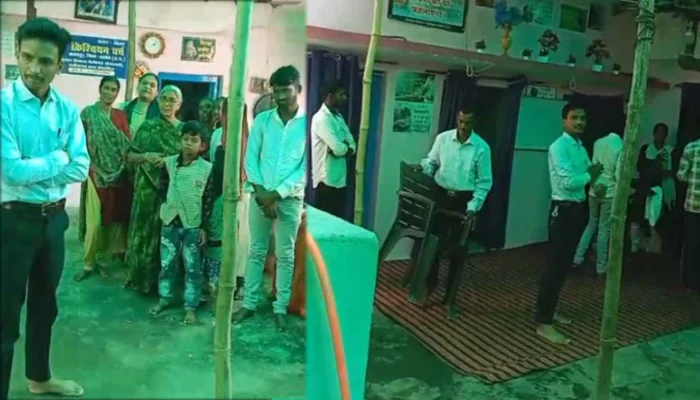
Case Summary
In the Kalangur village of Balod district, Chhattisgarh, Hindu villagers were lured and targeted for conversion under the guise of a prayer meeting by two Christian pastors. According to reports, for several weeks, the two Christian pastors had been organising prayer meetings without permission, luring Hindu villagers for conversion. On 23 November 2025, a similar prayer meeting was organised inside a private house illegally, which was attended by nearly 30 Hindu villagers, including women and children. Villagers had repeatedly reported that the gathering was being used for conversion activity, prompting members of the Vishwa Hindu Parishad and Bajrang Dal to monitor the situation closely. When Hindu activists received information that the prayer meeting was organised, they reached the site and confronted the accused. They also began protesting against illegal conversion, while informing the police. The police promptly arrived, restored order, and arrested the two Christian pastors, identified as Vijay and Mithlesh. The police stated that further legal action would be taken after investigation.
Why it is Hate Crime ?
This case has been added to the tracker under the primary category of - Predatory Proselytisation. Within it, the sub-category selected is - Proselytisation by grooming, brainwashing, manipulation or subtle indoctrination. The tertiary category under this is: Conversion of minor and Pattern of targeting Hindus. Religious brainwashing essentially means the often subtle and forcible indoctrination to induce someone to give up their religious beliefs to accept contrasting regimented ideas. Religious grooming or brainwashing also involves propaganda and manipulation. It involves the systematic effort, driven by religious malice and indoctrination, to persuade “non-believers’ to accept allegiance, command, or doctrine to and of a contrasting faith. Cases of such grooming or brainwashing are far more nuanced than direct threats, coercion, inducement and violence. In such cases, it is often seen that there is repeated, subtle and continual manipulation of the victim to induce disaffection towards their own faith and acceptance of the contrasting faith of the perpetrator. While subtle indoctrination is widely acknowledged as predatory, an element which is often understated in such conversions or the attempts of such conversion is the role of loyalty and trust which might develop between the perpetrator and the victim. Fiduciary relationships are often abused to affect such religious conversion. For example, an educator transmitting religious doctrine of a competing faith to a Hindu student. The Hindu student is likely to accept what the teacher is transmitting owing to existence of the fiduciary relationship. The exploitation of the fiduciary relationship to religiously indoctrinate victims would also be included in this category. Since the underlying animosity towards the victim’s faith forms the basis of predatory proselytization, such cases are considered religiously motivated hate crimes. This case has been added to the tracker because Hindu villagers were lured and targeted for conversion under the guise of a prayer meeting by two Christian pastors. Firstly, the Christian pastors lured Hindu villagers for religious conversion under the guise of a prayer meeting. What was presented as a simple prayer meeting inside a house was in reality a covert attempt at religious conversion. These were not genuine community prayers but calculated efforts to exploit the trust of Hindus and manipulate them into abandoning their faith. Furthermore, the prayer meetings were organised without permission from the administration, indicating an attempt at deception and secrecy. By conducting such a prayer meeting covertly, the Christian missionaries sought to manipulate vulnerable Hindus, taking advantage of their emotional and social circumstances to push them towards conversion. Secondly, it was stated that some of the victims present were children; therefore, some of the victims who were converted were minors. Since some victims were minors, this means the element of consent and genuine change of conscience was missing ab initio. Minors, due to their young age and lack of maturity, are particularly vulnerable to manipulation and coercion. They may not have the ability to fully understand the implications of converting to another religion, and the Christian perpetrator purposely targeted and exploited this vulnerability of the victim. Thirdly, the accused had been organising these prayer meetings for several weeks. This demonstrates that the incident was not isolated but part of a larger, well-organised effort to systematically target Hindus for conversion. These repeated acts illustrate a deliberate strategy to alter the religious demographics of the locality by gradually eroding the Hindu population’s connection to their faith. The sustained targeting highlights the perpetrators’ deep-rooted animosity and their intent to change the cultural and religious fabric of the community. This pattern goes far beyond individual conversions; it is a long-term campaign of religious hostility designed to weaken Hindu faith and impose an alien Christian identity on vulnerable Hindus. The Christian faith, by its very theological foundations, places a strong emphasis on proselytisation. In pursuit of conversion objectives, Christian evangelists often employ unethical means, ranging from psychological pressure and misinformation to inducements such as money or jobs. These tactics are designed not as acts of charity but as tools to engineer religious change under the guise of social upliftment, particularly among vulnerable and underprivileged communities. Since the perpetrator's actions were motivated by religious animosity, this case has been added to the tracker.


Case Status
Arrested


Perpetrators Details
Perpetrators
Christian Extremists
Perpetrators Range
From 2 To 5
Perpetrators Gender
male
 Sources




