Hindu woman raped for three years after being lured with false promises of healing daughter through Christian conversion
 Dhamtari, Chhattisgarh, India
  31 December, 2021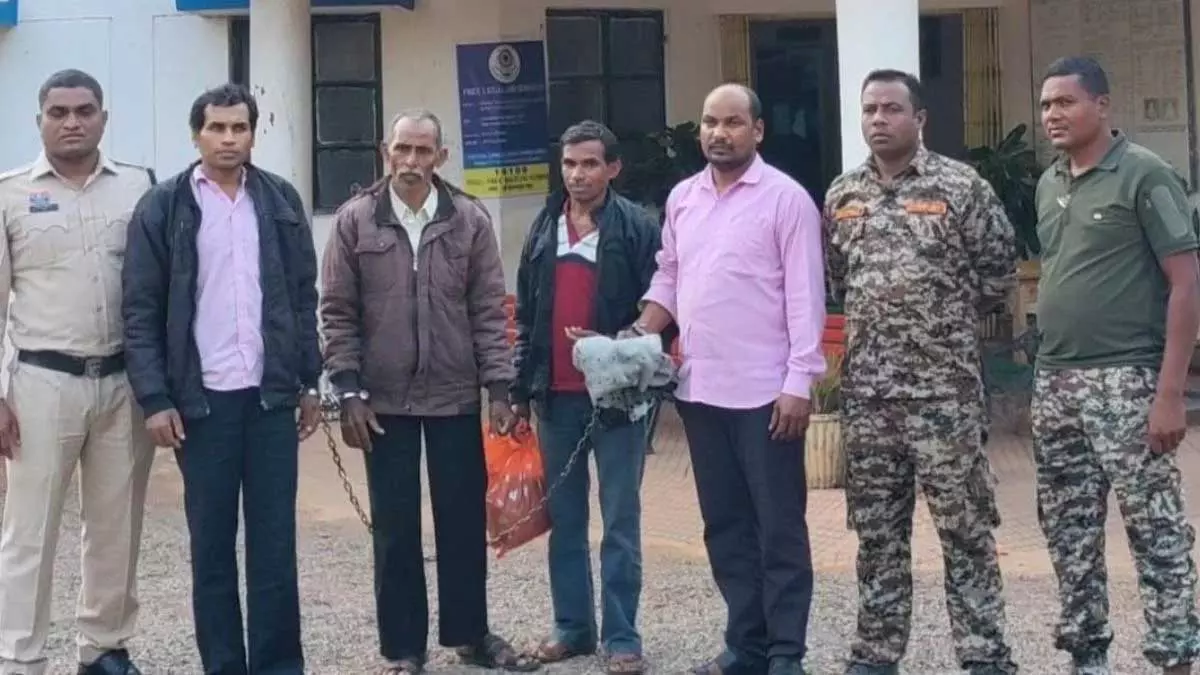
Case Summary
A Hindu woman was systematically lured and sexually exploited for nearly three years by four men who falsely promised that converting to Christianity would cure her chronically ill daughter in Dhamtari, Chhattisgarh. The victim, who had been caring for her ailing child for eight years, stated that the accused manipulated her vulnerability by claiming that prayers to Jesus Christ would bring healing while denigrating her Hindu deities. The repeated assaults began in early 2022 when the woman, facing a sudden deterioration in her daughter's health, contacted the accused for spiritual support. Instead of providing help, they subjected her to religious coercion, threats of violence, and repeated sexual assault under the guise of religious rituals. She was also threatened with death if she revealed it to anyone. The final documented assault occurred on 15 June 2025, culminating in the victim filing a formal police complaint. Police registered a case under Sections 70(1) and 299 of the Bharatiya Nyaya Sanhita alongside Section 4 of the Chhattisgarh Religious Freedom Act 1968. All four accused, identified as Dhanesh Sahu of Kamraud, Munesh Sahu and Nandu Sahu of Senhabhatha, and Narendra Mahar of Khairjhiti, were arrested by the police.
Why it is Hate Crime ?
The primary category in this case is: Predatory Proselytisation. The first subcategory in this case is: Conversion/ attempts to convert by inducement. Predatory Proselytisation is not just limited to threat, harassment, force and violence, but it also has contours of stealth. In several cases, the Hindu victim is exploited to convert, with non-Hindus taking advantage of their poverty. In such cases, the Hindu victim who is suffering financially is offered monetary benefits, including lucrative offers for jobs, health treatment, education, etc, to induce the victim into changing his/her religion. In such cases, the religious identity of the victim and the aim to disenfranchise him from his faith form the heart of the crime. Also, taking advantage of and exploiting an individual’s economic vulnerabilities is widely acknowledged as exploitation, forms of which are often penalised by law. Such cases therefore are considered religiously motivated hate crimes since the victim’s religious identity forms the very heart of the crime itself. The second subcategory under this is: Attempting to convert/converting by denigrating Hinduism. In several cases, Hindus are converted or an attempt is made to convert Hindus by denigrating their faith, Hinduism. In such cases, the Hindus associate with the non-Hindu perpetrators often by choice and then, the attempt to convert them by insulting their faith, showing the faith down etc begins. An example of this would be a non-Hindu gathering where the Hindus are attending the gathering of their own free will. However, once they attend the gathering, there is an explicit attempt to convert them by abusing their faith and hailing the faith of the perpetrator. The denigration of the Hindu faith is often based on misrepresentation of the Hindu faith, its doctrine and scriptures and insult to espoused traditions if not blatant lies about Hindu beliefs and ways. Such conversions or attempts at conversions are driven by animosity towards the Hindu faith and are therefore documented as religiously motivated hate crimes. The third subcategory under this uis: Attempting to convert/converting by denigrating Hinduism. In several cases, Hindus are converted or an attempt is made to convert Hindus by denigrating their faith, Hinduism. In such cases, the Hindus associate with the non-Hindu perpetrators often by choice and then, the attempt to convert them by insulting their faith, showing the faith down etc begins. An example of this would be a non-Hindu gathering where the Hindus are attending the gathering of their own free will. However, once they attend the gathering, there is an explicit attempt to convert them by abusing their faith and hailing the faith of the perpetrator. The denigration of the Hindu faith is often based on misrepresentation of the Hindu faith, its doctrine and scriptures and insult to espoused traditions if not blatant lies about Hindu beliefs and ways. Such conversions or attempts at conversions are driven by animosity towards the Hindu faith and are therefore documented as religiously motivated hate crimes. The fourth subcategory in this case is: Proselytisation by grooming, brainwashing, manipulation or subtle indoctrination. The tertiary category under this is: Rape and sexual assault/harassment. Religious brainwashing essentially means the often subtle and forcible indoctrination to induce someone to give up their religious beliefs to accept contrasting regimented ideas. Religious grooming or brainwashing also involves propaganda and manipulation. It involves the systematic effort, driven by religious malice and indoctrination, to persuade “non-believers’ to accept allegiance, command, or doctrine to and of a contrasting faith. Cases of such grooming or brainwashing are far more nuanced than direct threats, coercion, inducement and violence. In such cases, it is often seen that there is repeated, subtle and continual manipulation of the victim to induce disaffection towards their own faith and acceptance of the contrasting faith of the perpetrator. While subtle indoctrination is widely acknowledged as predatory, an element which is often understated in such conversions or the attempts of such conversion is the role of loyalty and trust which might develop between the perpetrator and the victim. Fiduciary relationships are often abused to affect such religious conversion. For example, an educator transmitting religious doctrine of a competing faith to a Hindu student. The Hindu student is likely to accept what the teacher is transmitting owing to existence of the fiduciary relationship. The exploitation of the fiduciary relationship to religiously indoctrinate victims would also be included in this category. Since the underlying animosity towards the victim’s faith forms the basis of predatory proselytisation, such cases are considered religiously motivated hate crimes. This case has been added to the tracker because it illustrates a sustained pattern of exploitation in which a Hindu woman’s vulnerability was used as an entry point to manipulate, coerce, and ultimately violate her. The conduct described does not remain confined to personal misconduct. It reflects a structured attempt to detach the victim from her religious identity by exploiting her emotional desperation, using fabricated promises of divine intervention, and presenting Hindu worship as ineffective or invalid. The combination of spiritual manipulation, psychological pressure, and sexual violence shows a deliberate targeting of the victim’s faith as the foundation of her exploitation. The religious element is not incidental. It is the mechanism through which the perpetrators gained access, control, and repeated physical domination over her. The case also reflects a familiar pattern where individuals in distress are approached with promises of miraculous relief on the condition that they distance themselves from their own tradition. The woman’s concern for her chronically ill daughter became the tool through which the perpetrators built trust and influence. Once that trust was established, they used it to steadily undermine her beliefs, portraying her religious practices as misguided and illegitimate. Such methods are recognised as a form of inducement because the promise of healing functioned as the reward for abandoning her faith, while the continued suffering of her child was presented as the consequence of remaining Hindu. The intention was not to provide spiritual comfort but to reshape her loyalty through false assurances. At the same time, the perpetrators repeatedly denigrated her religious practices. They framed Hindu devotion as morally wrong and spiritually worthless once she had been exposed to their teachings. This tactic is significant because the erosion of dignity, combined with the suggestion that she was obligated to abandon her traditions, served as a means of pressure. By weakening her confidence in her faith and presenting her devotion as a barrier to her daughter’s recovery, the perpetrators established a psychological imbalance that made her increasingly vulnerable to further abuse. The sexual violence adds a grave and undeniable dimension to the religious targeting. The assaults were not isolated acts but part of a long sequence of manipulation in which the same individuals used their fabricated spiritual authority to justify or enable violations of her bodily autonomy. When coercion, grooming, and sexual assault become intertwined with attempts to distance a Hindu victim from her religious identity, the hostility is directed not only toward the individual but toward the faith that anchors her sense of self. For these reasons, this case is classified as a hate crime against Hindus and documented in the tracker. The exploitation of religious vulnerability, the sustained denigration of Hindu beliefs, and the use of spiritual manipulation to facilitate sexual assault collectively show hostility rooted in the victim’s identity as a Hindu. Reports specify only that the ordeal began in early 2022. For documentation purposes, a placeholder date of 1 January 2022 has been used. The Hinduphobia Tracker follows the principle of recording the earliest identifiable point at which the victim’s suffering began when an exact date is unavailable. Disclaimer: Since reports mention only that the ordeal began in the early months of 2022, a provisional date of 1 January 2022 has been entered for documentation. This approach allows the Hinduphobia Tracker to mark the beginning of the victim’s suffering as faithfully as possible when an exact date is not provided.
Victim Details
Total Victim
1
Deceased
0
Gender
- Male 0
- Female 1
- Third Gender 0
- Unknown 0
Caste
- SC/ST 0
- OBC 0
- General 0
- Unknown 1
Age Group
- Minor 0
- Adult 1
- Senior Citizen 0
- Unknown 0


Case Status
Arrested


Perpetrators Details
Perpetrators
Christian Extremists
Perpetrators Range
From 2 To 5
Perpetrators Gender
male
 Sources




