Hindu organisation workers assaulted for opposing anti-Hindu book sale at event in Jabalpur, Madhya Pradesh
 Jabalpur, Madhya Pradesh, India
  22 November, 2025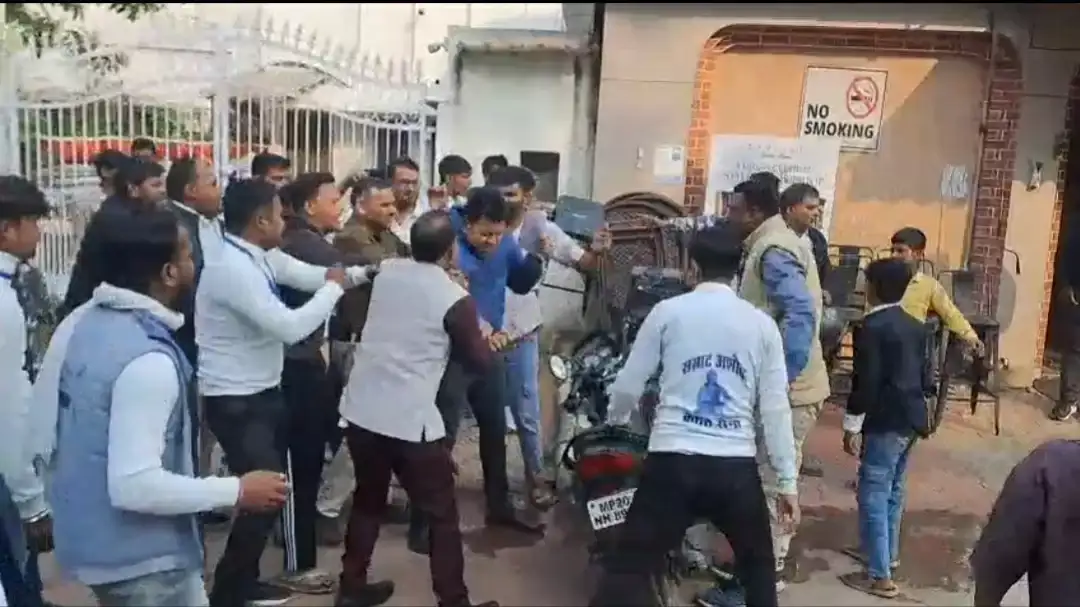
Case Summary
Hindu organisation Bajrang Dal workers were assaulted by event organisers in Jabalpur, Madhya Pradesh, while they protested against an anti-Hindu book that was being sold at a public programme. The violence took place at Manas Bhavan on the evening of 23 November 2025 during an event held to mark Emperor Ashoka's Victory Day. Members of Hindu groups had received information that a book containing objectionable material about Hinduism was available at a stall inside the venue. Several workers went to the programme, purchased the book, and paid online. When they examined the text, they found obscene and derogatory remarks about Hindu deities and Hindu religious traditions. They immediately called additional workers to the spot and raised objections against the sale of the material. The organisers responded by surrounding the Bajrang Dal members and attacking them. Two workers were seriously injured, and the assault happened in full view of the police. Congress MLA Lakhan Ghanghoria, who was present at the programme, argued with the police. He alleged that an ST-SC OBC convention was being held there when some people from outside arrived and tore copies of the Constitution, disrupting the entire event. The police detained two youths involved in the chaos and assault, and the accused identified themselves as members of a Hindu organisation. After the incident, the workers went to Madan Mahal police station and protested, yet the police did not register a case. Bajrang Dal representatives, including Rakesh Singh and Sumit Singh Thakur, said that the anti-Hindu literature had been openly sold in the presence of the police and that workers were beaten with the intention to cause fatal harm. They also claimed that individuals from a particular community joined the organisers in the attack. They considered it especially serious that the violence happened while police officers were standing nearby. The workers stated that the claim that they were merely reading the Constitution was false and added that CCTV footage would clarify the sequence of events. They also noted that even after the assault, the police allowed the event to continue instead of stopping it. Injured workers submitted complaints but received only a promise of inquiry. The Bajrang Dal issued a twenty-four-hour ultimatum to the police, saying that if an FIR was not filed against the assailants, they would initiate a strong agitation in the city. Leaders of Hindu organisations said that anti-Hindu activities and conversion-related events were ongoing across Jabalpur without administrative intervention and that authorities routinely responded to complaints with assurances rather than concrete action.
Why it is Hate Crime ?
The primary category in this case is: Attack not resulting in death. The first subcategory under this is: Attacked for opposing radicals or trying to save victim. In several cases, Hindus are attacked for opposing religiously motivated crimes being committed against a fellow Hindu or simply for voicing an opinion opposing radical elements, who either have in the past or continue to persecute Hindus. In such cases, the initial attack against the victim, against which the Hindu was trying to defend the victim, would also need to be classified as a religiously motivated hate crime. Since the initial crime itself was religiously motivated and the subsequent crime of attempting to save the victim or speaking against the radical elements ends up inviting a violent attack, it would also be classified as a religiously motivated hate crime under this category. The second primary category in this case is: Hate speech against Hindus. The subcategory under this is: Anti-Hindu slurs, mocking faith. Anti-Hindu slurs and the deliberate mocking of the Hindu faith owing to religious animosity involve the usage of derogatory terms, stereotypes, or offensive references to religious practices, symbols, or figures. One of the common anti-Hindu slurs used against Hindus is “cow-worshipper” and “cow piss drinker”. The intention of using this term is to demean and mock Hindus as a group and their religious beliefs since Hindus consider the cow holy. Additionally, some symbols and the slurs attached to them have a historical context that exacerbates the insult, hate, stereotyping, dehumanisation and oppression against Hindus. Cow worship has been used for centuries to denigrate Hindus, insult their faith and oppress Hindus specifically as a religious group. There has been overwhelming documentation about how cow slaughter has been used to persecute Hindus with cow meat being thrown in temples and places of worship. There has also been overwhelming documentation where cow meat (beef) has been force-fed to Hindus to either forcefully convert them to Islam or denigrate their faith. Apart from cow worship, the Swastika – which holds deep religious significance for the Hindus – has also been misinterpreted and distorted to use as a slur against Hindus. Similarly, the worship of the Shivling has been used by supremacist ideologies and religions to denigrate Hindus owing to religious animosity. Such slurs and denigration stem out of inherent animosity and hate towards Hindus and their faith, therefore, it is categorised as hate speech targeted at Hindus specifically owing to their religious identity. This incident has been added to the tracker because it presented a clear instance in which Hindus faced violence while objecting to material that targeted their religious identity. The workers approached the venue after receiving information that a book containing offensive depictions of Hindu traditions was being circulated. Their intervention was not opportunistic but a response to what they perceived as a direct affront to their religious community. The subsequent attack revealed how opposition to anti-Hindu material exposed them to coordinated violence by organisers and accompanying individuals, all of which unfolded in the presence of law enforcement. These features make the episode significant for documentation because it combines targeted aggression, public humiliation, and administrative inaction within a single frame. The case is also treated as a hate crime against Hindus because the conflict originated in the circulation of a book that contained vulgar commentary about Hindu deities and rituals. The workers identified the material as part of a broader continuum of narratives that caricature Hindu beliefs in order to undermine the dignity of the community. Once they objected, they were physically attacked in a manner that went beyond spontaneous anger and instead resembled an attempt to silence resistance to anti-Hindu messaging. Violence that arises from an attempt to defend a religious community from denigration is not a neutral dispute. It reflects a pattern in which Hindu individuals are targeted for challenging material or behaviour that carries explicit or implicit hostility toward their faith. The presence of offensive content in the book created the first layer of religiously motivated harm. The assault on those who protested against that content created a second layer of hostility that aligns with recognised classifications of bias-driven violence. When the initial provocation is rooted in contempt for a religious tradition, and the subsequent attack punishes those who object, the chain of events forms a coherent pattern of hate directed at the same community. The combination of derogatory literature, physical aggression, and police inaction, therefore, meets the criteria for inclusion in the tracker and demonstrates why the episode is categorised as a hate crime against Hindus.
Victim Details
Total Victim
2
Deceased
0
Gender
- Male 2
- Female 0
- Third Gender 0
- Unknown 0
Caste
- SC/ST 0
- OBC 0
- General 0
- Unknown 2
Age Group
- Minor 0
- Adult 2
- Senior Citizen 0
- Unknown 0


Case Status
Complaint filed


Perpetrators Details
Perpetrators
Others
Perpetrators Range
N/A
Perpetrators Gender
unknown
 Sources




