Minor Hindu boy abused and beaten by school director for greeting with Jai Shri Ram; previously targeted for wearing kalava
 Patan, Madhya Pradesh, India
  20 November, 2025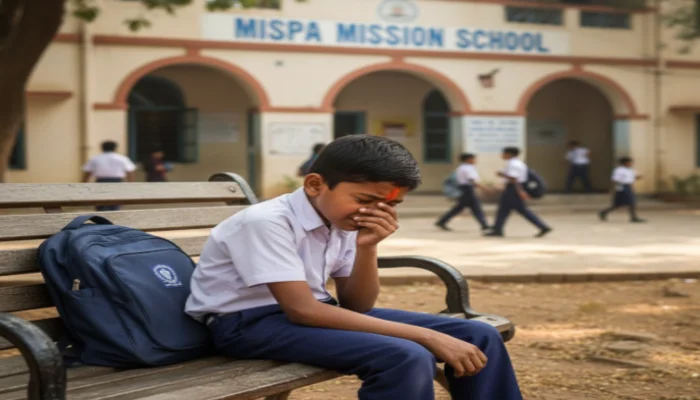
Case Summary
In Patan city of Jabalpur district, Madhya Pradesh, a 14-year-old Hindu student named Prabal Singh Rathod was scolded and beaten by his school director, Rajesh Khandare, after he greeted the school guard with "Jai Shri Ram." According to media reports, the incident occurred at the Mispa Mission School, Patan, on 21 November 2025, where the minor victim, a resident of Sahu Colony, reached the school gate and greeted the school security guard with "Jai Shri Ram", as it was the guard’s birthday. The school director, Rajesh Khandare, who was present, heard this exchange and intervened to stop the victim. He grabbed the victim by his hair, reprimanded him and slapped him several times, declaring that the student should enter the school by saying 'Good Morning'. He also warned the victim to never say "Jai Shri Ram" to anyone inside the school again. The victim, who also sustained injuries, returned home crying, prompting his family to contact local Hindu organisations. The following day, family members and Hindu activists reached the Patan police station and submitted a written complaint, demanding strict action. Based on the complaint, the police accordingly registered an FIR against the director for assault and misconduct and began an investigation into the incident. The victim also revealed that he was previously beaten by the accused for wearing a sacred thread, a kalava. The Hindu activists also gathered at the school, protested at the premises, and raised slogans against the school administration. Meanwhile, the school principal, Anil Dubey, claimed that the accused, Rajesh Khandare, had objected to the victim's "inappropriate manner" and there was no beating. He further claimed that all the staff and students at the school are Hindus and there was no objection to Hindu culture, but the way of greeting was inappropriate, so the victim was scolded.
Why it is Hate Crime ?
This case has been added to the tracker under the primary category - Restriction/ban on Hindu religious practice. Within this, the subcategory selected is- Restriction on expression of Hindu identity. An example of the state-affected prejudicial and targeted orders against the Hindu community would be a government denying the right of a Hindu or a group of Hindus to hold a religious procession owing to the animosity of non-Hindu groups. Denial of the religious right of the Hindus to assuage the non-Hindu group which harbours animosity to a point where it could lead to violence against Hindus is not only a failure of law and order but is a prejudicial order against Hindus, denying them their fundamental rights to express their religious identity. An example of a hate crime against Hindus by a non-Hindu would be a non-Hindu institution forcing its Hindu employees to abandon religious symbols that a Hindu would wear as an expression of faith owing to inherent prejudice against the faith professed by the victim or a non-Hindu group of people restricting a Hindu group from constructing a place of worship simply because the demography of the area in which the temple is being built is dominated by non-Hindus. Such actions are driven by religious animosity and/or prejudice against Hindus and their faith and would therefore be categorized as a hate crime. The other primary category selected here is - Attack not resulting in death. Within it, the sub-category selected is - Attacked for Hindu identity. In several cases, Hindus are attacked merely for their Hindu identity without any perceived provocation. A classic example of this category of religiously motivated hate crime is a murder in 2016. 7 ISIS terrorists were convicted for shooting a school principal in Kanpur because they got ‘triggered’ seeing the Kalava on his wrist and the tilak that he had put. In this, the Hindu victim had offered no provocation except for his Hindu religious identity. The motivation for the murder was purely religious, driven by religious supremacy. Such cases where Hindus are targeted merely for their religious identity would be documented as a hate crime under this category. This case has been added to the tracker because a minor Hindu student was scolded and beaten by his school director, Rajesh Khandare, for expressing a customary Hindu greeting, “Jai Shri Ram,” to the school security guard. The victim was scolded, reprimanded and slapped for simply using a traditional Hindu greeting, a form of salutation. This was not an issue of discipline or behaviour; it was a targeted act rooted in hostility towards a Hindu religious expression, making it a clear instance of religious intolerance. The victim’s greeting, “Jai Shri Ram,” is not merely a phrase but a devotional salutation deeply tied to Hindu identity and spirituality. For many Hindus, it is a respectful way of greeting elders, affirming their connection to their faith. Punishing a Hindu child for uttering this greeting is an attempt to suppress his religious expression and his Hindu identity in an environment meant for learning and inclusivity. Such behaviour fosters an atmosphere of religious discrimination, where Hindu students may feel alienated or pressured to suppress their faith to avoid punishment or humiliation. This is particularly concerning as children are highly impressionable, and such incidents can subtly manipulate them into distancing themselves from their religious and cultural roots. The use of physical violence makes this case even more egregious. This was not merely verbal discouragement or subtle manipulation; it was a direct and violent attack on a Hindu child for practising his faith. Such violence against a minor child is an overt expression of bias, reflecting disdain for Hindu religious traditions. It creates an atmosphere of fear among other Hindu students, who may feel compelled to conceal their religious identity to avoid similar treatment. Furthermore, the victim also revealed that he was previously beaten for wearing a kalava or the sacred thread. The Kalava or a tilak are not merely decorative things; they hold profound spiritual and cultural significance for Hindus. They are emblems of Hindu religious identity, often worn during prayers, rituals, and as a daily affirmation of faith. Forcing Hindu students to remove these religious symbols is a deliberate effort to erase their religious identity and expression. Such an act is deeply disrespectful and constitutes a direct attack on the values and practices of Hinduism. The repetition of such incidents points to a sustained pattern of targeting Hindu symbols and religious markers. These actions cannot be seen in isolation. They represent a wider pattern where Hindu children are pressured, prohibited, and punished for practising their religion. Such actions are, in fact, a direct attempt to alienate a child from his or her faith. These actions serve as the first step in a larger pattern of grooming, where consistent ridicule and suppression of Hindu practices make a child more susceptible to abandoning their faith. These actions leave Hindu children in a state of confusion about whether their religious practices are wrong or unacceptable in society. It is important to note here that the victim was a minor. At an impressionable age, when children are still forming their sense of self, being told that their sacred symbols cannot be worn or are punished for religious expression creates inner conflict and weakens their connection to their faith. Over time, this can instil a sense of shame or embarrassment about openly practising Hinduism, making them hesitant to uphold their traditions in public spaces. This case qualifies to be added to the Hinduphobia Tracker because it reflects a clear act of religious intolerance targeting a Hindu student for expressing their faith. The fact that the victim was a minor, who was not yet cognitively developed to critically resist such pressure, makes this even more serious. Moreover, this act stems from hostility towards the Hindu faith, as it specifically targets a Hindu religious expression; therefore, this case has been added to the tracker.
Victim Details
Total Victim
1
Deceased
0
Gender
- Male 1
- Female 0
- Third Gender 0
- Unknown 0
Caste
- SC/ST 0
- OBC 0
- General 1
- Unknown 0
Age Group
- Minor 1
- Adult 0
- Senior Citizen 0
- Unknown 0


Case Status
Complaint registered


Perpetrators Details
Perpetrators
Others
Perpetrators Range
One Person
Perpetrators Gender
male
 Sources




