Minor Hindu girls targeted in Pakistan, barred from attending government school unless they convert to Islam
 Mirpur Sakro, Sindh, Pakistan
  20 November, 2025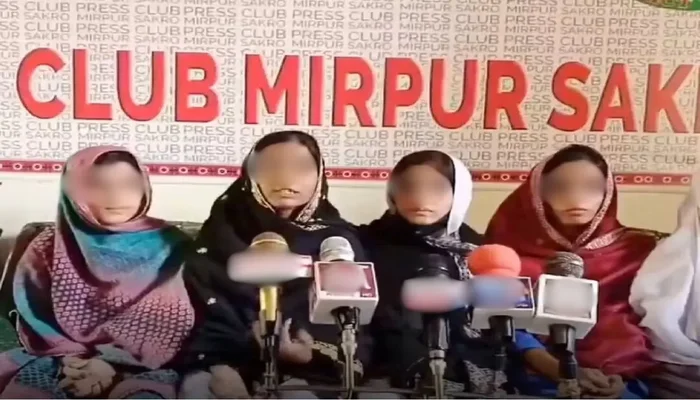
Case Summary
In Sindh, Pakistan, minor Hindu girls were barred from attending a government school and receiving an education unless they converted to Islam. According to media reports, the Muslim headmaster of the Government Girls High School in Mirpur Sakro, Sindh, told the girls they would not be permitted to study unless they embraced Islam. The headmaster stated that conversion was a prerequisite for continuing their education and that, without it, they had no right to attend the school. Parents expressed that the government school was meant to be a place of learning and opportunity for all students, regardless of their faith. Instead, it had become an instrument of oppression, where Hindu girls were denied their fundamental right to education unless they abandoned their religion. This administrative stance had already resulted in several Hindu girls being expelled from the school and sent home. In response, the affected girls and their families gathered outside the Sakro Press Club on 21st November 2025 to protest and demand action against the discriminatory treatment. Pakistani Hindu activist Shiva Kachhi also shared the incident on his official X account. He wrote, “‘Become Muslim first, then come to school.’ Minority schoolgirls of Mirpur Sakro raised complaints against the school administration. ‘Convert to Islam and come; otherwise, go home.’ The girls protested against the headmistress’s orders, alleging that they were told, ‘Accept Islam first, then study in the school; otherwise, you have no right to attend.’ They were forcibly removed from the school.” This case highlights the persecution faced by the Hindu minorities in Pakistan, marked by systemic discrimination, violence, and forced conversions. Hindu women, particularly young girls, are often abducted, forcibly converted to Islam, and married off to Muslim men with little to no legal recourse. Temples are frequently vandalised or destroyed, and Hindu communities are subjected to social and economic marginalisation. Blasphemy laws are disproportionately used against Hindus, leading to false accusations and severe punishments. Many Hindu families are forced to flee their homes due to religious intolerance, living in constant fear of attacks. This sustained persecution highlights the dire conditions for Hindus in Pakistan, where their religious identity makes them targets of oppression.
Why it is Hate Crime ?
The primary category in this case is: Predatory Proselytisation. The first subcategory selected under this is: Harassment, threats, coercion for conversion. Harassment covers a wide range of behaviours of an offensive nature. It is commonly understood as behaviour that demeans, humiliates, and intimidates a person, including threats and coercion. Harassment and threats, in this case, find their root on discriminatory grounds, which has the effect of nullifying a person’s rights or infringing upon his freedom to exercise his right specifically owing to the victim’s religious identity. Verbal and physical threats and psychological or physical harassment are often used against Hindu victims because they choose to practice their professed religion. Religious harassment also includes forced and involuntary conversions by harassment, threats or coercion. Coercion includes intimidatory tactics like force-feeding a Hindu victim beef to convert to another religion, forceful circumcision, etc. In several cases documented, non-Hindu perpetrators or those who harbour specific animosity towards Hinduism, harass victims simply based on their religious identity. Such cases often also include harassment to ensure the Hindu victim abandons his/her professed religion and adopts the religion of the perpetrator. Such cases, where Hindu victims are harassed to convert to the perpetrator’s religion, are rooted in animosity towards the victim’s religious identity and are therefore documented as religiously motivated hate crimes. The second subcategory selected under this is: Proselytisation by grooming, brainwashing, manipulation or subtle indoctrination. The tertiary category selected is: Conversion of Minor. Religious brainwashing essentially means the often subtle and forcible indoctrination to induce someone to give up their religious beliefs to accept contrasting, regimented ideas. Religious grooming or brainwashing also involves propaganda and manipulation. It involves the systematic effort, driven by religious malice and indoctrination, to persuade “non-believers’ to accept allegiance, command, or doctrine to and of a contrasting faith. Cases of such grooming or brainwashing are far more nuanced than direct threats, coercion, inducement and violence. In such cases, it is often seen that there is repeated, subtle and continual manipulation of the victim to induce disaffection towards their own faith and acceptance of the contrasting faith of the perpetrator. While subtle indoctrination is widely acknowledged as predatory, an element which is often understated in such conversions or the attempts of such conversion is the role of loyalty and trust which might develop between the perpetrator and the victim. Fiduciary relationships are often abused to affect such religious conversion. For example, an educator transmitting religious doctrine of a competing faith to a Hindu student. The Hindu student is likely to accept what the teacher is transmitting owing to the existence of the fiduciary relationship. The exploitation of the fiduciary relationship to religiously indoctrinate victims would also be included in this category. Since the underlying animosity towards the victim’s faith forms the basis of predatory proselytisation, such cases are considered religiously motivated hate crimes. In this case, minor Hindu girls were banned from attending their school unless they converted to Islam by the headmaster of a government school in Sindh, Pakistan. The explicit threat to deprive young Hindu girls of their right to education reflects a disturbing pattern of religious profiling and communal animosity deeply entrenched in Pakistani society. The fact that this threat was made by the headmaster of a government school reveals the extent of radicalisation within the Muslim community, where even those entrusted with educating children have adopted extremist and fanatical mindsets. The act of barring entry to Hindu girls unless they convert to Islam is a clear case of harassment and coercion. This was an intentional attempt to forcibly convert the victims to Islam, demonstrating profound religious animosity towards their faith. Employing threats and denying access to education—a fundamental right—as leverage to force religious conversion exposes the malicious intent behind this act. It constitutes a blatant, religiously motivated hate crime against the Hindu victims, driven by intolerance and a desire to erase their religious identity. Furthermore, since the victims are minors, the element of genuine consent is completely absent. Children lack the maturity and understanding necessary to comprehend the long-term consequences of converting to another religion. The Muslim perpetrator took deliberate advantage of this vulnerability, manipulating and pressuring young, impressionable Hindu children to renounce their faith if they wanted to study at the school. Denial of education on religious grounds weaponises the right to education and intensifies hostility towards the Hindu community. This case must also be understood in the broader context of Pakistan, a country where religious minorities—especially Hindus—face systematic oppression and daily persecution based on their faith. Such a background highlights why this incident is an unmistakable anti-Hindu hate crime. Meeting all critical criteria defining such crimes, this case has been duly included in the hate crime database of the Hinduphobia Tracker. Disclaimer: The Hinduphobia Tracker records incidents based on when an event occurred or when the victim's ordeal began, rather than solely relying on media reporting dates. It is important to clarify that none of the media sources covering this case has specified the exact date of the incident. What has been documented is that on 21st November 2025, the victims protested against the discriminatory treatment. Therefore, for the purpose of accurate documentation, this date is used as the indicative date of the incident.


Case Status
Unknown


Perpetrators Details
Perpetrators
Muslim Extremists
Perpetrators Range
One Person
Perpetrators Gender
unknown
 Sources




