Hindu man attacked by group of armed Muslim youths for organising Hanuman Chalisa sessions in Uttar Pradesh
 Etah, Uttar Pradesh, India
  18 November, 2025
Case Summary
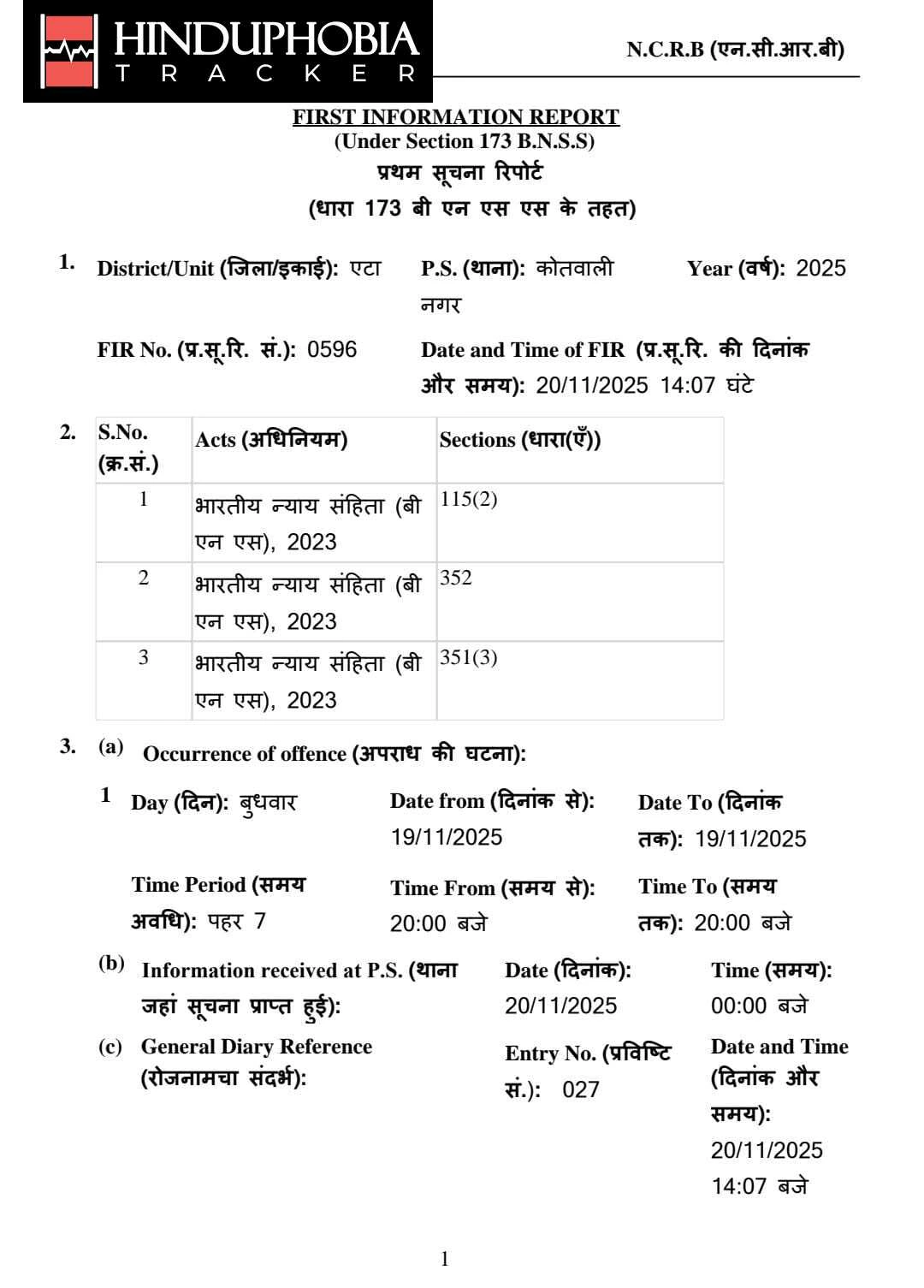
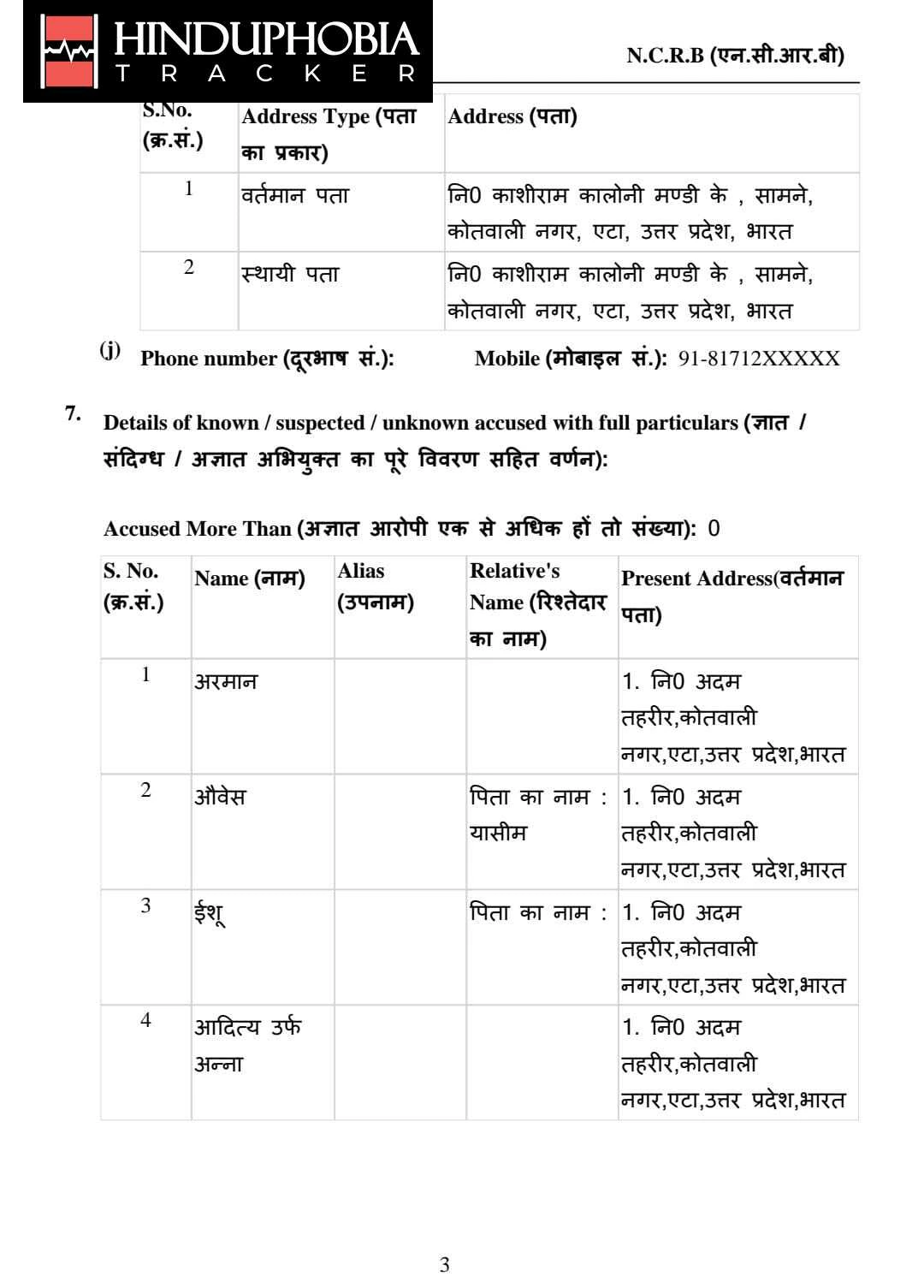
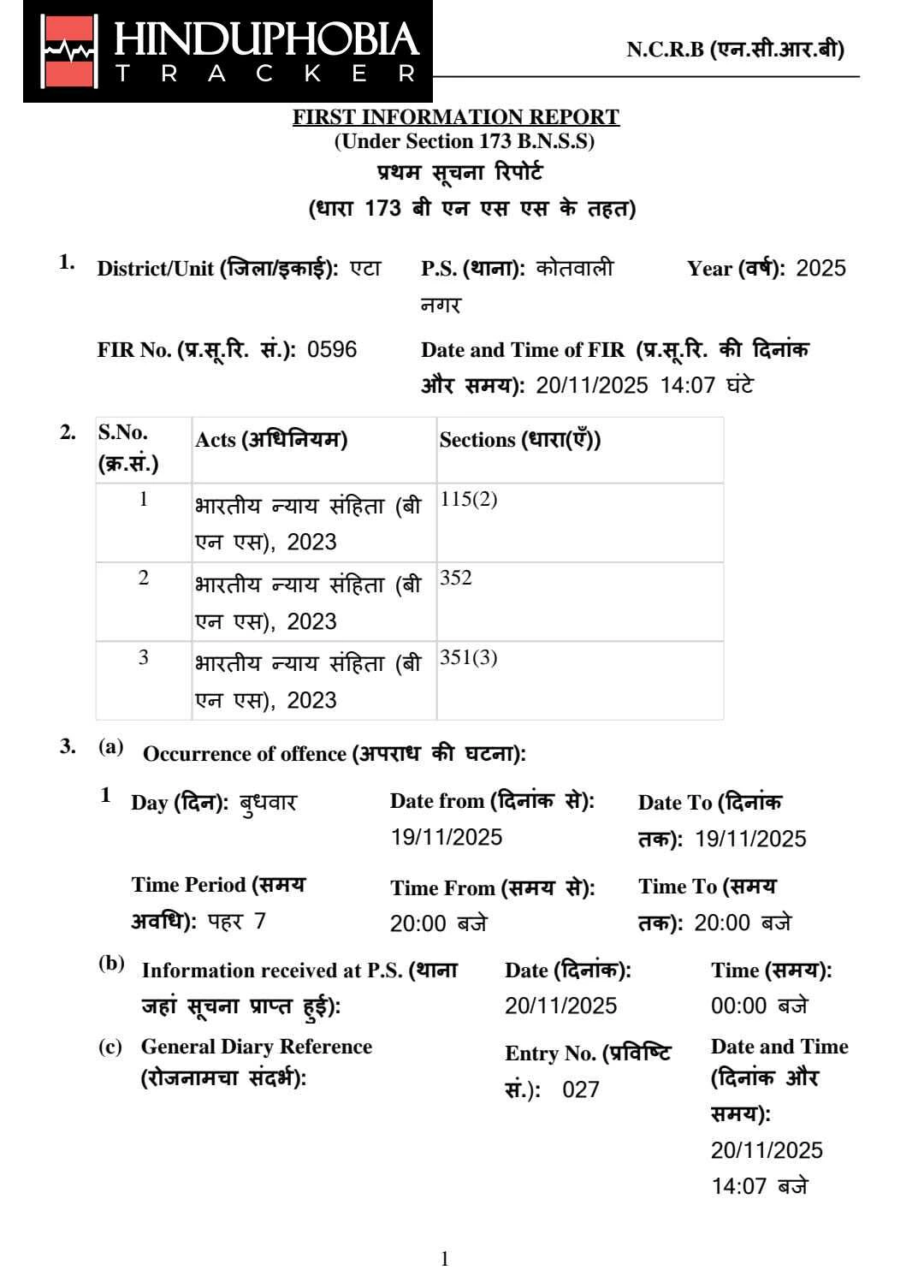
In Etah, Uttar Pradesh, a Hindu man named Divyam Chauhan was violently attacked by a group of armed Muslim youth for organising Hanuman chalisa sessions. According to reports, Divyam Chauhan, a resident of Kanshiram Colony opposite the Mandi Samiti, was the district head of the Bajrang Dal, a Hindu organisation, and conducted weekly recitation sessions of the Hanuman Chalisa in his area. The victim stated that, at around 8 p.m., while he was taking a walk outside the colony, three Muslim youths, identified as Armaan, Owais and Ishu and their accomplice Aditya, with an iron rod and wooden sticks, abused him and threatened to kill him. The Muslim youths declared that they would not allow the weekly Hanuman Chalisa sessions to continue at any cost. Gunshots were also fired during the assault, but the victim survived. Local residents intervened and managed to rescue the victim, after which the attackers fled while issuing further death threats. Following the incident, the victim approached the Kotwali Nagar police station, filed a written complaint, and demanded legal action. He further stated that one of the accused was involved in 'Love jihad' — a term used to describe the religious profiling and deliberate targeting of Hindu women by Muslim men through relationships or marriage for sexual exploitation or coerced religious conversion. At the time of writing this report, the police investigation is still ongoing.
Case Images
Why it is Hate Crime ?
This case has been added to the tracker under the primary category of - Restriction/ban on Hindu practices. Within it, the sub-category selected is- Restriction on expression of Hindu identity. An example of the state-affected prejudicial and targeted orders against the Hindu community would be a government denying the right of a Hindu or a group of Hindus to hold a religious procession owing to the animosity of non-Hindu groups. Denial of the religious right of the Hindus to assuage the non-Hindu group which harbours animosity to a point where it could lead to violence against Hindus is not only a failure of law and order but is a prejudicial order against Hindus, denying them their fundamental rights to express their religious identity. An example of a hate crime against Hindus by a non-Hindu would be a non-Hindu institution forcing its Hindu employees to abandon religious symbols that a Hindu would wear as an expression of faith owing to inherent prejudice against the faith professed by the victim or a non-Hindu group of people restricting a Hindu group from constructing a place of worship simply because the demography of the area in which the temple is being built is dominated by non-Hindus. Such actions are driven by religious animosity and/or prejudice against Hindus and their faith and would therefore be categorized as a hate crime. The second primary category selected here is - Attack not resulting in death. Within it, the sub-category selected is - Attacked for Hindu identity. In several cases, Hindus are attacked merely for their Hindu identity without any perceived provocation. A classic example of this category of religiously motivated hate crime is a murder in 2016. 7 ISIS terrorists were convicted for shooting a school principal in Kanpur because they got ‘triggered’ seeing the Kalava on his wrist and tilak that he had put. In this, the Hindu victim had offered no provocation except for his Hindu religious identity. The motivation for the murder was purely religious, driven by religious supremacy. Such cases where Hindus are targeted merely for their religious identity would be documented as a hate crime under this category. The other sub-category selected here is - Attacked for supporting/being part of perceived Hindu party/org or working for Hindu community. In several cases, Hindus are attacked specifically or tangentially for their association with parties or organisations perceived to be pro-Hindu and/or for working in favour of the Hindu community. One of the classic cases was the attack against a Bharatiya Janata Party Yuva Morcha (BJYM) worker Praveen Nettaru. Nettaru was attacked and hacked to death for his association with Hindu organizations and his work for the Hindu community. He was murdered by PFI, a terror organization which aimed to commit a genocide of Hindus, target Hindu leaders specifically and turn India into an Islamic Nation. In such cases, it is possible that the immediate trigger for the violence is non-religious – either according to the perpetrator or the police. However, there are surrounding circumstances from which the conclusion can be reached that the victim was attacked for his association with a Hindu organization. In a similar case, Rinku Sharma was attacked by radicals. He was a member of Bajrang Dal and regularly worked for the Hindu community. While the police cited a different non-religious trigger for the attack, it is true that he was associated to a Hindu organization and the family of Rinku Sharma specifically attributed his gruesome murder to him working for Bajrang Dal and raising Jai Shree Ram slogans. Such cases are intrinsically driven by religious hate and would therefore be documented as a hate crime under this category. This case has been added to the tracker because a Hindu man named Divyam Chauhan was violently attacked by a group of armed Muslim youth for organising Hanuman chalisa sessions in the area. The only trigger in this case was the victim organising Hanuman chalisa sessions; this alone was enough for the Muslim youths to launch a violent and targeted assault on the victim. This is on the lines of a pattern where Hindus are attacked by the Muslims just for expressing their religious identity or for outward display of their faith or devotion. The perpetrators’ actions were not out of any personal dispute, provocation or prior conflict; their anger was entirely directed at the fact that a Hindu devotional activity was being conducted openly in a shared public space, and the victim was explicitly involved in organising such events. The victim’s role in organising these weekly sessions made him a visible representative of Hindu religious practice, and this alone became the trigger for the attack. The attackers declared that they would not allow the weekly Hanuman Chalisa sessions to continue at any cost. The attackers perceived this outward display of Hindu faith as something that needed to be suppressed, revealing that their motivations were explicitly religious, not personal. This attempt to restrict Hindu religious practices demonstrated an effort to assert dominance and intimidate the Hindu community. The violent attack on the victim served as a statement to other Hindus to restrict themselves from engaging in or participating in such activities. The threats were aimed not just at the victim but at the wider Hindu community. The violent nature of the assault further highlighted the depth of the perpetrators’ religious hostility. Armed with weapons and willing to use physical force, they sought to punish the victim for merely organising a Hindu devotional gathering. These actions reflected a dangerous mindset of religious supremacy that demands dominance and submission through violence. This supremacist attitude results in disdain and hostility toward the Hindu community and their religious practices. The belief that Hindus lack equal standing leads to violent enforcement of dominance. This case is on the lines of patterns where Hindus are harassed, intimidated or harmed for outwardly displaying their faith or their Hindu identity. The communal nature of the case was therefore unambiguous: the victim was attacked because he was a Hindu asserting his Hindu identity, and the perpetrators acted out of religious animosity with a clear intent to restrict Hindu presence and practice in public spaces. The victim’s association with a Hindu organisation contributed to his targeting by the Muslim perpetrators. Multiple past cases have shown that Hindu activists affiliated with such organisations are often more vulnerable to attacks by Muslim extremists. The brutality of this assault on the Hindu activist underscores the continuation of that pattern, marking it as a clear anti-Hindu hate crime. Citing the religious motive behind the attack, the case has been officially recorded in the Hinduphobia Tracker’s hate crime database. Disclaimer: Hinduphobia Tracker is accounting incidents against Hindus by non-Hindu perpetrators, and for this reason, we are just considering the Muslim perpetrators, Armaan, Owais and Ishu, in the perpetrator count.
Victim Details
Total Victim
1
Deceased
0
Gender
- Male 1
- Female 0
- Third Gender 0
- Unknown 0
Caste
- SC/ST 0
- OBC 0
- General 1
- Unknown 0
Age Group
- Minor 0
- Adult 1
- Senior Citizen 0
- Unknown 0


Case Status
Complaint registered


Perpetrators Details
Perpetrators
Muslim Extremists
Perpetrators Range
From 2 To 5
Perpetrators Gender
male
 Sources




