Hindu families attacked by Islamic organisation members to induce migration in Faridpur, Bangladesh
 Faridpur District, Bangladesh
  13 November, 2025
Case Summary
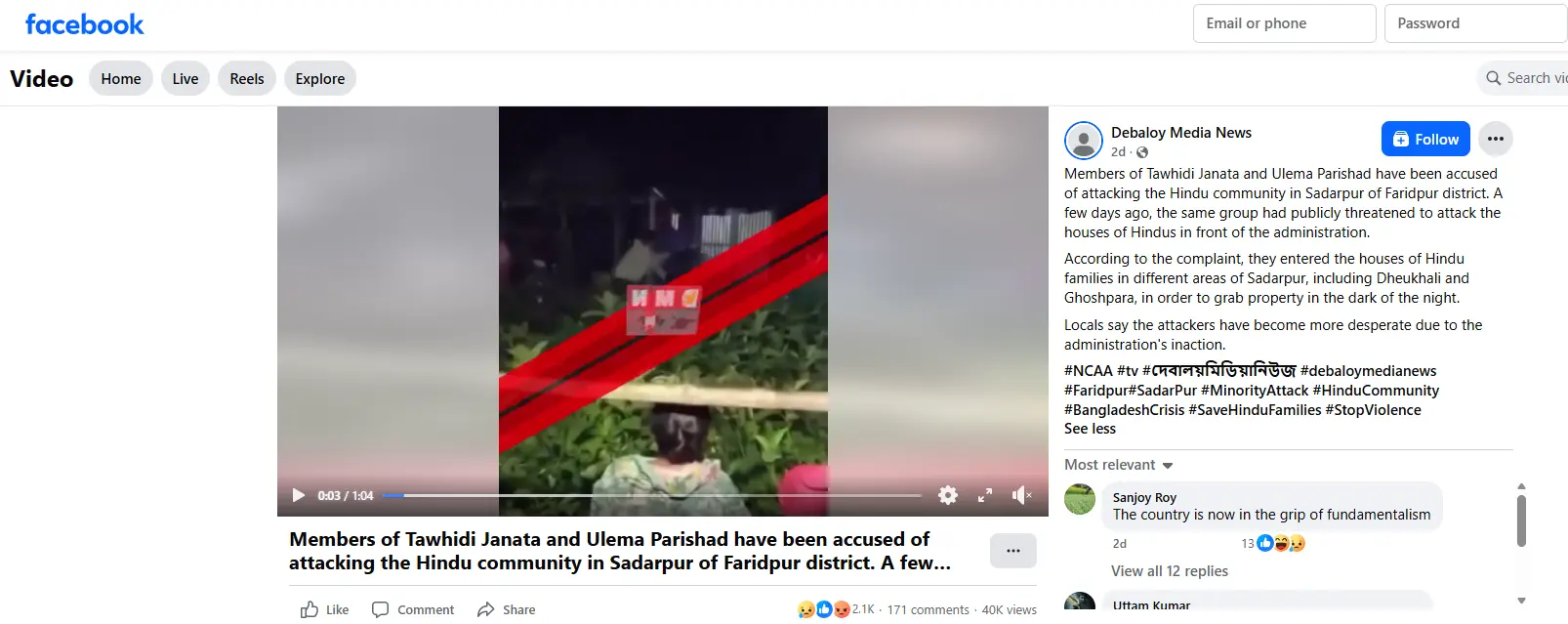
Hindu families were attacked in Sadarpur of Faridpur district, Bangladesh, when members of Tawhidi Janata and Ulema Parishad entered their homes at night on 14 November 2025 in areas such as Dheukhali and Ghoshpara and attempted to seize property. Locals said the same group had openly threatened to attack Hindu houses a few days earlier in front of the administration. A mandir in the area had also faced damage before this incident. Residents said the attackers had grown increasingly aggressive because the administration failed to act on repeated warnings. A complaint was filed, and police confirmed that a case had been registered and an investigation had begun. The attack formed part of a larger pattern of escalating violence against Hindus in Bangladesh after the fall of Sheikh Hasina’s government on 5 August 2024. Islamist groups took advantage of the political instability and carried out widespread assaults on Hindu homes, temples and community members. Several Hindu religious events were targeted, including an attack on a Ganesha procession in Chittagong on 6 September and multiple incidents of idol vandalism in Mymensingh, Pabna, Rajshahi, Kishoreganj and Dhaka. On 29 November, three temples in Patharghata, Chittagong, were attacked by a violent mob after Jumma Namaz, and Hindu journalist Munni Saha was arrested in Dhaka on 30 November. Reports also documented a Muslim mob burning Hindu houses in Jessore’s Abhaynagar upazila on 22 May 2025. Hindu teachers and officials were forced to resign in large numbers, and activist Asad Noor stated that Hindus were being coerced into joining Jamaat e Islami. ISKCON leaders, including Chinmoy Krishna Das Prabhu, were also targeted, with efforts made to suppress Hindu protests.
Case Images
Why it is Hate Crime ?
The primary category in this case is: Attack not resulting in death, The subcategory under this is: Attacked for Hindu identity. In several cases, Hindus are attacked merely for their Hindu identity without any perceived provocation. A classic example of this category of religiously motivated hate crime is a murder in 2016. 7 ISIS terrorists were convicted for shooting a school principal in Kanpur because they got ‘triggered’ seeing the Kalava on his wrist and tilak that he had put. In this, the Hindu victim had offered no provocation except for his Hindu religious identity. The motivation for the murder was purely religious, driven by religious supremacy. Such cases where Hindus are targeted merely for their religious identity would be documented as a hate crime under this category. The second subcategory under this is: Attacked to induce migration from non-Hindu dominated area. There have been cases where the Hindus living in an area, often with a majority dwelling belonging to non-Hindus or those harbouring animosity towards the Hindu faith, the Hindu residents experience threats and violence. The violence is employed with the aim of making the Hindus leave the area and relocate, so the area could be turned into an exclusive ghetto for adherents of the non-Hindu faith or those who harbor animosity towards the Hindu faith. In several cases, the aim of exodus is explicit. However, in several cases, the demand for exodus of Hindu residents is not explicit, however, violence by non-Hindu residents leaves the Hindu residents no option but to leave the area, thereby, turning the area into an exclusive ghetto of non-Hindu residents. In such cases, there are instances violence against the Hindu residents explicitly. For example, in the Hauz Qazi case of 2019, the Muslim residents claimed that mob violence against the Hindu residents had been triggered by a parking dispute. However, the violence did turn religious with a temple being desecrated and was directed specifically against the Hindu residents. The Hindu residents of the area were clear that the violence was religiously motivated and one of the motives was to affect an exodus of the Hindu residents. In such cases, even though the perpetrators have not explicitly expressed the aim of affecting exodus, the given circumstances and violence and precedent point to the intention of exodus and therefore would be categorized under this sub-category. Such crimes are religiously motivated and therefore are hate crimes. This case has been added to the tracker because the assault on Hindu families in Sadarpur reflects a direct and targeted act of violence rooted in hostility toward their Hindu identity. The perpetrators, identified by locals as members of Tawhidi Janata and Ulema Parishad, entered Hindu homes at night, damaged property, and attempted to seize land in multiple neighbourhoods. These actions were not preceded by any provocation from the victims. Instead, the attack followed earlier public threats issued by the same Islamic group, indicating that the violence was planned and directed at the Hindu community specifically because of their religious identity. The fact that a mandir in the area had been damaged earlier reinforces the religious nature of the hostility. Residents emphasised that the violence escalated because the administration failed to intervene despite prior warnings. This lack of official response appears to have emboldened the perpetrators and intensified the targeting of Hindu households. This incident is also emblematic of a larger pattern of targeting Hindus in Bangladesh, where attacks have increased significantly since political instability began in August 2024. Across the country, Hindu homes, temples, community leaders, and religious events have faced repeated violence from groups harbouring religious animosity. The Sadarpur attack fits into this broader pattern, not as an isolated act of criminality, but as part of an environment where Hindu identity itself has become a focal point of aggression. Additionally, the nature of the assault in Sadarpur suggests an effort to intimidate or displace Hindu residents from areas where they are vulnerable minorities. Entering homes at night, damaging property, and using physical force are tactics often used to push minority communities into migration. Local accounts indicate that the intent behind these actions was not merely theft or vandalism but the creation of fear and uncertainty among Hindu families. Given the precedents in other parts of Bangladesh, where similar violence has led to the displacement of Hindu communities, the Sadarpur incident raises comparable concerns. The absence of explicit statements demanding exodus does not diminish this interpretation. In many documented cases, the aim to drive out Hindu residents is inferred from the pattern of selective targeting, the timing of attacks, and the history of similar incidents in the region, especially in a country like Bangladesh. Here, the combination of prior threats, targeted entry into Hindu homes, attempts at land grabbing, and the administration’s failure to act suggests a context in which the attackers sought to assert dominance and unsettle the Hindu community. For these reasons, the incident is recorded as a hate crime motivated by religious hostility, where Hindus were attacked for their identity and subjected to violence that appears designed to intimidate and potentially displace them from their homes.


Case Status
Unknown


Perpetrators Details
Perpetrators
Muslim Extremists
Perpetrators Range
Unknown
Perpetrators Gender
unknown
 Sources




