Hindu pilgrims mocked, insulted and denied entry for Nankana Sahib by Pakistan authorities
 Punjab, Pakistan
  4 November, 2025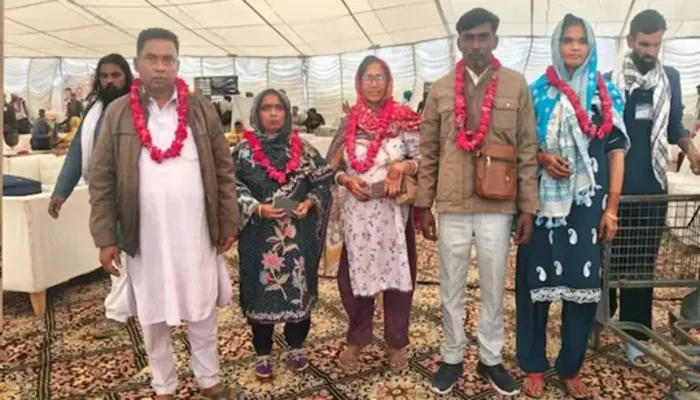
Case Summary
Hindu devotees, who had travelled from India as part of a Sikh pilgrimage group visiting Pakistan for the 556th birth anniversary of Guru Nanak Dev, were insulted and denied entry by Pakistan authorities. According to reports, the Hindu devotees were part of a large group of Sikh pilgrims who went to Nankana Sahib in Pakistan to mark the 556th birth anniversary of Guru Nanak Dev Ji, the founder of Sikhism. The group of Indian pilgrims departed for this purpose on 4 November 2025 via the Wagah border, with a planned return of 13 November 2025. However, Hindu families were singled out and refused entry by Pakistan authorities, even though they had valid visas issued prior by the Pakistan High Commission and had completed all immigration formalities at Attari and Wagah. Pakistani Rangers and immigration officials singled them out, declaring, "You are Hindus, you cannot go with the Sikh group," even though Nankana Sahib had no such restriction on the entry of Hindus. They even mocked and insulted Hindu pilgrims, saying, "Go to your temples, what are you going to do with Sikh gurdwaras?" Hindu devotees repeatedly explained that Guru Nanak Dev Ji was revered by Hindus as well, yet Pakistani authorities refused to let them continue the pilgrimage. Several Hindu families had even been born in Pakistan and had travelled with the Sikh group specifically to mark the Prakash Parv at Nankana Sahib, but were forced to walk back to the Indian side of the border. Some Hindu pilgrims such as Amar Chand and Ganga Ram recounted how Pakistani officials had stamped their passports, accepted their bus fare, allowed them to proceed past several checks, and then abruptly revoked their permission at the last stage without refunding their money. A group of fourteen Hindu families was turned back from Wagah, while another twelve devotees who had crossed the border on November 4 were stopped at the immigration counters inside Pakistan and sent back the next day. Indian officials in Amritsar confirmed that all Hindu devotees who had been refused entry had returned to India, and the matter was being taken up diplomatically.
Why it is Hate Crime ?
This case has been added to the tracker under the primary category of - Restriction/ban on Hindu practices. Within it, the sub-category selected is - Administration restricting religious practice. In several cases, it is seen that the administration/state disallows a religious practice owing to prejudicial orders and concerns, targeted specifically against the Hindu community. Such restriction/prohibition would be considered documented as a hate crime because the orders are often a result of pressure by groups that harbour animosity towards Hinduism and Hindus. Often, the restriction by the authorities is driven by bias, hostility, or prejudice against the specific community being stopped from holding a religious practice, by pressure groups that harbour animosity towards Hindus, intrinsic to their faith. Since practices are intrinsic to the faith of the Hindus, such prejudicial restriction is considered a curtailing of the fundamental rights of the Hindu community. In several cases, for example, the authorities ban a Hindu religious practice due to pressure from groups opposed to the religion. In other instances the prohibition is selectively enforced against one religious group (Hindus) while others are allowed to proceed. There are still other cases where the authorities preemptively restrict a religious practice by Hindus because those who hold animosity towards Hindus may get “provoked” leading to them being violent, thereby assuaging the sentiments of those who hold animosity towards Hindus by curtailing the religious rights of Hindus. Such acts and orders are prejudiced, indicating discriminatory motives owing to the capitulation to groups that harbour animosity towards Hindus and therefore, would be categorized as a religiously motivated hate crime since the original pressure leading to the order itself is a result of hatred/bias/prejudice/religious hate against Hindus. The other sub-category selected here is - Restriction on expression of Hindu identity. An example of the state-affected prejudicial and targeted orders against the Hindu community would be a government denying the right of a Hindu or a group of Hindus to hold a religious procession owing to the animosity of non-Hindu groups. Denial of the religious right of the Hindus to assuage the non-Hindu group which harbours animosity to a point where it could lead to violence against Hindus is not only a failure of law and order but is a prejudicial order against Hindus, denying them their fundamental rights to express their religious identity. An example of a hate crime against Hindus by a non-Hindu would be a non-Hindu institution forcing its Hindu employees to abandon religious symbols that a Hindu would wear as an expression of faith owing to inherent prejudice against the faith professed by the victim or a non-Hindu group of people restricting a Hindu group from constructing a place of worship simply because the demography of the area in which the temple is being built is dominated by non-Hindus. Such actions are driven by religious animosity and/or prejudice against Hindus and their faith and would therefore be categorized as a hate crime. The other primary category selected here is - Hate speech against Hindus. Within it, the sub-category selected is - Anti-slurs, mocking faith. Anti-Hindu slurs and the deliberate mocking of the Hindu faith owing to religious animosity involve the usage of derogatory terms, stereotypes, or offensive references to religious practices, symbols, or figures. One of the common anti-Hindu slurs used against Hindus is “cow-worshipper” and “cow piss drinker”. The intention of using this term is to demean and mock Hindus as a group and their religious beliefs since Hindus consider the cow holy. Additionally, some symbols and the slurs attached to them have a historical context that exacerbates the insult, hate, stereotyping, dehumanisation and oppression against Hindus. Cow worship has been used for centuries to denigrate Hindus, insult their faith and oppress Hindus specifically as a religious group. There has been overwhelming documentation about how cow slaughter has been used to persecute Hindus with cow meat being thrown in temples and places of worship. There has also been overwhelming documentation where cow meat (beef) has been force-fed to Hindus to either forcefully convert them to Islam or denigrate their faith. Apart from cow worship, the Swastika – which holds deep religious significance for the Hindus – has also been misinterpreted and distorted to use as a slur against Hindus. Similarly, the worship of the Shivling has been used by supremacist ideologies and religions to denigrate Hindus owing to religious animosity. Such slurs and denigration stem out of inherent animosity and hate towards Hindus and their faith, therefore, it is categorised as hate speech targeted at Hindus specifically owing to their religious identity. This case has been added to the tracker because Hindu devotees, who had travelled from India as part of a Sikh pilgrimage group visiting Pakistan, were insulted and denied entry by Pakistan authorities. It is important to understand here that Guru Nanak Dev Ji’s birthplace, Nankana Sahib, holds deep spiritual significance not only for Sikhs but also for Hindus. For centuries, Hindus have revered Guru Nanak Dev Ji as a spiritual teacher who transcended religious boundaries and emphasised shared values of truth, compassion, and devotion. Pilgrimages to Nankana Sahib by Hindus have historically been common, and many Hindu families, particularly those originally from regions now in Pakistan, continue to consider the site sacred. Therefore, Hindu devotees travelling to Nankana Sahib were engaging in a legitimate and meaningful act of religious devotion. Their connection to the site is both historical and spiritual, and their presence within a Sikh pilgrimage group was entirely consistent with longstanding cultural and religious practice. Despite this, Hindu devotees with valid visas, stamped passports, and completed travel documentation were deliberately singled out by Pakistan authorities solely because of their religion. Pakistan is a state founded on a religious identity, an Islamic identity, and thus has deep-seated hostility towards Hindus and Hinduism. The conduct of Pakistan authorities reflected this entrenched religious animosity. The Hindus were not denied entry due to administrative or procedural issues; they were denied because of their religious identity as Hindus. Their actions were rooted in anti-Hindu sentiment. It is important to emphasise that Nankana Sahib, while a major Sikh pilgrimage site, does not prohibit entry to people of any religion. There is no religious restriction that bars Hindus from offering prayers or paying respects. Hindus have historically visited Sikh gurdwaras, and Sikh shrines traditionally remain open to all, regardless of caste, creed, or faith. Thus, the Hindu devotees who travelled to Nankana Sahib were participating in a genuine religious observance of revering Guru Nanak Dev Ji. The fact that they were denied entry purely because they were Hindu, despite the gurdwara having no such prohibition, clearly demonstrates religious discrimination. Their attempt to engage in peaceful religious practice was obstructed specifically due to religious hostility. Such discrimination at a holy site that is open to all constitutes a direct manifestation of anti-Hindu animosity. Furthermore, while denying entry, Pakistan authorities also mocked, verbally abused and insulted Hindu pilgrims. Statements such as “Go to your temples, what are you going to do with Sikh gurdwaras?” were made in a condescending tone that belittled Hindu religious identity. Such humiliating remarks constitute hate speech because they attack and ridicule the Hindu religious identity; such speech leads to the normalisation of mockery of Hindu beliefs. Taken together, the discriminatory denial of entry, the targeting of pilgrims solely based on their Hindu identity, and the mocking of Hindus clearly establish this as a hate crime rooted in religious animosity. Therefore, this case has been added to the tracker.
Victim Details
Total Victim
26
Deceased
0
Gender
- Male 0
- Female 0
- Third Gender 0
- Unknown 26
Caste
- SC/ST 0
- OBC 0
- General 0
- Unknown 26
Age Group
- Minor 0
- Adult 0
- Senior Citizen 0
- Unknown 26


Case Status
Unknown


Perpetrators Details
Perpetrators
State and Establishment
Perpetrators Range
Unknown
Perpetrators Gender
unknown
 Sources




