Hindus targeted for conversion through Christian prayer gathering in Madhopur, Bihar
 Bihar Sharif, Bihar, India
  12 November, 2025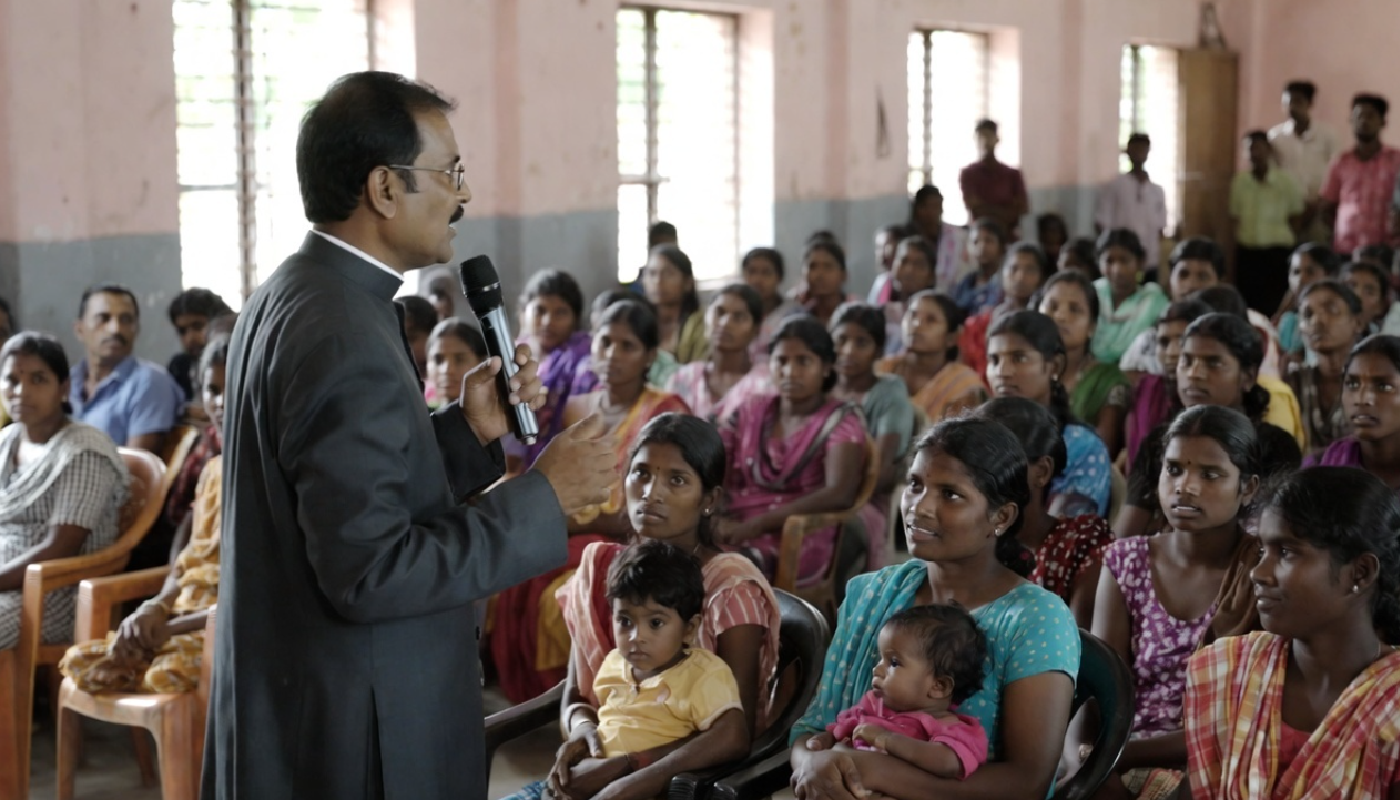
Case Summary
Hindus were targeted for religious conversion during a Christian prayer gathering held in Madhopur, Bihar Sharif, Bihar, where a large event connected to Christian preaching had been taking place for two days. The incident came to light on 13 November 2025, when Bajrang Dal members intervened and disrupted the programme, finding that religious conversions were being carried out under the guise of prayers. The event was being held at a hall near Madhopur Chowk, where attendees from several districts were present, with a significant number of them being Hindu women. According to reports, the prayer meeting was organised under the pretext of spreading spiritual teachings, but participants were being influenced to adopt Christianity through emotional persuasion and promises of material benefits. A large number of men, women, and children had been attending the event, which was led by local preachers associated with Christian missionary activity. Bajrang Dal activists stated that Hindu participants, particularly women from financially weaker backgrounds, were being lured with money and incentives to renounce their faith and convert to Christianity. When Bajrang Dal members reached the site and raised objections, a commotion broke out, and police from the local Madhopur station were called to restore order. Eyewitnesses stated that several of the Hindu attendees were unaware of the true nature of the event and were later shocked to discover that it was a conversion drive in the name of prayer. After receiving information about the incident, police arrived and took control of the situation, preventing further escalation. Hindu women who had attended the event told reporters that they had participated over the previous two days and confirmed that several poor women were present and they had no money for treatment. Hindu leaders Praveen Kumar Supan and Mukesh Sahu stated that such gatherings had been occurring in the region for the past seven years, during which many Hindu women were gradually converted under the same pretext. They accused the organisers of systematically targeting poor Hindu families and demanded that the administration take strict legal action against those promoting conversion under religious disguise.
Why it is Hate Crime ?
The primary category in this case is: Predatory Proselytisation. The first subcategory under this is: Conversion/ attempts to convert by inducement. Predatory Proselytisation is not just limited to threat, harassment, force and violence, but it also has contours of stealth. In several cases, the Hindu victim is exploited to convert, with non-Hindus taking advantage of their poverty. In such cases, the Hindu victim who is suffering financially is offered monetary benefits, including lucrative offers for jobs, health treatment, education, etc, to induce the victim into changing his/her religion. In such cases, the religious identity of the victim and the aim to disenfranchise him from his faith form the heart of the crime. Also, taking advantage of and exploiting an individual’s economic vulnerabilities is widely acknowledged as exploitation, forms of which are often penalised by law. Such cases therefore are considered religiously motivated hate crimes since the victim’s religious identity forms the very heart of the crime itself. The second subcategory under this is: Proselytisation by grooming, brainwashing, manipulation or subtle indoctrination. The tertiary category under this is: Conversion of minor. Religious brainwashing essentially means the often subtle and forcible indoctrination to induce someone to give up their religious beliefs to accept contrasting regimented ideas. Religious grooming or brainwashing also involves propaganda and manipulation. It involves the systematic effort, driven by religious malice and indoctrination, to persuade “non-believers’ to accept allegiance, command, or doctrine to and of a contrasting faith. Cases of such grooming or brainwashing are far more nuanced than direct threats, coercion, inducement and violence. In such cases, it is often seen that there is repeated, subtle and continual manipulation of the victim to induce disaffection towards their own faith and acceptance of the contrasting faith of the perpetrator. While subtle indoctrination is widely acknowledged as predatory, an element which is often understated in such conversions or the attempts of such conversion is the role of loyalty and trust which might develop between the perpetrator and the victim. Fiduciary relationships are often abused to affect such religious conversion. For example, an educator transmitting religious doctrine of a competing faith to a Hindu student. The Hindu student is likely to accept what the teacher is transmitting owing to existence of the fiduciary relationship. The exploitation of the fiduciary relationship to religiously indoctrinate victims would also be included in this category. Since the underlying animosity towards the victim’s faith forms the basis of predatory proselytization, such cases are considered religiously motivated hate crimes. This case in Madhopur, Chanda reflects a textbook instance of predatory proselytisation, structured around exploitation of poverty, religious manipulation, and long-term indoctrination of vulnerable Hindus, particularly women. What makes this case distinct is the sustained and organised nature of the activity; a two-day prayer gathering framed as a spiritual event but functioning as a covert mechanism to facilitate conversion through inducement and grooming. The accounts from attendees and Hindu organisation members reveal the deliberate use of material promises and emotional pressure to influence participants. Hindu women from economically weaker families were targeted with assurances of financial help, medical assistance, and emotional support. Such inducements exploit the material vulnerabilities of victims while disguising the underlying intent — religious displacement. This method of proselytisation does not rely on overt force; instead, it cultivates dependency and gratitude, which are then redirected toward religious submission. The use of charity or humanitarian language to convert people of a different faith adds a layer of moral camouflage, making these acts more insidious and difficult to detect legally. The psychological and social manipulation evident here also reveals the deeper mechanics of grooming. Participants were repeatedly exposed to selective religious messaging that denigrated Hindu beliefs while glorifying Christianity as a “path of peace” and redemption. Over time, such narratives work to induce spiritual self-doubt among Hindu attendees, encouraging them to abandon inherited traditions. These gatherings create spaces where repeated exposure and social reinforcement normalise the idea of conversion. Once emotional trust is established, doctrinal persuasion becomes easier, especially for those facing economic hardship or social marginalisation. This case also shows the intergenerational dimension of conversion efforts. The mention of children and families in attendance implies that the process is not only aimed at individuals but at the slow transformation of entire family units. The presence of minors in such religious gatherings underlines the long-term strategy of indoctrination at formative ages, embedding new religious loyalties through early psychological conditioning. From a broader perspective, the pattern seen in Madhopur aligns with a repeated trend across tribal and semi-urban regions of Chhattisgarh. These activities represent not only violations of individual religious freedom but a systematic effort to erode Hindu community integrity through exploitation of socio-economic fragility. The religious identity of the victims is central to the act, and the conversion process itself is rooted in ideological hostility toward Hinduism.


Case Status
Complaint filed


Perpetrators Details
Perpetrators
Christian Extremists
Perpetrators Range
Unknown
Perpetrators Gender
unknown
 Sources




