Hindu man killed by girlfriend’s Muslim family over interfaith relationship; victim’s family faced casteist abuse and death threats
 Pipraich, Uttar Pradesh, India
  31 October, 2024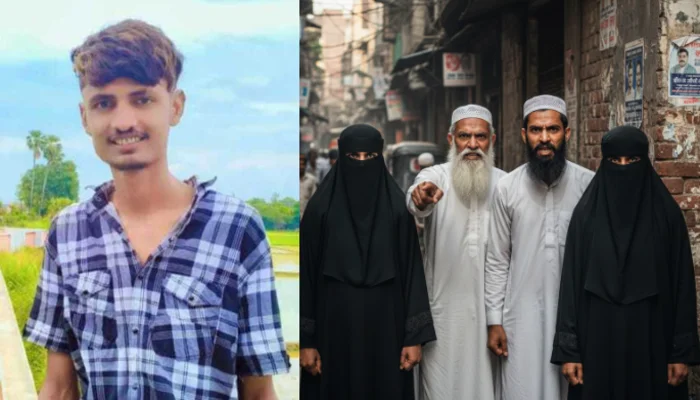
Case Summary
In Pipraich town of Gorakhpur, Uttar Pradesh, a Hindu man named Abhishek Bharti (22), alias Vikas, was killed over an interfaith relationship by his Muslim girlfriend's family members. The Muslim family had previously threatened to kill the victim's family and also hurled casteist abuses at them. The Hinduphobia Tracker accessed the FIR filed by the victim's father, Ram Ashish Bharti, after the victim's body was found hanging from a village water tank on 30 October 2025. He revealed that his son, Abhishek, was in a relationship with a Muslim girl named Sakina, the daughter of Shahjahan, of the village. The victim worked as a labourer at a local shop, while his father was a mason. He was the youngest of two brothers and a sister. Approximately one year ago, on 1 November 2024, both ran away from their homes, due to which the girl's mother filed a police complaint. Due to police pressure based on the complaint, both came to the police station and insisted on living together as husband and wife, after which he was thrown out of the house. Subsequently, they began living together outside as a couple. During this time, Shahjahan (Sakina's father), Jameerun Nisha (wife of Shahjahan), Sajid Ali, Sakina's elder sister Rukhsana and her brother-in-law, and Warish Ali came to the victim's house and threatened to kill him and his entire family and to bomb the house, while hurling casteist abuses at them. The family was traumatised and called Abhishek and Sakina back home out of fear. On 1 April 2025, a panchayat meeting was held where the girl was sent back to her parents in the presence of panchayat members. However, on 18 October 2025, Sakina returned to Abhishek's house, insisting on staying with him, stating that she had converted to Hinduism. Abhishek's family intervened and sent her back home to avoid escalation. When Sakina's family was taking her away, they again threatened to kill the victim's family while hurling casteist abuses at them, leaving the victim's mother ill for several days. Following this altercation, on 30 October 2025, Abhishek's body was found hanging from a village water tank. He had been missing since the previous evening and had spoken to his father around 9 pm, saying he was coming home, but his phone was switched off shortly afterwards. Villagers discovered his body the following morning and alerted the police, who recovered the body and sent it for post-mortem examination. Subsequently, the victim's father filed a complaint with the police, based on which an FIR was registered against seven people. Based on the investigation, Sakina's father, Shahjahan, was arrested, produced before the court, and sent to jail. MLA Mahendra Pal Singh visited the family, assuring them of fair action, while the investigation continued.
Case Images
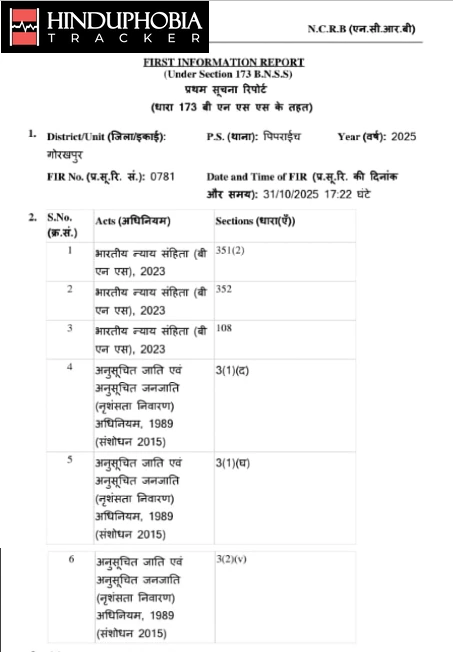
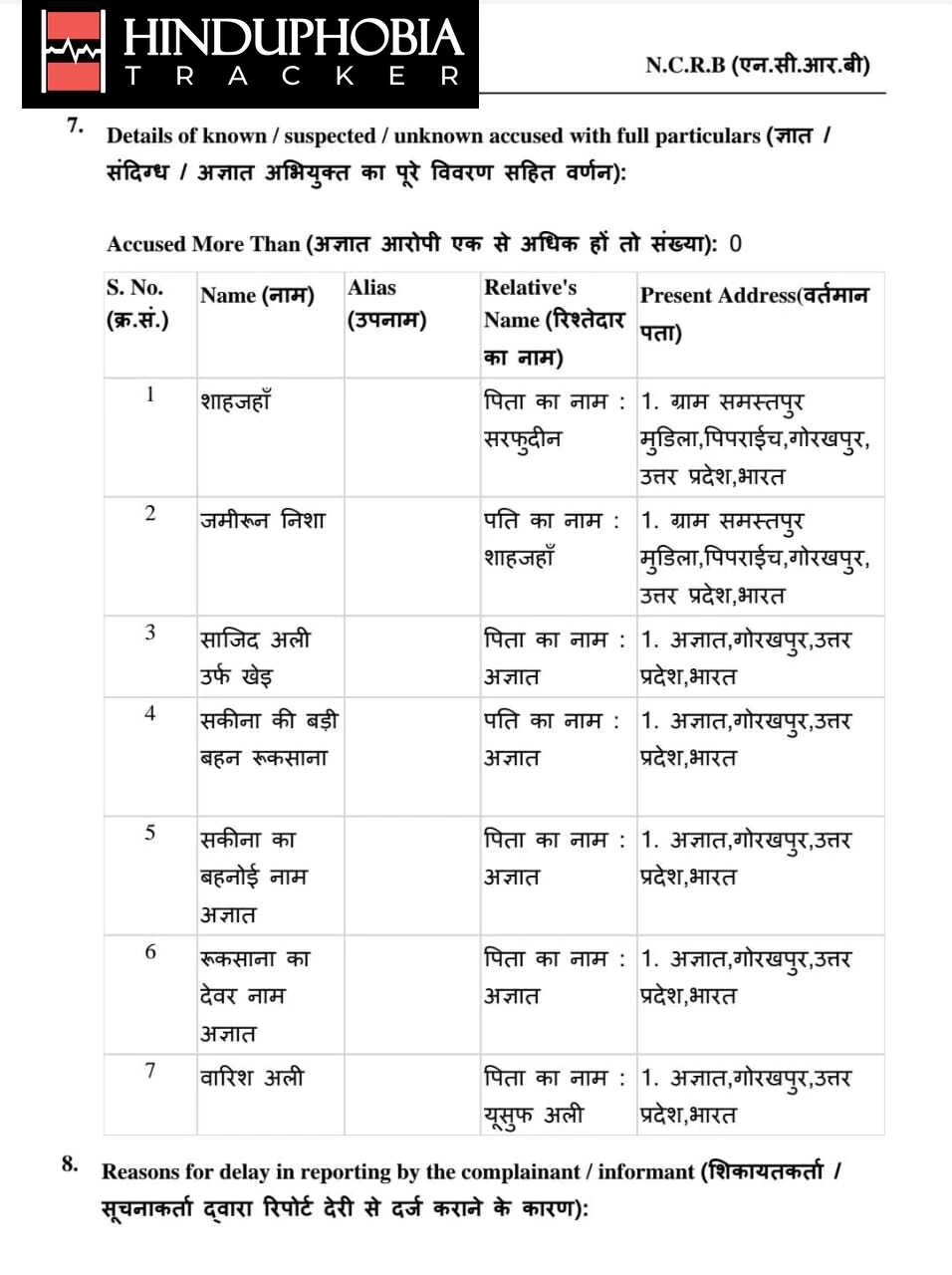
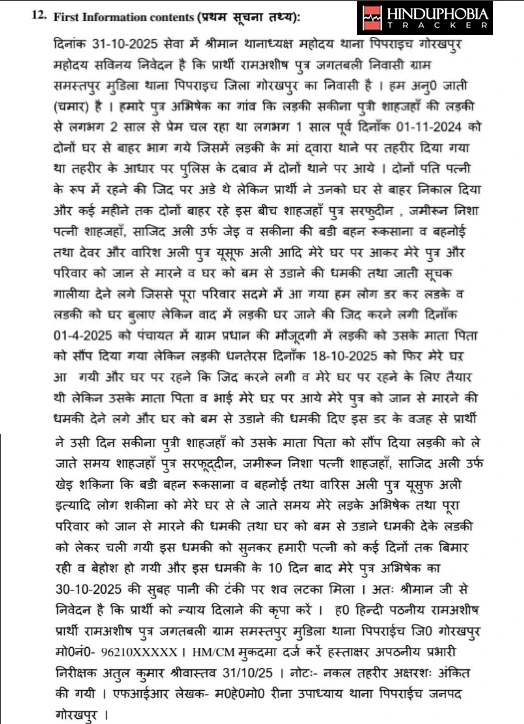
Why it is Hate Crime ?
This case has been added to the tracker under the primary category of - Men attacked for being associated with non-Hindu women. Within it, the sub-category selected is - Attacked by non-Hindu partner or/and her family. When Hindu men are in a relationship with non-Hindu women, there are cases where the man is forced to convert his religion and upon his refusal to do so, the partner or/and her family attacks the victim. Such relationships may be consensual with the religious identity of the non-Hindu woman known to the victim. Somewhere along the relationship, the non-Hindu woman or her family starts forcing/pressurizing the Hindu man to convert. In some of these cases, the association could be non-consensual as well or, the religious identity of the non-Hindu woman could be previously unknown to the Hindu victim. In such cases, the Hindu man is first forced/pressurized to change his religion by the non-Hindu woman or her family. The force/pressure could involve threats. The trigger for directing violence against the Hindu man is in these cases his refusal to comply and change his religion under threat and/or force. In other cases that have been documented, it is also seen that the Hindu partner is assaulted by the non-Hindu woman or her family simply for his relationship with the non-Hindu woman and by virtue of him following the Hindu faith and not the religion of the non-Hindu woman. In such cases, the relationship is consensual in most cases and the religion of both partners is known to the other. Often, in such cases, there is no direct force/pressure to convert either, however, the attack is a result of the Hindu man being in a relationship with the non-Hindu partner and not following her religion/following Hinduism specifically. Such cases are driven by specific religious motivations and against the religious identity of the victim and are therefore qualified as hate crimes. The other sub-category selected here is - Killed by non-Hindu partner's family. When Hindu men are in a relationship with non-Hindu women, there are cases where the man is forced/pressured to convert his religion and upon his refusal to do so, the family of the non-Hindu partner murders the victim. Such relationships may be consensual with the religious identity of the non-Hindu woman known to the victim. Somewhere along the relationship, the non-Hindu woman and her family start forcing/pressurizing the Hindu man to convert. In some of these cases, the association could be non-consensual as well or, the religious identity of the non-Muslim woman could be previously unknown to the Hindu victim. In such cases, the Hindu man is first forced/pressurized to change his religion by the non-Hindu woman’s family. The pressure could involve threats. The trigger to murdering the Hindu man in these cases is his refusal to comply and change his religion under threat and/or force. In other cases that have been documented, it is also seen that the Hindu partner is murdered by the family of the non-Hindu woman simply for his relationship with the non-Hindu woman and by virtue of him following the Hindu faith and not the religion of the non-Hindu woman. In such cases, the relationship is consensual in most cases and the religion of both partners is known to the other. Often, in such cases, there is no direct force/pressure to convert either, however, the murder is a result of the Hindu man being in a relationship with the non-Hindu partner and not following her religion/following Hinduism specifically. Such cases are driven by specific religious motivations and against the religious identity of the victim and are therefore qualified as hate crimes. The second primary category selected here is - Hate speech against Hindus. Within it, the sub-category selected is- Anti-Hindu slurs, mocking faith. Anti-Hindu slurs and the deliberate mocking of the Hindu faith owing to religious animosity involve the usage of derogatory terms, stereotypes, or offensive references to religious practices, symbols, or figures. One of the common anti-Hindu slurs used against Hindus is “cow-worshipper” and “cow piss drinker”. The intention of using this term is to demean and mock Hindus as a group and their religious beliefs since Hindus consider the cow holy. Additionally, some symbols and the slurs attached to them have a historical context that exacerbates the insult, hate, stereotyping, dehumanisation and oppression against Hindus. Cow worship has been used for centuries to denigrate Hindus, insult their faith and oppress Hindus specifically as a religious group. There has been overwhelming documentation about how cow slaughter has been used to persecute Hindus with cow meat being thrown in temples and places of worship. There has also been overwhelming documentation where cow meat (beef) has been force-fed to Hindus to either forcefully convert them to Islam or denigrate their faith. Apart from cow worship, the Swastika – which holds deep religious significance for the Hindus – has also been misinterpreted and distorted to use as a slur against Hindus. Similarly, the worship of the Shivling has been used by supremacist ideologies and religions to denigrate Hindus owing to religious animosity. Such slurs and denigration stem out of inherent animosity and hate towards Hindus and their faith, therefore, it is categorised as hate speech targeted at Hindus specifically owing to their religious identity. The other sub-category relevant here is - Violent threats. Violent threats, explicit, implicit or implied, is the most dangerous form of hate speech since it goes beyond discriminatory and prejudicial language to express the intent of causing harm to an individual or a group of people based on their religious identity and faith. There could be several different kinds of threats that are issued to Hindus based on religious animosity. An explicit threat would mean the direct threat of violence towards an individual Hindu, a group of Hindus or Hindus at large. Physical violence, death threats, threats of destruction of property belonging to Hindus and threats of genocide would mean explicit threats against Hindus for their religious identity. Implicit threats may not be a direct threat but implied through the use of symbols of actions – for example – in the Nupur Sharma case, other than explicit threats, there were also implicit threats when Islamists took to the streets to burn and beat her effigies. It implies that they want to do the same to Nupur Sharma – thereby is considered an implicit threat. Violent threats can be delivered in person, through letters, phone calls, graffiti, or increasingly through social media and other online platforms. It would be important to understand that a threat – explicit or implicit, online or offline – to an individual who happens to be a Hindu does not qualify as a religiously motivated threat. Such a threat, while vile and dangerous, could be owing to non-religious reasons and/or personal animosity. To qualify as a religiously motivated threat, it would need to exhibit an indication that the individual is being targeted for religious reasons and/or owing to his/her religious identity as a Hindu. The third primary category selected here - Attack resulting in death. Within it, the sub-category selected here - Attacked for Hindu identity. In several cases, Hindus are attacked merely for their Hindu identity without any perceived provocation. A classic example of this category of religiously motivated hate crime is a murder in 2016. 7 ISIS terrorists were convicted for shooting a school principal in Kanpur because they got ‘triggered’ seeing the Kalava on his wrist and tilak that he had put. In this, the Hindu victim had offered no provocation except for his Hindu religious identity. The motivation for the murder was purely religious, driven by religious supremacy. Such cases where Hindus are targeted merely for their religious identity would be documented as a hate crime. Under this category, cases where the attack led to the death of the Hindu victim/s would be documented. This case has been added to the tracker because a Hindu man, Abhishek Bharti alias Vikas, was killed by his Muslim girlfriend's family for having an interfaith relationship. The violent threats, casteist abuse and subsequent death were not isolated incidents or spontaneous acts of rage but were instead rooted in a pattern of hostility directed specifically toward his Hindu identity. The family of the Muslim woman had repeatedly threatened Abhishek and his family with death, hurled casteist abuses, and even warned that they would bomb the house. Such actions by the Muslim family and the eventual death of the victim all point towards an act driven by deep-seated religious animosity rather than a private familial dispute. Firstly, it is important to understand that the Muslim girl was in a consensual relationship with the Hindu youth. Both partners were aware of each other’s religious identities, yet their relationship drew severe opposition from the woman’s family. In Islamic belief, a marriage or even a relationship between a Muslim woman and a non-Muslim man is considered illegitimate unless the man converts to Islam. For those who strictly adhere to such views, a Muslim daughter’s union with a Hindu man without conversion is not only socially unacceptable but also seen as a direct challenge to religious authority. This ingrained notion of religious supremacy often transforms personal disapproval into violent enforcement of religious boundaries. In this case, the family of the Muslim girl, motivated by religious hostility and notions of “honour,” systematically targeted Abhishek for being a Hindu man in a relationship with their daughter. Secondly, the sequence of events, threats, casteist slurs, and the killing of the Hindu man clearly shows that the hostility toward Abhishek was not merely personal but ideological. These actions were a result of Abhishek's romantic relationship with the Muslim girl, which was unacceptable to her brothers and family within the Muslim community. Their violent reaction was not a personal dispute but a manifestation of deep-seated religious hatred targeting his Hindu identity. This was no private quarrel but a clear act of religious intolerance and supremacy, whereby the victim’s Hindu identity and interfaith relationship resulted in his killing. The justification for such actions stems from the conspiracy theory of ‘Bhagwa Love Trap’, which is explicitly rooted in anti-Hindu sentiment. This false narrative vilifies Hindu men by portraying them as predators targeting Muslim women, despite no basis in reality. It is weaponised to legitimise violence against Hindus, as seen in this case, where a group of Muslim men took it upon themselves to stop the Hindu boy and the Muslim girl and assault the Hindu boy for his faith. Thirdly, giving death threats and bomb threats to a Hindu family because of a consensual interfaith relationship is a direct expression of communal hatred. It was an attempt to force them into submission through violence and explicit threats. These violent threats were not isolated acts of provocation but part of a sustained campaign of intimidation. They highlighted the deep-rooted animosity against the Hindu family, which was systematically expressed through acts of violence, threats, and continued harassment. Fourth, the Muslim family also hurled casteist abuses at the victim's family. While some may argue that the caste-specific slurs targeted the victim’s micro-identity as a Dalit Hindu rather than his broader religious identity, in the context of Abrahamic hostility toward non-believers, such micro-identities — caste, language, or region — are secondary. The primary animosity is directed toward the victim’s family’s Hindu identity. Thus, while the perpetrators invoked casteist abuse, their hostility was fundamentally anti-Hindu in nature. The intent was not to highlight caste difference but to humiliate the Hindu family through the idioms of social inferiority. The use of caste as an instrument of insult was simply a means to intensify religious contempt. Therefore, the fact that caste-based slurs were used by Muslim perpetrators does not diminish the communal motive — it reinforces it. This makes the crime an unmistakably religiously motivated act of hatred against Hindus, reflecting both doctrinal animosity and social prejudice against a Hindu from the Dalit community. This incident falls into a broader and disturbing pattern where Hindu men are targeted specifically for being in relationships with Muslim women. These assaults are often framed as matters of "honour," but the underlying motivation is deeply religious. In many such cases, the religious identity of the Hindu male partner becomes the key trigger for violence, especially when there is no conversion to Islam. Even if conversion is not directly demanded in every case, the violence is often aimed at punishing the Hindu man for not adhering to Islamic norms in the context of a relationship with a Muslim woman. Abhishek’s death was not a personal tragedy alone; it was a manifestation of communal hatred directed at a Hindu man who crossed religious boundaries. The calculated intimidation of his family, the systematic threats of violence, and the eventual discovery of his body hanging from a water tank all reflect a deliberate effort to punish him for defying religious orthodoxy. His killing served as a warning to other Hindus that they would meet a similar fate if they dared to associate with a Muslim girl. Given the religious motive, the explicit targeting of the victim’s Hindu identity, casteist slurs and his eventual death, this incident qualifies as a definitive case of a religiously motivated hate crime. The targeting of Abhishek Bharti for his Hindu identity and relationship with a Muslim woman places this case squarely within the framework of anti-Hindu hate crime; thus, it was added to the tracker. Disclaimer: It is important to clarify that none of the media sources covering this case have specified the exact date when the victim's ordeal began. The earliest date mentioned is 1 November 2024, when the couple ran away from their homes and the girl's mother filed a complaint. Since Hinduphobia Tracker records the incident based on when the victim’s ordeal began and not when it was reported, we have considered the date of the incident as 1 November 2024, though the media reported the incident later.
Victim Details
Total Victim
5
Deceased
1
Gender
- Male 3
- Female 2
- Third Gender 0
- Unknown 0
Caste
- SC/ST 5
- OBC 0
- General 0
- Unknown 0
Age Group
- Minor 0
- Adult 5
- Senior Citizen 0
- Unknown 0


Case Status
Case sub-judice


Perpetrators Details
Perpetrators
Muslim Extremists
Perpetrators Range
From 5 to 10
Perpetrators Gender
both
 Sources




