Ancient Hindu temple with deity carvings defaced, idols removed; premise marked as Waqf property by Muslims
 Tiruchirappalli, Tamil Nadu, India
  28 October, 2025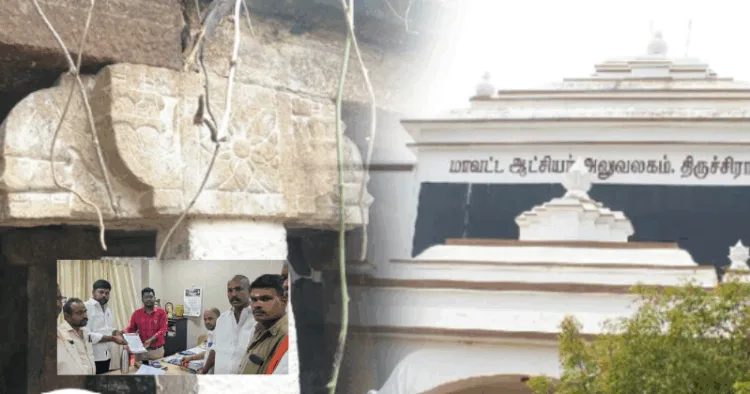
Case Summary
A Hindu temple was targeted in Venkangudi village near Samayapuram in Trichy district, Tamil Nadu, where Muslims pulled down a 1,000-year-old Hindu stone mandapam belonging to the Nangamangalam Choultry and removed the idols worshipped there by Hindus for generations. According to Hindu Munnani functionary Guna, the idols were thrown out and a board was installed claiming that the property belongs to the Waqf Board, which led to tension in the village. Hindu residents said that the stone structure had carvings of Hindu deities on its pillars, and it was designed in traditional Hindu temple architecture. Hindu Munnani stated that attempts were being made to convert the ancient Hindu religious structure into a mosque and dargah. They said that Muslims illegally encroached upon the mandapam and were trying to convert it into an Islamic religious place by erasing all Hindu symbols and claiming ownership through the Waqf Board. Hindu Munnani submitted a petition to the Trichy District Collector, demanding that the property be retrieved and handed back to the lawful Hindu owners. A petition dated 29 October 2025, submitted by Hindu Munnani district executive council member M Pandian to the Collector, stated that Muslims have forcefully taken over the mandapam and put up a Waqf property board. The petition mentioned that the figurines of Hindu deities existed in the mandapam and villagers were praying to them for generations. A mosque already exists next to the mandapam. The new board, claiming control, triggered serious objections from Hindu residents. Hindu Munnani and locals described this as an attempt to seize temple property and erase Hindu cultural identity. They demanded that the Archaeological Survey of India conduct an inspection and take over the property to preserve its heritage.
Why it is Hate Crime ?
The primary category in this case is: Attack on Hindu religious representations. The first subcategory under this is: Attack on Temples. In Hinduism, a temple is the abode of the Deity. The Deity in the Temple is consecrated, thereby, making it a real, breathing entity. Hindus believe that not just the Deity but the temple premises itself are sacred to Hindus since Hindus hold the faith that the entire Temple space is an amalgamation of the divine energy of the deity. Given the central significance of Temples in Hindu Dharma, any attack against a Hindu Temple or its peripheral premises is an attack on the faith itself and is born out of animosity towards the faith, of which, the Temple is a central tenet. Any manner of attack against a Temple and/or its premises would therefore be considered a religiously motivated hate crime. The second subcategory under this is: Desecration of Hindu religious symbol. Icons and symbols or a religious representation of a spiritual ideal are widely revered in Hinduism. Iconography is of vital significance in the Hindu milieu. It helps connect people’s spiritual beliefs with the real world. Iconography within the Hindu faith takes several shapes and forms. Murtis are of most significance to Hindus, to which daily rituals, prayers and offerings are done. Besides the murtis, there are several other symbols which have deep significance in the Hindu faith – the Om and Swastika for example. Since these Hindu religious symbols hold paramount importance in Hinduism, any desecration of symbols, icons, murtis, religious representations and manifestations, is driven by animosity towards the faith itself which manifests itself through these murtis, icons and symbols. Therefore, any desecration of these Hindu religious symbols and representations is considered religiously motivated hate crimes under this category. The third subcategory under this is: Defiling religious customs. Sanatan Dharma is not a religion of one book, which is to say that while it has religious scriptures that form the central tenets of the faith, there are several traditions followed through thousands of years, mostly passed from generation to generation orally. There are several such customs and traditions that are followed by various Hindus and Hindu sects. Defiling of these traditions and customs is a breach of an individual or group’s religious practices. Such practices can range from dietary restrictions like not eating non-vegetarian food for a certain period of the year, not eating non-vegetarian food at all, not eating beef since the cow is considered holy in Hinduism, the sanctity of religious customs followed in the house (like many ISCKON devotees), etc. Any malicious action leading to the breach of such traditions or defilement of these traditions owing to animosity towards the faith or for the sake of activism stems not only from the lack of faith in the religion itself but also from disregard for the faith of the devotees who follow the customs/traditions and implicit bias against the faith, the tradition itself. Since these specific traditions are central to the faith of the devotees of that specific sect of Hindus, any non-compliance with these traditional rules would be considered a religiously motivated hate crime. The fourth subcategory under this is: Encroachment or illicit takeover of temple land/land near temple. In Hinduism, a temple is the abode of the Deity. The Deity in the Temple is consecrated, thereby, making it a real, breathing entity. Hindus believe that not just the Deity but the temple premises itself are sacred to Hindus since Hindus hold the faith that the entire Temple space is an amalgamation of the divine energy of the deity. Not only the Temple but the Temple premises in its entirety are considered sacred by Hindus. In several cases, the premises of the Temple and/or religious centre are illicitly taken over by institutions belonging to other faiths – like the Waqf board or the Church. Other times, the temple property, land or the property of religious centres are illicitly encroached by non-Hindu groups. Any illicit take over or encroachment is a crime an initio, however, when non-Hindu groups illicitly take over or encroach the sacred land of Hindus, it is an affront to the Hindu community and is therefore classified as a religiously motivated hate crime under this category. This case is included in the Hinduphobia Tracker because the incident in Venkangudi concerns a direct intervention into a historical Hindu religious structure and the displacement of Hindu iconography. A thousand-year-old stone mandapam with carvings of Hindu deities on its pillars was pulled down. Idols worshipped by Hindu villagers were removed and thrown out. This is categorically an attack on a Hindu sacred space, and therefore fits the primary category of Attack on Hindu religious representations, specifically Attack on Temples and Desecration of Hindu religious symbols. The Waqf board's claim over this property adds an additional layer. In the last decade, there have been repeated instances in multiple Indian states where properties with Hindu religious roots, or older Hindu heritage structures, have become subjects of sudden Waqf claims. This creates a structural pattern where Hindu sacred sites are vulnerable to administrative overreach by an institution that is not accountable to Hindus, yet gains legal control. That dynamic has a profound implication: the Hindu side is left to prove its right to its own cultural and religious inheritance. In this case, local Hindu residents have consistently said that this mandapam contained figurines of Hindu deities to which they have offered prayers for generations. When a board is suddenly erected claiming that the same structure is now Waqf property, it is not a neutral designation change. It is a declaration that Hindu historical continuity in that site is being set aside, and a new religious identity is being imposed on the structure. The petition submitted by Hindu Munnani to the District Collector also shows that the concern is not rhetorical. They have called for administrative inspection and have specifically asked that the Archaeological Survey of India take possession of the structure to prevent loss of heritage. This approach indicates that the Hindu side is not responding through street reaction alone, but is seeking institutional remedy and heritage protection. The reason this case is documented here is that it demonstrates how Hinduphobia can operate through property claims and encroachment rather than through direct violence. A heritage mandapam can be removed quietly. Idols can be taken out without confrontation. A new board can reassign identity without public debate. The effect, however, is a substantial alteration of Hindu cultural space and memory. The hostility here is not expressed in loud slogans. It is expressed through the replacement of one community’s heritage with another authority’s ownership mark. The disappearance of Hindu symbols from their own land constitutes a serious injury to Hindu identity. That is why this case merits documentation as a hate crime within this Tracker. Disclaimer: Since media reports do not mention the exact date on which the incident took place, the date on which the complaint was filed has been taken as the earliest verifiable date. Therefore, 29 October 2025 has been selected as the date of the incident for documentation purposes.


Case Status
Complaint filed


Perpetrators Details
Perpetrators
Muslim Extremists
Perpetrators Range
Unknown
Perpetrators Gender
unknown
 Sources




