Hindus targeted through fake healing prayer to force Christian conversion in Gorakhpur, Uttar Pradesh
 Gorakhpur, Uttar Pradesh, India
  1 November, 2025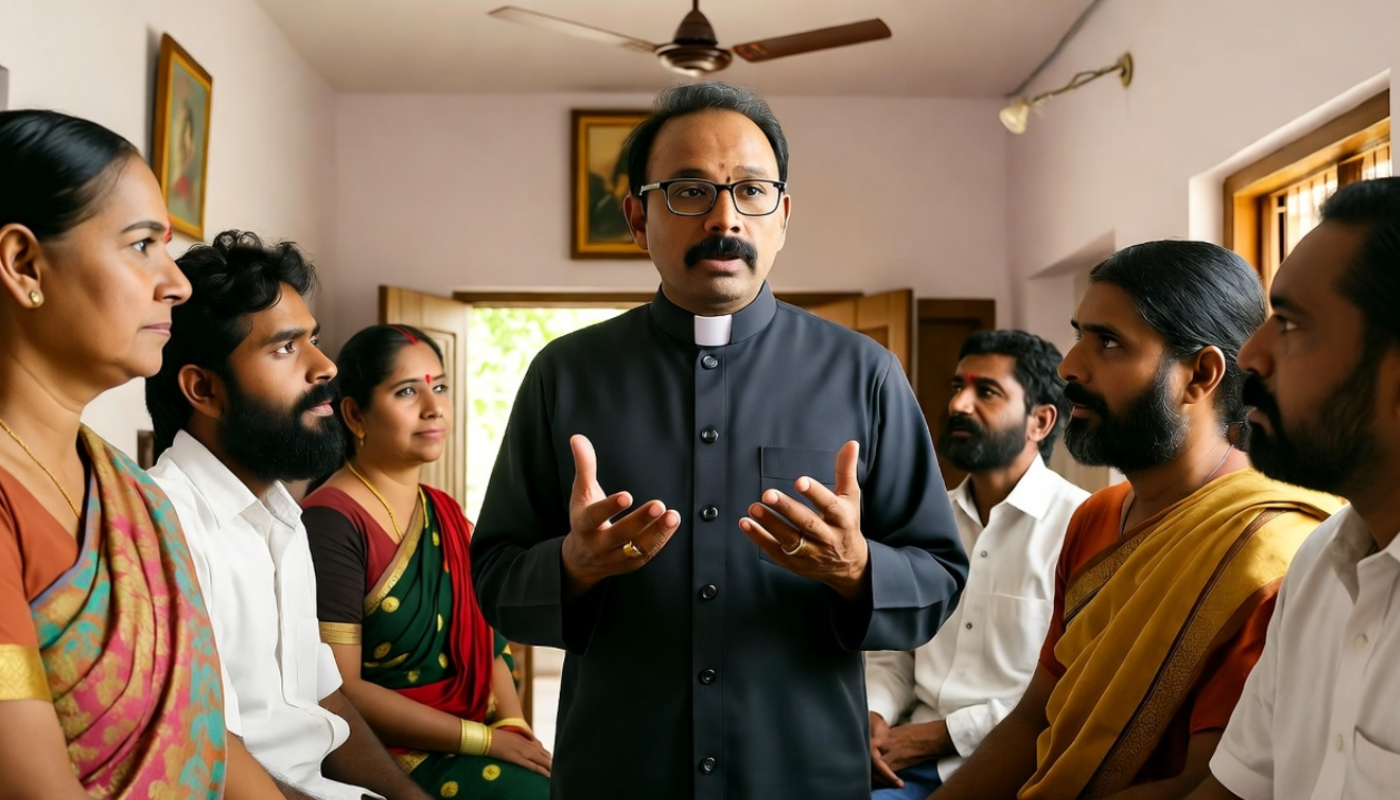
Case Summary
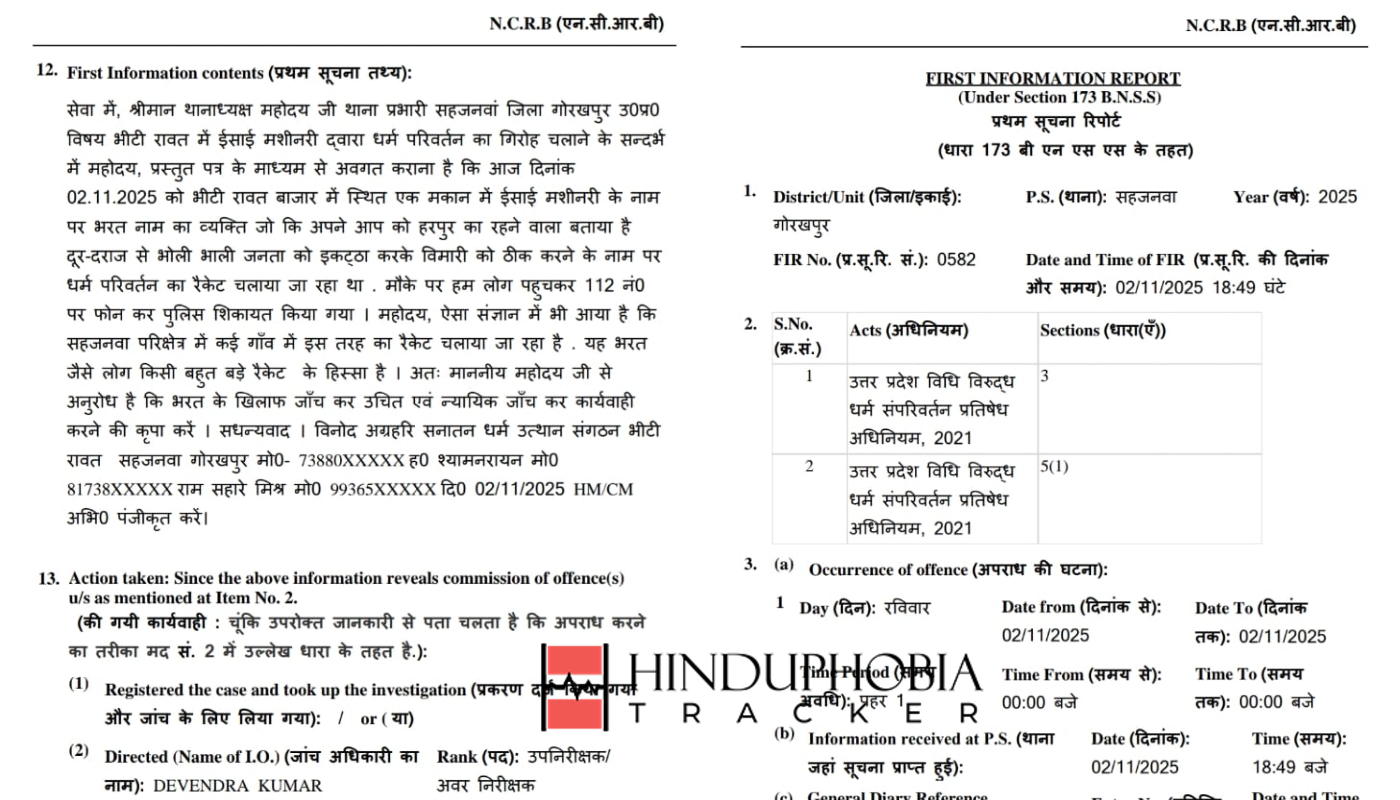
Hindus were being converted under the garb of a healing meeting in Bhagoura village in Sahjanwa, Gorakhpur, Uttar Pradesh. On 02 November 2025, more than a dozen people were gathered inside a house where outsiders had come and begun a prayer-style programme. On receiving information, local Hindu organisations reached the spot and objected. Slogans were raised an argument took place before Sahjanwa police arrived and controlled both sides. A complaint was filed by Ramsahare Mishra of Bhitirawat later that day. On 03 November 2025, police arrested Bharat of Harpur Budhat for orchestrating this conversion attempt. His mobile call records were being examined, and police also started searching for his accomplices. Police booked Bharat under the state anti-conversion law and other sections and sent him to jail. Those inside the house claimed it was only a healing activity for illness and not a religious ritual.
Case Images
Why it is Hate Crime ?
The primary category in this case is: Predatory Proselytisation. The first subcategory under this is: Conversion/ attempts to convert by inducement. Predatory Proselytisation is not just limited to threat, harassment, force and violence, but it also has contours of stealth. In several cases, the Hindu victim is exploited to convert, with non-Hindus taking advantage of their poverty. In such cases, the Hindu victim who is suffering financially is offered monetary benefits, including lucrative offers for jobs, health treatment, education, etc, to induce the victim into changing his/her religion. In such cases, the religious identity of the victim and the aim to disenfranchise him from his faith form the heart of the crime. Also, taking advantage of and exploiting an individual’s economic vulnerabilities is widely acknowledged as exploitation, forms of which are often penalised by law. Such cases therefore are considered religiously motivated hate crimes since the victim’s religious identity forms the very heart of the crime itself. The second subcategory under this is: Proselytisation by grooming, brainwashing, manipulation or subtle indoctrination. Religious brainwashing essentially means the often subtle and forcible indoctrination to induce someone to give up their religious beliefs to accept contrasting, regimented ideas. Religious grooming or brainwashing also involves propaganda and manipulation. It involves the systematic effort, driven by religious malice and indoctrination, to persuade “non-believers’ to accept allegiance, command, or doctrine to and of a contrasting faith. Cases of such grooming or brainwashing are far more nuanced than direct threats, coercion, inducement and violence. In such cases, it is often seen that there is repeated, subtle and continual manipulation of the victim to induce disaffection towards their own faith and acceptance of the contrasting faith of the perpetrator. While subtle indoctrination is widely acknowledged as predatory, an element which is often understated in such conversions or the attempts of such conversion is the role of loyalty and trust which might develop between the perpetrator and the victim. Fiduciary relationships are often abused to affect such religious conversion. For example, an educator transmitting religious doctrine of a competing faith to a Hindu student. The Hindu student is likely to accept what the teacher is transmitting owing to the existence of the fiduciary relationship. The exploitation of the fiduciary relationship to religiously indoctrinate victims would also be included in this category. Since the underlying animosity towards the victim’s faith forms the basis of predatory proselytization, such cases are considered religiously motivated hate crimes. This case has been added to the Hinduphobia tracker because this was not a normal prayer meeting or a normal religious event. It was a clear example of a conversion attempt being carried out secretly inside a Hindu house, while pretending that it was only a healing or faith cure session. Such attempts are not accidental. These attempts work specifically on the weakest point of the Hindu victim. Here, the victims were approached when they were already seeking help and relief from their problems. The group that came from outside tried to take advantage of that situation. This is the very pattern seen in predatory proselytisation. This makes it a hate crime against Hindus because the entire intention of the activity was to make Hindus leave their religion. The victims were targeted directly because they were Hindu. That is the definition of a religiously motivated crime. These are not open debates or fair discussions. These are planned strategies to slowly break the confidence of a Hindu victim and plant a different religious belief system inside them. The aim is to disconnect the Hindu from his or her own tradition, practices, and gods, and attach them to a different faith without them even noticing how it happened. Such cases are not violent in a physical way, but they are deeply violent towards religious identity. The perpetrator does not show respect for Hindu belief or Hindu tradition. The perpetrator does not approach a Hindu as an equal. Instead, the perpetrator sees the Hindu only as someone to be converted. This is what makes the act hateful. The Hindu identity of the victim is treated as something that should be replaced and erased. Also, this is a form of exploitation, because it uses the weakness of the victim. When a Hindu is poor, or sick, or troubled, they are more vulnerable. These conversion agents wait exactly for these moments. They know when a Hindu is most likely to listen and most likely to follow. Instead of helping the Hindu honestly, they try to reshape his or her religious identity. This is why the case deserves to be tracked. It shows how conversion mafias attempt to change the religious identity of Hindus quietly, secretly, and by emotional exploitation. It is important to record such cases so that people understand that hate crimes against Hindus are not only violent street attacks. Hate crimes also take place inside houses, in quiet rooms, in the form of deceit, manipulation, and covert conversion. Disclaimer: The case mentions that more than a dozen individuals were baptised by the accused, but does not provide an exact number. For documentation purposes, we have conservatively kept the victim count as 12 in the database.
Victim Details
Total Victim
12
Deceased
0
Gender
- Male 0
- Female 0
- Third Gender 0
- Unknown 12
Caste
- SC/ST 0
- OBC 0
- General 0
- Unknown 12
Age Group
- Minor 0
- Adult 0
- Senior Citizen 0
- Unknown 12


Case Status
Arrested


Perpetrators Details
Perpetrators
Christian Extremists
Perpetrators Range
One Person
Perpetrators Gender
male
 Sources




