Hindu priest assaulted and deities abused at ancient Kali temple by Muslim man objecting to Bhajan
 Lalitpur, Uttar Pradesh, India
  27 October, 2025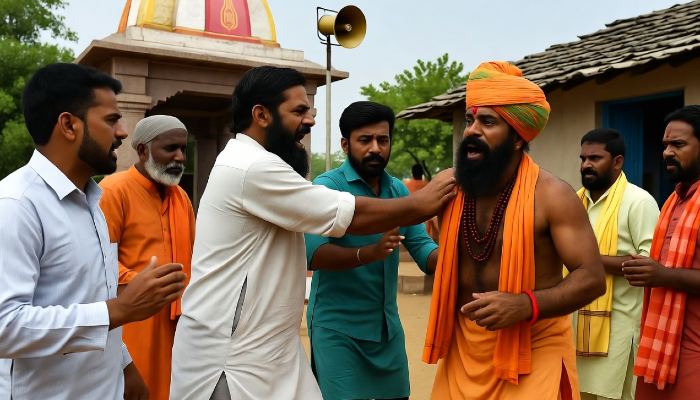
Case Summary
A Hindu priest was assaulted, and Hindu gods and goddesses were insulted by a Muslim man in Sindhpur village under the Talbehat police station area of Lalitpur district, Uttar Pradesh. The incident occurred on the evening of 28 October 2025 at the ancient Kali temple when a local Muslim man, identified as Fakhruddin Master, objected to the temple’s loudspeaker during a bhajan (devotional singing) session. When the priest, Thakur Prasad Gupta, refused to stop the microphone, Fakhruddin forcibly dragged him outside the temple, beat him on the road, and hurled profanities along with derogatory remarks against Hindu deities. Hearing the commotion, nearby residents rushed to the spot and intervened to end the altercation. The assault deeply angered devotees, leading to widespread outrage in the locality. Later that evening, several members of the Hindu community, including the priest and local leaders such as Vishnu Mishra, Babul Gupta, Lalla Tripathi, Kishan Mishra, and others, reached the Talbehat police station demanding strict action against the accused. The police registered a case against Fakhruddin under relevant sections of the Indian Penal Code for assault and disturbing communal harmony. He was arrested and taken into custody for interrogation. Authorities assured residents that legal proceedings would be carried out strictly and urged them to maintain peace. The incident triggered resentment among the Hindu community, who emphasised that such attacks on temples and devotees during prayers were an assault on their faith and an attempt to disturb social harmony. Locals demanded that security be increased around religious sites to prevent similar incidents in the future.
Why it is Hate Crime ?
The primary category in this case is: Attack not resulting in death. The first subcategory under this is: Attacked for Hindu identity. In several cases, Hindus are attacked merely for their Hindu identity without any perceived provocation. A classic example of this category of religiously motivated hate crime is a murder in 2016. 7 ISIS terrorists were convicted for shooting a school principal in Kanpur because they got ‘triggered’ seeing the Kalava on his wrist and tilak that he had put. In this, the Hindu victim had offered no provocation except for his Hindu religious identity. The motivation for the murder was purely religious, driven by religious supremacy. Such cases where Hindus are targeted merely for their religious identity would be documented as a hate crime under this category. The second subcategory under this is: Attack against Hindu devotees. Hindu devotees are a few of the easiest targets of religiously motivated hate crimes because during the festival/procession/puja etc, for non-Hindus it is easy to profile their victims on the basis of religion. Hindu devotees come under attack on several occasions by individual non-Hindus or mobs of non-Hindus owing to their animosity against Hinduism, its symbols and tradition/practices. There are several instances of Hindu devotees being attacked while they worship in temples or temporary religious structures, during religious processions, doing bhajan/kirtan/puja in their own homes, in the residential society etc. These attacks are perpetrated by non-Hindus primarily because of their animosity towards Hindus and their faith. In some cases, the trigger for the violence may be non-religious, however, there are two elements that make these hate crimes. First, the Hindus who come under attack are attacked violently while indulging in religious activity. Whether they are in a place of worship or not is immaterial to the crime. When individuals are attacked while indulging in religious practices, the attack in itself is a hindrance to their freedom to practice religion and therefore constitutes a hate crime. Secondly, religious supremacist doctrines and ideologies deem religious practices of Hindus to be offensive ab initio since they are considered “sinful” by these ideologies, worthy to be annihilated by force or coercion. Driven by these religious supremacist ideologies and doctrines, the attacks against Hindu devotees stem from intrinsic animosity towards Hinduism. In some cases, the trigger for the violence may be non-religious, however, it develops into a religiously motivated crime during the course of the violence. Since these attacks stem from animosity towards Hindus and Hinduism, they are considered religiously motivated hate crimes under this category. Another primary category in this case is: Hate speech against Hindus. The subcategory under this is: Anti-Hindu slurs, mocking faith. Anti-Hindu slurs and the deliberate mocking of the Hindu faith owing to religious animosity involve the usage of derogatory terms, stereotypes, or offensive references to religious practices, symbols, or figures. One of the common anti-Hindu slurs used against Hindus is “cow-worshipper” and “cow piss drinker”. The intention of using this term is to demean and mock Hindus as a group and their religious beliefs since Hindus consider the cow holy. Additionally, some symbols and the slurs attached to them have a historical context that exacerbates the insult, hate, stereotyping, dehumanisation and oppression against Hindus. Cow worship has been used for centuries to denigrate Hindus, insult their faith and oppress Hindus specifically as a religious group. There has been overwhelming documentation about how cow slaughter has been used to persecute Hindus with cow meat being thrown in temples and places of worship. There has also been overwhelming documentation where cow meat (beef) has been force-fed to Hindus to either forcefully convert them to Islam or denigrate their faith. Apart from cow worship, the Swastika – which holds deep religious significance for the Hindus – has also been misinterpreted and distorted to use as a slur against Hindus. Similarly, the worship of the Shivling has been used by supremacist ideologies and religions to denigrate Hindus owing to religious animosity. Such slurs and denigration stem out of inherent animosity and hate towards Hindus and their faith, therefore, it is categorised as hate speech targeted at Hindus specifically owing to their religious identity. The other category added here is- Attack on Hindu religious representations, and within this, the subcategory selected is- Defiling religious customs. Sanatan Dharma is not a religion of one book, which is to say that while it has religious scriptures that form the central tenets of the faith, there are several traditions followed through thousands of years, mostly passed from generation to generation orally. There are several such customs and traditions that are followed by various Hindus and Hindu sects. Defiling of these traditions and customs is a breach of an individual or group’s religious practices. Such practices can range from dietary restrictions like not eating non-vegetarian food for a certain period of the year, not eating non-vegetarian food at all, not eating beef since the cow is considered holy in Hinduism, the sanctity of religious customs followed in the house (like many ISCKON devotees), etc. Any malicious action leading to the breach of such traditions or defilement of these traditions owing to animosity towards the faith or for the sake of activism stems not only from the lack of faith in the religion itself but also from disregard for the faith of the devotees who follow the customs/traditions and implicit bias against the faith, the tradition itself. Since these specific traditions are central to the faith of the devotees of that specific sect of Hindus, any non-compliance with these traditional rules would be considered a religiously motivated hate crime. This case has been entered into the Hinduphobia Tracker because it reflects a clear instance of religiously motivated aggression against a Hindu priest and the Hindu faith itself. The assault on the priest, Thakur Prasad Gupta, inside the ancient Kali temple of Sindhpur village, Lalitpur, cannot be reduced to a personal quarrel or a dispute over noise. It was an act of hostility rooted in intolerance toward Hindu worship and symbolism. The accused, identified as Fakhruddin Master, a Muslim man, intruded upon a sacred space during a bhajan session and demanded that the devotional singing be stopped. When his demand was refused, he resorted to physical assault and uttered abusive and derogatory remarks against Hindu gods and goddesses. The choice of target, the site of the attack, and the language used all point to a deliberate act of desecration aimed at humiliating the Hindu community and its religious identity. The priest, as a religious figure conducting devotional activity, was attacked precisely because of his Hindu identity and his role in leading prayer. Such attacks represent a wider pattern of animosity wherein Hindus engaged in open expressions of faith become visible targets of religious hostility. The fact that the assault occurred inside a temple amplifies its significance, as it was not only an assault on a person but also an intrusion into a place of worship. The temple, as a symbol of faith and collective devotion, was violated in a manner that sought to intimidate worshippers and assert religious dominance. The outrage that followed among local residents and devotees was therefore not merely emotional but a response to an act perceived as an attack on their collective dignity and spiritual autonomy. The incident is also a case of an attack against Hindu devotees since it occurred inside a temple, turning what should have been a peaceful religious gathering into an occasion of violence and desecration. The assault was not provoked by any individual wrongdoing but by visible signs of Hindu devotion, the sound of bhajan and the presence of a priest performing his duties. Such visibility of faith often becomes the reason for persecution, reflecting a deeper ideological disdain toward Hinduism and its practices. The verbal abuse directed at Hindu deities adds another layer of hate speech to the crime. The offender’s use of anti-Hindu insults was not incidental but part of a broader pattern of mockery and contempt aimed at Hindu beliefs and symbols. This kind of speech, when coupled with violence, transforms an assault into a hate crime because it expresses deep-seated animosity and a desire to demean the faith itself. The derogatory remarks made during the attack mirror the historical use of slurs and ridicule to denigrate Hindu practices, suggesting that the motivation stemmed from religious prejudice rather than personal animus. Furthermore, the assault occurred inside a sacred space during an active act of worship, directly violating the sanctity of the temple and the freedom of devotees to perform their religious rites without disturbance. The priest was engaged in bhajan, a devotional practice central to Hindu worship, when the accused not only interrupted the ritual but also used force against the priest and hurled derogatory remarks against Hindu deities. Importantly, the bhajan was being played within the temple premises and did not cause any disturbance to outsiders. The act of aggression was therefore completely unprovoked, suggesting that the objection to the devotional singing was not out of genuine inconvenience but rooted in religious intolerance and animosity toward Hindu practices. Such actions go beyond physical assault; they represent a deliberate desecration of religious observance and space. By objecting to the temple’s devotional singing, dragging the priest out during worship, and insulting Hindu gods, the accused disrespected the core tenets of Hindu ritual purity and sanctity. In Hindu tradition, the temple and its ongoing worship are considered embodiments of the divine presence, and disrupting or defiling them through violence or abuse is viewed as a grave affront to the faith itself. Therefore, this act is not merely an individual altercation but a targeted violation of Hindu religious customs and sacred practice, intended to humiliate both the deity and the devotee community. This event, therefore, qualifies as a hate crime against Hindus because it satisfies every defining condition of religiously motivated hostility: the victim was targeted due to his religious identity, the setting was a Hindu temple, the act was accompanied by verbal denigration of the Hindu faith, and the aftermath revealed widespread fear and resentment among the community. The attack on the priest was symbolic of a broader effort to silence Hindu expression and intimidate those who practise their religion publicly. By attacking a priest and mocking Hindu deities, the perpetrator not only inflicted physical harm but also sought to undermine the sanctity of Hindu worship itself. This layered assault on faith, identity, and dignity is what makes this case a textbook example of a hate crime motivated by Hinduphobia.
Victim Details
Total Victim
1
Deceased
0
Gender
- Male 1
- Female 0
- Third Gender 0
- Unknown 0
Caste
- SC/ST 0
- OBC 0
- General 0
- Unknown 1
Age Group
- Minor 0
- Adult 1
- Senior Citizen 0
- Unknown 0


Case Status
Arrested


Perpetrators Details
Perpetrators
Muslim Extremists
Perpetrators Range
One Person
Perpetrators Gender
male
 Sources




