Hindu organisation subjected to abusive, threatening, and derogatory remarks by Muslim man in Madhya Pradhesh
 Chhatarpur, Madhya Pradesh, India
  28 October, 2025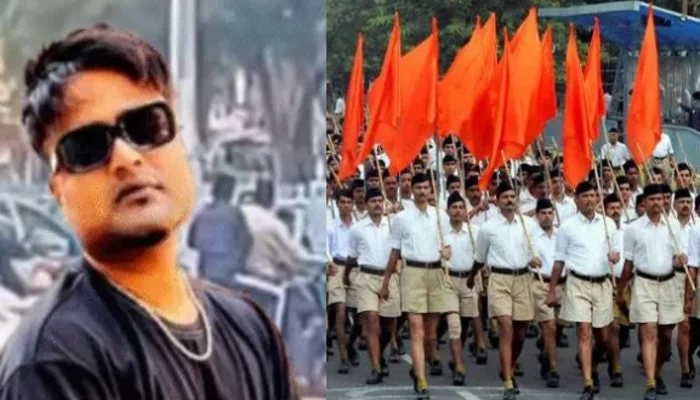
Case Summary
In Chhatarpur, Madhya Pradesh, the Rashtriya Swayamsevak Sangh (RSS), a reputable Hindu organisation, was subjected to abusive, threatening, and derogatory remarks by a Muslim man named Farhan Nizami. The incident took place near the Babulal Chaturvedi Stadium, where an RSS shakha (branch meeting) was underway on 29 October 2025. Farhan recorded a video in which he was abusing the RSS, calling it “a bunch of donkeys” and “assholes.” Farhan mocked the RSS members conducting the shakha (meeting), saying, “Look, brother (calling to Muslim brothers), this RSS gang is leaving. We came here, and a shakha was going on. They ran away after seeing us.” He also claimed that he felt like hitting them with slippers, while expressing anger and contempt towards the organisation and its members, questioning, “What have they done for the country? They did not fight for independence.” He then issued a rhetorical threat to wipe them out, saying, “Waqt aane do, naam aur nishan mita diya jayega” (Let the time come, their name and trace will be erased), implying complete eradication of the organisation and its workers. Farhan later uploaded this video to social media, after which the video went viral. Farhan's use of obscene and threatening language drew immediate outrage. Members of the Vishwa Hindu Parishad (VHP), Bajrang Dal, and RSS approached the Civil Lines police station and filed a complaint. Subsequently, the police registered a case under sections 2023, 296, and 353(2) of the Indian Penal Code along with relevant provisions of the Information Technology (Amendment) Act. Police confirmed that the accused was arrested. According to VHP departmental minister Prakhar Bhatt, the incident occurred during the regular branch meeting held at the stadium, when Farhan arrived armed with weapons, abused the RSS workers, and even issued death threats.
Why it is Hate Crime ?
This case has been added to the tracker under the primary category of - Hate speech against Hindus. Within it, the sub-category selected is - Anti-Hindu slurs, mocking faith. Anti-Hindu slurs and the deliberate mocking of the Hindu faith owing to religious animosity involve the usage of derogatory terms, stereotypes, or offensive references to religious practices, symbols, or figures. One of the common anti-Hindu slurs used against Hindus is “cow-worshipper” and “cow piss drinker”. The intention of using this term is to demean and mock Hindus as a group and their religious beliefs since Hindus consider the cow holy. Additionally, some symbols and the slurs attached to them have a historical context that exacerbates the insult, hate, stereotyping, dehumanisation and oppression against Hindus. Cow worship has been used for centuries to denigrate Hindus, insult their faith and oppress Hindus specifically as a religious group. There has been overwhelming documentation about how cow slaughter has been used to persecute Hindus with cow meat being thrown in temples and places of worship. There has also been overwhelming documentation where cow meat (beef) has been force-fed to Hindus to either forcefully convert them to Islam or denigrate their faith. Apart from cow worship, the Swastika – which holds deep religious significance for the Hindus – has also been misinterpreted and distorted to use as a slur against Hindus. Similarly, the worship of the Shivling has been used by supremacist ideologies and religions to denigrate Hindus owing to religious animosity. Such slurs and denigration stem out of inherent animosity and hate towards Hindus and their faith, therefore, it is categorised as hate speech targeted at Hindus specifically owing to their religious identity. The other sub-category relevant here is - Violent threats. Violent threats, explicit, implicit or implied, is the most dangerous form of hate speech since it goes beyond discriminatory and prejudicial language to express the intent of causing harm to an individual or a group of people based on their religious identity and faith. There could be several different kinds of threats that are issued to Hindus based on religious animosity. An explicit threat would mean the direct threat of violence towards an individual Hindu, a group of Hindus or Hindus at large. Physical violence, death threats, threats of destruction of property belonging to Hindus and threats of genocide would mean explicit threats against Hindus for their religious identity. Implicit threats may not be a direct threat but implied through the use of symbols of actions – for example – in the Nupur Sharma case, other than explicit threats, there were also implicit threats when Islamists took to the streets to burn and beat her effigies. It implies that they want to do the same to Nupur Sharma – thereby is considered an implicit threat. Violent threats can be delivered in person, through letters, phone calls, graffiti, or increasingly through social media and other online platforms. It would be important to understand that a threat – explicit or implicit, online or offline – to an individual who happens to be a Hindu does not qualify as a religiously motivated threat. Such a threat, while vile and dangerous, could be owing to non-religious reasons and/or personal animosity. To qualify as a religiously motivated threat, it would need to exhibit an indication that the individual is being targeted for religious reasons and/or owing to his/her religious identity as a Hindu. This case represents a clear instance of anti-Hindu hate speech and ideological hostility directed towards a Hindu organisation and, by extension, the Hindu community. The accused, Farhan Nizami, filmed a video in which he hurled abusive and threatening remarks against the Rashtriya Swayamsevak Sangh (RSS). It is essential to note that the RSS is a Hindu organisation founded on the ideology of Hindutva — a political, cultural, and civilisational movement aimed at protecting Hinduism from anti-Hindu forces such as Islamist fundamentalism, Khalistani extremism, aggressive Christian proselytisation, and left-liberal or Marxist ecosystems that promote anti-Hindu narratives. The ideology of Hindutva is not one of violence or suppression; it stands for unity, strength, and self-defence. It encourages Hindus, across caste and class lines, to unite in preserving their faith, dignity, and cultural identity. Firstly, Farhan approached an ongoing RSS shakha armed with weapons, with the deliberate intent to disrupt the gathering. He used profane and aggressive language, mocking the participants and questioning their contribution to the country. His video not only insulted the RSS but also displayed open contempt and hatred for its members. Such conduct reflected not spontaneous anger but a premeditated act meant to demean and provoke those associated with a Hindu organisation engaged in peaceful activity. Secondly, Farhan’s hatred towards the RSS and its members was not because of any personal or specific grievance or incident involving the RSS. His animosity stemmed from what the RSS represents - the collective assertion of Hindu identity and unity. RSS symbolises the cultural and religious identity of millions of Hindus. It is pertinent to note that Muslim extremists harbour specific animosity towards Hindus and their faith and also view India as a Hindu collectivity. The very basis of the partition of India was that the Muslims believed that Islam was a nation unto itself, which could not survive with a Hindu collectivity like India. RSS represents that Hindu collectivity, which the Muslim accused opposed and hated. Thus, Farhan's speech was not random but borne out of animosity towards Hinduism or anything that represents Hinduism. Therefore, the accused’s remarks reveal an ideological intolerance towards Hinduism itself. By targeting the RSS, he targeted the broader Hindu cause, reflecting a mindset that views Hindu assertion as a threat. Thirdly, Farhan's explicit threat, “Waqt aane do, naam aur nishan mita diya jayega” (“Let the time come, their name and trace will be erased”), signified not mere opposition but a call for eradication or genocide. It was a violent declaration of intent to erase a Hindu organisation and those associated with it. Such rhetoric cannot be dismissed as casual abuse; it is hate speech that seeks to intimidate, silence, and terrorise individuals because of their religious identity and beliefs. Fourth, speeches and videos of this nature can contribute to the normalisation of hostility towards Hindus and their organisations. Such videos can foster a climate where hatred, mockery, and threats against Hindu organisation and their members, even leading to violence against them. Such statements actively stigmatise Hindus for practising their faith, participating in cultural organisations, and promoting social discipline within their communities. This vilification constitutes hate speech because it maligns an entire religious community and encourages discrimination against Hindus based on their faith. This case, therefore, stands as a textbook example of hate-motivated targeting of a Hindu institution and ideology. In recent times, social media has increasingly become a platform for anti-Hindu hate, with derogatory memes, videos, and messages targeting Hindu religious symbols, practices, and deities. Such content is recognised as part of a broader pattern of Hinduphobia and religious hate crimes online. This deliberate targeting of Hindu organisation firmly establishes this act as a religiously motivated hate crime; therefore, it is being categorised under the hate crime database.


Case Status
Arrested


Perpetrators Details
Perpetrators
Muslim Extremists
Perpetrators Range
One Person
Perpetrators Gender
male
 Sources




