Minor Hindu girls coerced to abandon faith by Muslim teacher; forced to worship Allah and refrained for appying Tilak and wearing Kalava
 Rampur, Uttar Pradesh, India
  26 October, 2025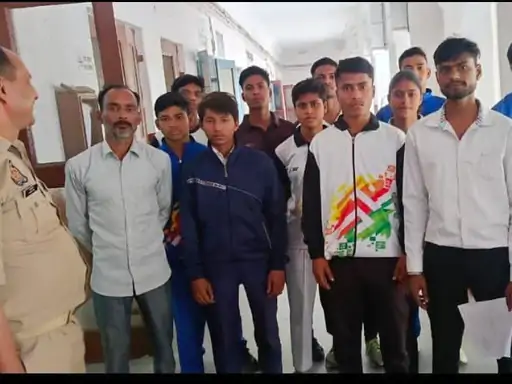
Case Summary
A Muslim coach in Rampur, Uttar Pradesh, coerced Hindu trainee girls to abandon their faith and follow Islamic practices. The accused, identified as Mohammad Faheem, a Khelo India coach, instructed the girls to worship Allah and refrain from performing Hindu customs such as applying Tilak, wearing Kalava (sacred thread), or observing religious fasts. The complaint, lodged by Radheshyam of Sai Vihar Colony and Prince Rajput of Mundia Kheda, stated that the coach created a hostile and discriminatory environment at Bamanpuri Stadium, where he trained under the Khelo India programme. Radheshyam stated that his 17-year-old daughter, Gungun, had been training under Faheem for nearly three years and faced continuous religious and caste-based bias. According to him, Faheem regularly told the children that “there is no God, only Allah should be worshipped,” and forcibly removed or wiped off any tilak or kalava seen on Hindu students. Parents also stated that Faheem used abusive, casteist remarks and mentally harassed students who refused to conform to his demands. Those who declined to renounce their faith or adopt Islamic practices were reportedly denied proper training and subjected to humiliation. The families sought immediate action against the coach and demanded that the authorities appoint a new trainer to ensure the safety and dignity of the children. Coach Mohammad Faheem denied all allegations, calling them unfounded, and claimed that he trained all children sincerely without discrimination. The matter sparked concern among local residents, who viewed the incident as an egregious violation of religious freedom and an alarming example of coercive religious influence within a government-linked sports initiative.
Why it is Hate Crime ?
The primary category in this case is: Predatory proselytisation. The subcategory under this is: Harassment, threats, coercion for conversion. Harassment covers a wide range of behaviours of an offensive nature. It is commonly understood as behaviour that demeans, humiliates, and intimidates a person, including threats and coercion. Harassment and threats, in this case, find their root on discriminatory grounds which has the effect of nullifying a person’s rights or infringing upon his freedom to exercise his right specifically owing to the victim’s religious identity. Verbal and physical threats and psychological or physical harassment are often used against Hindu victims because they choose to practice their professed religion. Religious harassment also includes forced and involuntary conversions by harassment, threats or coercion. Coercion includes intimidatory tactics like force-feeding a Hindu victim beef to convert to another religion, forceful circumcision etc. In several cases documented, non-Hindu perpetrators or those who harbour specific animosity towards Hinduism, harass victims simply based on their religious identity. Such cases often also include harassment to ensure the Hindu victim abandons his/her professed religion and adopts the religion of the perpetrator. Such cases where Hindu victims are harassed to convert to the perpetrator’s religion are rooted in animosity towards the victim’s religious identity and are therefore documented as religiously motivated hate crimes. Another subcategory under this is: Proselytisation by grooming, brainwashing, manipulation or subtle indoctrination. The tertiary categories under this is: Conversion of minor and Pattern of targeting Hindus. Religious brainwashing essentially means the often subtle and forcible indoctrination to induce someone to give up their religious beliefs to accept contrasting regimented ideas. Religious grooming or brainwashing also involves propaganda and manipulation. It involves the systematic effort, driven by religious malice and indoctrination, to persuade “non-believers’ to accept allegiance, command, or doctrine to and of a contrasting faith. Cases of such grooming or brainwashing are far more nuanced than direct threats, coercion, inducement and violence. In such cases, it is often seen that there is repeated, subtle and continual manipulation of the victim to induce disaffection towards their own faith and acceptance of the contrasting faith of the perpetrator. While subtle indoctrination is widely acknowledged as predatory, an element which is often understated in such conversions or the attempts of such conversion is the role of loyalty and trust which might develop between the perpetrator and the victim. Fiduciary relationships are often abused to affect such religious conversion. For example, an educator transmitting religious doctrine of a competing faith to a Hindu student. The Hindu student is likely to accept what the teacher is transmitting owing to existence of the fiduciary relationship. The exploitation of the fiduciary relationship to religiously indoctrinate victims would also be included in this category. Since the underlying animosity towards the victim’s faith forms the basis of predatory proselytisation, such cases are considered religiously motivated hate crimes. Another primary category in this case is: Attack on Hindu religious representations. The subcategory under this is: Desecration of Hindu religious symbol. Icons and symbols or a religious representation of a spiritual ideal are widely revered in Hinduism. Iconography is of vital significance in the Hindu milieu. It helps connect people’s spiritual beliefs with the real world. Iconography within the Hindu faith takes several shapes and forms. Murtis are of most significance to Hindus, to which daily rituals, prayers and offerings are done. Besides the murtis, there are several other symbols which have deep significance in the Hindu faith – the Om and Swastika for example. Since these Hindu religious symbols hold paramount importance in Hinduism, any desecration of symbols, icons, murtis, religious representations and manifestations, is driven by animosity towards the faith itself which manifests itself through these murtis, icons and symbols. Therefore, any desecration of these Hindu religious symbols and representations is considered religiously motivated hate crimes under this category. Another primary category in this case is: Hate speech against Hindus. The subcategory under this is: Anti-Hindu slurs, mocking faith. Anti-Hindu slurs and the deliberate mocking of the Hindu faith owing to religious animosity involve the usage of derogatory terms, stereotypes, or offensive references to religious practices, symbols, or figures. One of the common anti-Hindu slurs used against Hindus is “cow-worshipper” and “cow piss drinker”. The intention of using this term is to demean and mock Hindus as a group and their religious beliefs since Hindus consider the cow holy. Additionally, some symbols and the slurs attached to them have a historical context that exacerbates the insult, hate, stereotyping, dehumanisation and oppression against Hindus. Cow worship has been used for centuries to denigrate Hindus, insult their faith and oppress Hindus specifically as a religious group. There has been overwhelming documentation about how cow slaughter has been used to persecute Hindus with cow meat being thrown in temples and places of worship. There has also been overwhelming documentation where cow meat (beef) has been force-fed to Hindus to either forcefully convert them to Islam or denigrate their faith. Apart from cow worship, the Swastika – which holds deep religious significance for the Hindus – has also been misinterpreted and distorted to use as a slur against Hindus. Similarly, the worship of the Shivling has been used by supremacist ideologies and religions to denigrate Hindus owing to religious animosity. Such slurs and denigration stem out of inherent animosity and hate towards Hindus and their faith, therefore, it is categorised as hate speech targeted at Hindus specifically owing to their religious identity. This case has been added to the Hinduphobia Tracker because it demonstrates a deliberate, systemic attempt at predatory proselytisation and psychological subjugation of Hindu minors through coercion, indoctrination, and religious humiliation. The Muslim coach, Mohammad Faheem, who was entrusted with the responsibility of training young athletes under the Khelo India programme, grossly abused his position of authority by exploiting the fiduciary relationship between a teacher and student to propagate his faith and demean the children’s own religion. His conduct was not an isolated act of personal prejudice but a sustained campaign of religious harassment aimed at dismantling the spiritual and cultural confidence of Hindu minors in his care. Faheem’s repeated insistence that “only Allah should be worshipped” and his explicit prohibition on wearing Tilak, Kalava, or observing Hindu fasts constitute a direct assault on the children’s freedom of belief. These symbols are central to Hindu religious expression; forcing their removal or mocking them is an act of desecration and humiliation rooted in religious hatred. By wiping off Tilaks and forbidding the wearing of Kalava, Faheem effectively desecrated sacred Hindu symbols and expressions of faith. His actions were calculated to instil shame and self-denial in the young trainees, gradually conditioning them to disassociate from their Hindu identity. This was further aggravated by the repeated use of anti-Hindu slurs, caste-based insults, and targeted humiliation of students who refused to conform. While the caste-based remarks may appear directed at the victim’s sub-identity within Hinduism, in the Abrahamic worldview, these micro-identities are irrelevant. The animus is directed toward the overarching Hindu identity itself, which is viewed as incompatible with the supremacist religious belief of the perpetrator. The use of caste-specific abuse thus served as an additional weapon to intensify the persecution of the victim’s Hindu identity, not as a separate vector of discrimination. Moreover, the victims in this case were minors. Their young age and impressionable minds made them particularly vulnerable to manipulation and psychological coercion. In such situations, the element of consent or genuine change of conscience is entirely absent. Children lack the maturity to critically evaluate religious propaganda or to comprehend the consequences of being alienated from their faith. The perpetrator exploited this vulnerability to introduce religious indoctrination under the guise of sports coaching, which adds a further layer of predation and moral corruption to his actions. This breach of trust transforms what could superficially appear as verbal coercion into a calculated act of religious grooming. Faheem’s position as a coach under a government-linked initiative such as Khelo India adds another alarming dimension to the case. A programme designed to nurture young talent and promote inclusivity was used as a platform for spreading sectarian hatred and for attempting to erode Hindu belief systems among children. The abuse of state-backed institutional authority for proselytising purposes reveals how predatory ideologies can infiltrate even public welfare structures to advance religious agendas. In sum, this case illustrates the intersection of religious coercion, institutional abuse, and the targeting of Hindu identity. The harassment was not incidental but motivated by deep-seated animosity toward Hindu beliefs and practices. The attempt to erase Hindu identity through intimidation and indoctrination is an act of religious aggression designed to impose the dominance of one faith over another. Since the actions were driven by hostility toward Hinduism and executed through coercive, manipulative, and demeaning means, this case qualifies unequivocally as a hate crime against Hindus and merits its inclusion in the Hinduphobia Tracker.


Case Status
Complaint filed


Perpetrators Details
Perpetrators
Muslim Extremists
Perpetrators Range
One Person
Perpetrators Gender
male
 Sources




