Hindu customs officer and his family brutally attacked by Muslim mob of 50 inside gated society in Sonarpur, West Bengal
 Kolkata, West Bengal, India
  24 October, 2025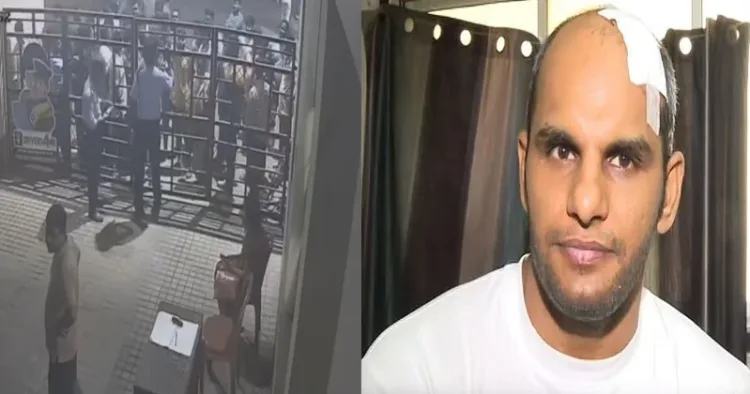
Case Summary
A Hindu man and his family were attacked by a Muslim mob in Sonarpur, South 24 Parganas, West bengal, on the evening of 23 October 2025. A group led by auto driver Azizul Gazi, reported to number between fifty and sixty people, forced their way into Tower 11 of the Deeshari Megacity condominium, broke into the fourth-floor flat of customs inspector Pradeep Kumar and beat him and his wife in front of their frightened four-year-old daughter. The incident was captured on CCTV. The violence followed an earlier traffic altercation when Kumar’s SUV clipped the three-wheeler of Azizul while trying to pass a Kali Puja immersion procession. Eyewitnesses said that on October 23, 2025, a large crowd gathered at the society gate, overwhelmed the two guards and then about fifty people scaled the security barrier and rushed to the flat. Residents said the attackers smashed the door and the collapsible gate, pushed Kumar’s wife as she tried to shield him and struck Kumar repeatedly about the head, forehead and chin. Kumar, who is originally from Uttar Pradesh, suffered head wounds and was taken for treatment to Kalyani AIIMS after local Bharatiya Janata Party (BJP) leaders and colleagues brought him in. Calls to the Sonarpur police station went unanswered at first because officers were reportedly on Kali Puja immersion duty. By the time police reached the complex forty minutes later, the attackers had fled. Both Kumar and Gazi filed complaints alleging assault and extortion against each other. Gazi was arrested on 24 October 2025 and charged with robbery, causing grievous hurt, mischief, trespass and wrongful restraint. He was released on bail the following day. Similar charges were later filed against three others, including another auto driver named Azad Ali Mondal, who was also freed within hours of their arrest on 26 October 2025. The episode drew sharp political condemnation. BJP leader Suvendu Adhikari met Kumar, disclosed the assailants as being Trinamool Congress (TMC) workers and said Gazi was close to Nazrul Ali, the husband of Sonarpur North MLA Firdousi Begum. Other BJP figures demanded answers over political protection and questioned the police response.
Why it is Hate Crime ?
The primary category in this case is: Attack not resulting in death. The subcategory under this is: Attacked for Hindu identity. In several cases, Hindus are attacked merely for their Hindu identity without any perceived provocation. A classic example of this category of religiously motivated hate crime is a murder in 2016. 7 ISIS terrorists were convicted for shooting a school principal in Kanpur because they got ‘triggered’ seeing the Kalava on his wrist and tilak that he had put. In this, the Hindu victim had offered no provocation except for his Hindu religious identity. The motivation for the murder was purely religious, driven by religious supremacy. Such cases where Hindus are targeted merely for their religious identity would be documented as a hate crime under this category. Another subcategory under this is: Attacked for opposing radicals or trying to save victim. In several cases, Hindus are attacked for opposing religiously motivated crimes being committed against a fellow Hindu or simply for voicing an opinion opposing radical elements, who either have in the past or continue to persecute Hindus. In such cases, the initial attack against the victim, against which the Hindu was trying to defend the victim, would also need to be classified as a religiously motivated hate crime. Since the initial crime itself was religiously motivated and the subsequent crime of attempting to save the victim or speaking against the radical elements ends up inviting a violent attack, it would also be classified as a religiously motivated hate crime under this category. Another subcategory under this is: Communal clash/attack. Communal clash is a form of collective violence that involves clashes between groups belonging to different religious identities. For a communal clash between Hindus and non-Hindus to qualify as a religiously motivated hate crime, the trigger of the violence itself would have to be anti-Hindu in essence. For example, if there is a Hindu religious procession that comes under attack from a non-Hindu mob and after the initial attack, Hindus retaliate in self-defence, leading to a communal clash between the two religious communities. While at a later stage, both communities are involved in the clash/violence, the initial trigger of the violence was by the non-Hindu mob against the Hindus and therefore, it could safely be termed as an anti-Hindu violence. Further, the trigger would also have to be religiously motivated. In the cited example, the attack by the non-Hindu mob was against religious processions and therefore, can be concluded to be religiously motivated. In some cases, the trigger may be non-religious, however, it develops into religious violence against Hindus at a later stage. In such cases too, the foundational animosity towards Hindus becomes the motivating factor of the crime and therefore, it would be classified as a religiously motivated hate crime against Hindus under this category. This case has been added to the Hinduphobia Tracker because it clearly reflects a pattern of religiously motivated hostility against a Hindu man and his family, disguised under the pretext of a minor altercation. The sheer scale, coordination, and brutality of the attack upon Pradeep Kumar, a Hindu customs inspector, cannot be rationally interpreted as an ordinary road rage incident. What began as a minor traffic mishap between Kumar’s SUV and an auto-rickshaw driven by Muslim resident Azizul Gazi during the Kali Puja immersion procession escalated, within hours, into a large-scale, premeditated assault carried out by a violent Muslim mob. The attack’s disproportionate nature, the choice of timing during a Hindu religious celebration, and the collective fury unleashed upon a single family unmistakably expose its communal character. The mob that descended upon Kumar’s residence was not an agitated few, but a crowd of approximately 200 men, led by Gazi, out of which fifty to sixty forced their way into a gated residential complex, broke security barriers, climbed to the fourth floor, smashed through locked doors, and launched an organised physical assault. Such actions do not arise spontaneously from an individual disagreement; they require intent, mobilisation, and a sense of collective entitlement rooted in religious identity. This was not an equal confrontation between two men but a targeted act of intimidation and punishment of a Hindu family during a sacred festival, executed by a crowd that derived strength from its shared communal identity. The timing of the assault—coinciding with the Hindu festival of Kali Puja—adds further weight to the communal dimension. Hindu festivals have increasingly become flashpoints where mobs from other communities seek to assert dominance or express contempt through physical violence and intimidation. In this case, the choice to retaliate during such a moment of cultural significance underscores the attackers’ intent to humiliate not just an individual but the community he represents. Moreover, the involvement of Pradeep Kumar’s wife, who was assaulted while trying to shield her husband from the radicals, reveals another dimension of communal cruelty. Her presence did not deter the mob; rather, it appeared to inflame them further, as if to make an example of a Hindu family that dared to resist. Such targeted aggression against a Hindu woman protecting her husband transforms the act from a spontaneous quarrel into a deliberate display of domination and terror. The mob’s composition and the later political revelations deepen the gravity of the case. Multiple reports and witness accounts identified the perpetrators as local Muslims affiliated with the ruling Trinamool Congress, many of whom were later released on bail within hours despite the severity of the charges. This leniency, coupled with the police’s delayed response due to “immersion duty,” not only reflects administrative negligence but also perpetuates a culture of impunity surrounding attacks on Hindus. The fact that a Central Government officer could be assaulted with such ferocity, inside a gated society, and that police failed to intervene for nearly forty minutes, illustrates how emboldened communal mobs have become in parts of West Bengal. This incident stands as a textbook example of a religiously motivated hate crime against Hindus. The disproportionate violence, the collective participation of a religiously homogenous mob, the timing during a Hindu festival, the assault upon the victim’s wife, and the coordinated targeting of a Hindu official within his home—all these factors combine to establish this case as a manifestation of deep-seated anti-Hindu animus. The attackers’ actions were not those of angry civilians avenging a minor traffic scrape, but of men acting with the confidence of religious dominance and political protection, intent on teaching a Hindu man his “place.” Hence, this case is documented under Attack not resulting in death, with the subcategory Attacked for Hindu identity, as well as Attacked for opposing radicals or trying to save the victim and Communal attack. The violence was not incidental but emblematic—an act that sought to intimidate a Hindu individual and his family into submission while asserting the supremacy of another communal bloc. It represents how ordinary civic disagreements in regions with tense religious demographics can mutate into full-blown communal assaults when underlying prejudices are left unchecked. Disclaimer: The number of perpetrators has been recorded as 60 because approximately sixty individuals forcibly entered the victim’s residence and directly participated in the assault. Although reports indicate that around 200 people had gathered outside the gated society, only these sixty were involved in the immediate and violent attack on the victim and his family.
Victim Details
Total Victim
2
Deceased
0
Gender
- Male 1
- Female 1
- Third Gender 0
- Unknown 0
Caste
- SC/ST 0
- OBC 0
- General 0
- Unknown 2
Age Group
- Minor 0
- Adult 2
- Senior Citizen 0
- Unknown 0


Case Status
Perpatrator released by Police


Perpetrators Details
Perpetrators
Muslim Extremists
Perpetrators Range
From 10 to 100
Perpetrators Gender
male
 Sources




