Hindu Gods mocked, Diwali callled “Garbage” and Hindus labelled as “Demonic” by Christian supremacists in Texas
 Irving, Texas, United States
  24 October, 2025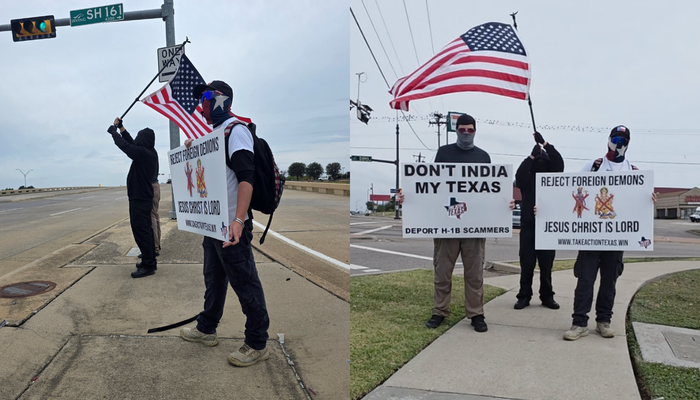
Case Summary
In Irving, Texas, a group of masked men publicly displayed banners insulting Hindu deities Vishnu and Ganesh, crossing their images and labelling them as “foreign demons.” The banners carried slogans such as “Don’t India my Texas,” “Deport H-1B Scammers,” “Reject Foreign Demons,” and “Jesus Christ is Our Lord.” The men’s actions were captured in photographs posted on X(Formerly Twitter) on 25 October 2025 by an account named ‘Take Action Texas,’ which also added a highly offensive caption referring to the Hindu festival of Diwali as “garbage.” The post stated, “In response to all the recent ‘Diwali’ garbage, we hit a couple of different spots in Irving – a city that has been ravaged by H-1B scams and massive demographic shifts due to labour imports coming from India.” The incident prompted the Coalition of Hindus of North America (CoHNAOfficial) to call on local political representatives to intervene and ensure the safety of Hindus in Irving. In a post on X, CoHNAOfficial highlighted the masked men’s promotion of Hinduphobia and hate against Indian Americans, urging the community to exercise caution while demanding that city authorities take notice and act to protect residents. The organisation emphasised that the banners and the accompanying X posts constituted a clear instance of targeted religious hostility. The ‘Take Action Texas’ account has a history of posting hostile and derogatory content targeting Hindus and Hindu festivals. In an earlier post on 22 October 2025, the account commented on a Diwali video message by Republican official Harmeet Kaur Dhillon, writing, “Diwali is a celebration of the demonic. Christ is King.” When questioned about these statements, the account further insulted the Hindu deity Ganesha, stating, “Hindus worship demons.” These incidents reflect a pattern of racism and Hinduphobia targeting Indian Americans, illustrating the increasing prevalence of anti-Hindu sentiment in Western countries, particularly on social media platforms.
Why it is Hate Crime ?
The primary category in this case is: Hate speech against Hindus. The subcategory under this is: Anti-Hindu slurs, mocking faith. Anti-Hindu slurs and the deliberate mocking of the Hindu faith owing to religious animosity involve the usage of derogatory terms, stereotypes, or offensive references to religious practices, symbols, or figures. One of the common anti-Hindu slurs used against Hindus is “cow-worshipper” and “cow piss drinker”. The intention of using this term is to demean and mock Hindus as a group and their religious beliefs since Hindus consider the cow holy. Additionally, some symbols and the slurs attached to them have a historical context that exacerbates the insult, hate, stereotyping, dehumanisation and oppression against Hindus. Cow worship has been used for centuries to denigrate Hindus, insult their faith and oppress Hindus specifically as a religious group. There has been overwhelming documentation about how cow slaughter has been used to persecute Hindus with cow meat being thrown in temples and places of worship. There has also been overwhelming documentation where cow meat (beef) has been force-fed to Hindus to either forcefully convert them to Islam or denigrate their faith. Apart from cow worship, the Swastika – which holds deep religious significance for the Hindus – has also been misinterpreted and distorted to use as a slur against Hindus. Similarly, the worship of the Shivling has been used by supremacist ideologies and religions to denigrate Hindus owing to religious animosity. Such slurs and denigration stem out of inherent animosity and hate towards Hindus and their faith, therefore, it is categorised as hate speech targeted at Hindus specifically owing to their religious identity. This case has been added to the Hinduphobia Tracker because it represents a deliberate, ideologically motivated attack on Hindu religious identity and practices through hate speech, targeting both Hindu deities and the sacred festival of Diwali. The actions of the ‘Take Action Texas’ group in Irving, Texas, were not isolated expressions of opinion but constituted a pattern of hostility aimed at denigrating Hindus, mocking their faith, and intimidating the Hindu community. By publicly displaying banners that crossed images of Vishnu and Ganesh, labelled them as “foreign demons,” and accompanied these with slogans such as “Don’t India my Texas” and “Reject Foreign Demons,” the perpetrators sought to humiliate Hindu religious symbols and assert dominance over Indian Americans practicing their faith. The deliberate insult to Diwali, calling it “garbage,” underscores the intent to degrade Hindu cultural and spiritual practices. In the Irving case, the use of masked individuals carrying banners with offensive imagery, along with the coordinated dissemination of these images and captions on social media, exemplifies an organised attempt to incite fear, mock Hindu religious identity, and denigrate sacred cultural practices. The repeated reference to Diwali as “garbage” and the derogatory labelling of Vishnu and Ganesh strike at the core of Hindu spiritual belief, which venerates these deities as manifestations of divinity and principles of dharma, virtue, and protection. Diwali, also known as Deepavali, holds profound importance for Hindus as it symbolises the victory of light over darkness, good over evil, and knowledge over ignorance. It commemorates the return of Lord Rama to Ayodhya after defeating the demon king Ravana, representing the triumph of righteousness (dharma) and virtue. The festival also celebrates the divine feminine energy through Goddess Lakshmi, who symbolises wealth, prosperity, and good fortune, and through Goddess Kali, who represents the destruction of evil forces. Diwali unites Hindu families and communities in prayer, celebration, and renewal, encouraging spiritual cleansing, positive beginnings, and harmony. The case meets the criteria for a hate crime because the perpetrators deliberately targeted Hindus on the basis of their religious identity. Anti-Hindu slurs, the mockery of faith, and offensive references to symbols such as the cow, the Swastika, and the Shivling have historically been used to demean Hindus and assert religious superiority. These practices, when replicated in contemporary contexts through social media and public demonstrations, perpetuate stereotypes, dehumanise Hindus, and foster an environment of hostility. By mocking Lord Hanuman as a “monkey god” and disparaging Diwali, the accused are attacking both the personal and collective religious identity of Hindus, undermining their freedom to worship and celebrate sacred festivals without fear. Hinduphobia Tracker has previously documented numerous cases of hate speech against Hindus and Diwali, highlighting a global trend of anti-Hindu sentiment that extends beyond India. In the United States, several high-profile instances demonstrate how Hindu religious symbols and festivals have been explicitly targeted. In August 2024, the Ashtalakshmi Temple in Sugar Land, Houston, Texas, installed a 90-foot bronze statue of Lord Hanuman, named the “Statue of Union,” which became the third-tallest statue in the United States. This statue, representing Hindu pride, heritage, and cultural identity, was subsequently mocked on social media by a Christian conservative woman named Megan Basham in October 2025, who referred to Lord Hanuman as a “monkey god.” Similarly, on 21 October 2025, Bradley Pierce, a Christian conservative constitutional attorney and Vice President of Heritage Defence, made a derogatory comment on X (formerly Twitter) in response to Diwali greetings shared by the Governor of Texas. He described the worship of Hindu deities as “false gods” and claimed it “provokes the righteous judgment of Christ upon our land.” These incidents reflect a pattern of targeted hate speech aimed at Hindus, their deities, and festivals in Western countries, demonstrating that such actions are not merely personal opinions but constitute religiously motivated antagonism. Hinduphobia Tracker documents such incidents to illustrate that anti-Hindu sentiment is not geographically confined and increasingly manifests in Western societies, including the United States. The Tracker considers these cases hate crimes because they involve deliberate targeting of Hindu religious identity, sacred symbols, and festivals, accompanied by an intent to humiliate, intimidate, or incite fear among Hindu communities. In conclusion, this case has been included in the Hinduphobia Tracker because it exemplifies a deliberate, ideologically driven attack on Hindu religious identity through hate speech, mocking sacred deities and festivals, targeting Indian American Hindus, and creating a climate of fear and intimidation. Such acts are categorically religiously motivated hate crimes against Hindus and form part of a broader pattern of transnational Hinduphobia, where hostility toward Hinduism transcends national boundaries and manifests across Western societies in both digital and physical spaces. The public defamation of Hindu deities and Diwali in Texas is not an isolated incident, but part of a wider ecosystem of global religious supremacy that views Hinduism as an alien or inferior faith. Much like the ideology of transnational loyalty to a religious collective, which sees Hindus and India as outsiders to a faith-based order, such expressions of Hinduphobia stem from a belief that non-Abrahamic religions, particularly Hinduism, have no legitimate place in societies shaped by Christian or Islamic dominance. The demonisation of Hindu deities and the rejection of Hindu cultural visibility represent the same mindset that once justified colonial and missionary attacks on Hindu civilisation — a belief that Hindu identity must be subdued, erased, or shamed wherever it asserts itself. Thus, the Irving incident is not merely local bigotry, but a manifestation of transnational Hinduphobia, where religious extremists and supremacist ideologues across continents share a common disdain for Hinduism and seek to marginalise Hindus globally through coordinated cultural, religious, and ideological hostility.


Case Status
Unknown


Perpetrators Details
Perpetrators
Christian Extremists
Perpetrators Range
N/A
Perpetrators Gender
male
 Sources




