Hindu man kidnapped, brutally assaulted and robbed in Bangladesh
 Narail District, Bangladesh
  21 October, 2025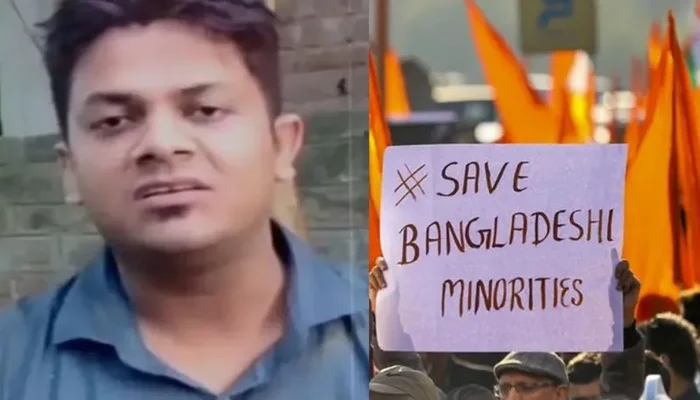
Case Summary
On October 22, 2025, in the Mauli area of Narail district in Bangladesh, Kinkor Das, a Hindu resident, was kidnapped by a group of armed men. He was subjected to severe torture. Found a day later, Das bore marks of brutal beatings, and his motorcycle, gold chain, and ring had been stolen. The Awami League shared details of the incident on X, describing it as a stark example of the escalating terror faced by Hindus in Bangladesh. They stated that Das’s abduction and torture were part of a broader pattern of systematic persecution of minorities, accusing the Muhammad Yunus-led interim government of allowing temple desecrations, idol vandalism, and targeted attacks to become routine. The party condemned the regime as an "illegitimate Jamaat-backed" administration, asserting that it had rendered justice nonexistent for minorities and questioning how a government could treat minority status as a crime. This incident occurred amidst a surge in communal violence against Hindus following the ouster of Sheikh Hasina’s Awami League government on August 5, 2024, after a student-led uprising. The Yunus-led interim government, intended to stabilise the country, faced allegations of failing to curb retaliatory attacks against Hindus, who made up roughly 8% of Bangladesh’s population and were often associated with Hasina’s secular policies. Islamist factions and mobs capitalised on the political upheaval, fueling anti-Hindu sentiment often linked to anti-India narratives and vengeance against perceived Awami League supporters. Human rights groups provided alarming statistics on the scale of the violence. The Bangladesh Hindu Buddhist Christian Unity Council recorded over 2,010 communal attacks between August 4 and 20, 2024, including assaults on 69 temples, the looting and burning of 157 Hindu properties, and the deaths of at least five Hindus, two of whom were tied to the Awami League. By mid-2025, the number of reported attacks had risen to 2,442, with Transparency International Bangladesh noting a lack of accountability in the interim government’s first 100 days, as investigations into anti-minority violence remained inadequate. A UN fact-finding mission, invited by the Yunus administration, confirmed widespread mob violence, arson, and attacks on Hindu places of worship, contradicting Yunus’s claims that such reports were exaggerated for political gain. The violence persisted beyond the initial post-uprising chaos. In December 2024, over 100 Hindu homes and businesses in Sunamganj’s Mangalgaon and Monigaon areas were vandalised and looted after unverified blasphemy allegations against a Hindu youth. The arrest of ISKCON leader Chinmoy Krishna Das on sedition charges in late 2024 further escalated tensions, with his supporters clashing with police, drawing condemnation from India and the United States. In April 2025, the abduction of Hindu leader Bhabesh Chandra Roy in Dinajpur highlighted the ongoing threat of targeted kidnappings. During Durga Puja preparations, temples faced vandalism and idol destruction, prompting the Awami League to denounce the interim government’s apparent complicity in fostering impunity. In September 2025, former Prime Minister Sheikh Hasina, exiled in India, expressed deep concern over the “multidimensional violence” against Hindus since August 2024, calling it a “horrific period of persecution” that had shocked the global community. The Awami League echoed her sentiments, alleging that the Yunus regime had made Bangladesh unsafe for all faiths, with minorities facing killings and assaults under its watch. The interim government’s response was inconsistent. While Yunus visited Dhaka’s Dhakeshwari Temple on August 13, 2024, promising equal rights for minorities, his later dismissal of the violence as overstated undermined public confidence. By December 2024, authorities acknowledged 88 cases of communal violence and made 70 arrests, but organisations like Amnesty International criticised the lack of prompt and impartial investigations. Protests by Hindu groups demanding protection erupted in Dhaka and other cities, while international figures, including US and UK lawmakers, called for stronger measures to safeguard minorities.
Why it is Hate Crime ?
This case has been categorised under the primary category- Attack not resulting in death, and within this, the subcategory selected is- Attacked for Hindu identity. In several cases, Hindus are attacked merely for their Hindu identity without any perceived provocation. A classic example of this category of religiously motivated hate crime is a murder in 2016. 7 ISIS terrorists were convicted for shooting a school principal in Kanpur because they got ‘triggered’ seeing the Kalava on his wrist and tilak that he had put. In this, the Hindu victim had offered no provocation except for his Hindu religious identity. The motivation for the murder was purely religious, driven by religious supremacy. Such cases where Hindus are targeted merely for their religious identity would be documented as a hate crime under this category. While the available details do not explicitly indicate a religious motive, the broader context cannot be ignored. When there is an ongoing ethnic cleansing based on religious identity, every crime in and of itself is assumed to be motivated by the same religious animosity, even if there is a lack of a specific religious marker in the immediate crime. During an ongoing ethnic cleansing, the dehumanisation of people based on their religious identity and the normalisation of religious hostility drive the crimes committed against them, even when there is a lack of stated religious motive. For the purpose of documenting the 2024 ethnic cleansing of Hindus in Bangladesh, the Hinduphobia Tracker is assuming religious motivation ab initio. If a case is specifically and beyond a reasonable doubt proven to be driven by motivations other than religious hostility, it will post-facto be removed from the hate crime database.
Victim Details
Total Victim
1
Deceased
0
Gender
- Male 1
- Female 0
- Third Gender 0
- Unknown 0
Caste
- SC/ST 0
- OBC 0
- General 0
- Unknown 1
Age Group
- Minor 0
- Adult 1
- Senior Citizen 0
- Unknown 0


Case Status
Unknown


Perpetrators Details
Perpetrators
Muslim Extremists
Perpetrators Range
Unknown
Perpetrators Gender
unknown
 Sources




