Hindu man abused, threatened with death and car set on fire by Muslim neighbour after argument over Diwali decorations
 Hyderabad, Telangana, India
  18 October, 2025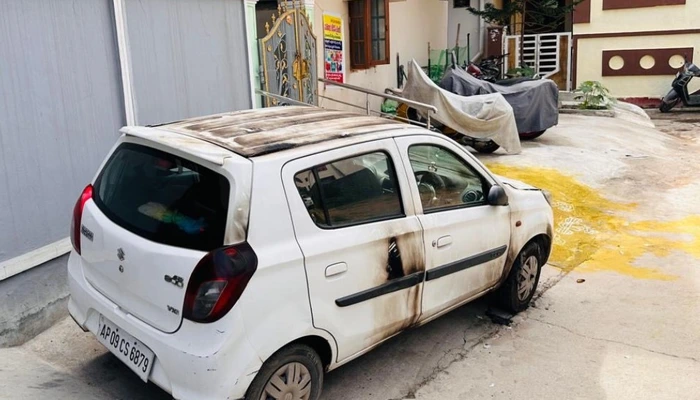
Case Summary
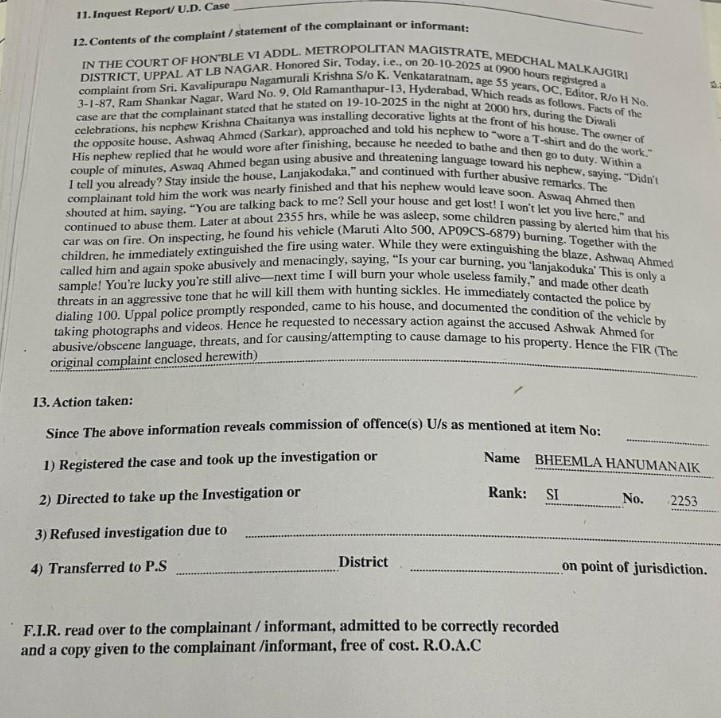
In Ramanthapur, Hyderabad, a Hindu man was abused, threatened with death, and his car was set on fire by a Muslim man following a confrontation over Diwali decorations. According to a complaint filed by Sri Kavalipurapu Nagamurali Krishna, a 55-year-old resident of Ram Shankar Nagar, the incident occurred on October 19, 2025, at approximately 8:00 PM. Krishna stated that while he and his nephew were putting up decorative lights for Diwali outside their home, a man identified as Ashwaq Ahmed from the opposite house approached and began abusing his nephew for not wearing a T-shirt and working outside. Despite being informed that the decorations were nearly complete and that he would go and bathe, Ashwaq used obscene language, shouted “Stay inside the house, Lanjakodaka" (a highly offensive and derogatory slur in the Telugu language that translates to "son of a prostitute") and threatened them. Later that night, at around 11:55 PM, the complainant’s car (Maruti Alto 800, AP09CS-6879) was found set on fire. Neighbours alerted Krishna, and he managed to extinguish the flames with the help of others. While the complainant and his family were putting out the fire, Ashwaq Ahmed reappeared, yelling, “Your car is burning, you lanjakodaka! You’re lucky you’re still alive — next time I will burn your whole useless family.” He also threatened to kill them with hunting sickles if they reported the incident. The complainant immediately informed the LB Nagar police, who visited the spot, recorded photographs and videos, and documented the damage. A formal complaint was then registered against Ashwaq Ahmed for arson, use of abusive and obscene language, criminal intimidation, and property damage. Police have initiated a probe into the incident, which occurred during Diwali preparations, and are investigating possible motives behind the attack.
Case Images
Why it is Hate Crime ?
This incident has been added under the primary category- Attack not resulting in death. Within this, the subcategory selected is- Attacked for Hindu identity. In several cases, Hindus are attacked merely for their Hindu identity without any perceived provocation. A classic example of this category of religiously motivated hate crime is a murder in 2016. 7 ISIS terrorists were convicted for shooting a school principal in Kanpur because they got ‘triggered’ seeing the Kalava on his wrist and tilak that he had put. In this, the Hindu victim had offered no provocation except for his Hindu religious identity. The motivation for the murder was purely religious, driven by religious supremacy. Such cases where Hindus are targeted merely for their religious identity would be documented as a hate crime under this category. The second category selected is- Hate speech against Hindus. Within this, the first subcategory selected is- Violent threats. Violent threats, explicit, implicit or implied, is the most dangerous form of hate speech since it goes beyond discriminatory and prejudicial language to express the intent of causing harm to an individual or a group of people based on their religious identity and faith. There could be several different kinds of threats that are issued to Hindus based on religious animosity. An explicit threat would mean the direct threat of violence towards an individual Hindu, a group of Hindus or Hindus at large. Physical violence, death threats, threats of destruction of property belonging to Hindus and threats of genocide would mean explicit threats against Hindus for their religious identity. Implicit threats may not be a direct threat but implied through the use of symbols of actions – for example – in the Nupur Sharma case, other than explicit threats, there were also implicit threats when Islamists took to the streets to burn and beat her effigies. It implies that they want to do the same to Nupur Sharma – thereby is considered an implicit threat. Violent threats can be delivered in person, through letters, phone calls, graffiti, or increasingly through social media and other online platforms. It would be important to understand that a threat – explicit or implicit, online or offline – to an individual who happens to be a Hindu does not qualify as a religiously motivated threat. Such a threat, while vile and dangerous, could be owing to non-religious reasons and/or personal animosity. To qualify as a religiously motivated threat, it would need to exhibit an indication that the individual is being targeted for religious reasons and/or owing to his/her religious identity as a Hindu. The second subcategory relevant is- Anti-Hindu slurs, mocking faith. Anti-Hindu slurs and the deliberate mocking of the Hindu faith owing to religious animosity involve the usage of derogatory terms, stereotypes, or offensive references to religious practices, symbols, or figures. One of the common anti-Hindu slurs used against Hindus is “cow-worshipper” and “cow piss drinker”. The intention of using this term is to demean and mock Hindus as a group and their religious beliefs since Hindus consider the cow holy. Additionally, some symbols and the slurs attached to them have a historical context that exacerbates the insult, hate, stereotyping, dehumanisation and oppression against Hindus. Cow worship has been used for centuries to denigrate Hindus, insult their faith and oppress Hindus specifically as a religious group. There has been overwhelming documentation about how cow slaughter has been used to persecute Hindus with cow meat being thrown in temples and places of worship. There has also been overwhelming documentation where cow meat (beef) has been force-fed to Hindus to either forcefully convert them to Islam or denigrate their faith. Apart from cow worship, the Swastika – which holds deep religious significance for the Hindus – has also been misinterpreted and distorted to use as a slur against Hindus. Similarly, the worship of the Shivling has been used by supremacist ideologies and religions to denigrate Hindus owing to religious animosity. Such slurs and denigration stem out of inherent animosity and hate towards Hindus and their faith, therefore, it is categorised as hate speech targeted at Hindus specifically owing to their religious identity. This case represents a clear instance of anti-Hindu hate and religiously motivated intimidation, carried out with the intent to humiliate, terrorise, and silence a Hindu individual for celebrating his faith. The attack occurred during Diwali, when the Hindu victim was decorating his home with lights, an integral part of Diwali rituals that symbolise the victory of light over darkness and good over evil. The Muslim accused not only verbally abused and threatened the Hindu family for decorating their home, but also used language that carried explicit religious and communal undertones. He ordered them to “stay inside,” insulted them using slurs, and demanded they sell their house and leave the locality — invoking the language of exodus, historically used to intimidate Hindus into silence or displacement from certain neighbourhoods. Hours later, he set the victim’s car on fire and returned to the scene, shouting, “Your car is burning — next time I’ll burn your whole family,” a direct threat of annihilation. The timing, target, and method of the attack reveal a pattern characteristic of religious hate crimes. It occurred on the eve of Diwali, a sacred Hindu festival, making the act both physically violent and symbolically desecrating. The arson of a Hindu household’s property, immediately after threats tied to religion, was not an impulsive act of anger, but a deliberate form of terrorism aimed at suppressing Hindu visibility and devotion. The religious supremacy evident in the attacker’s language and conduct underscores the ideological motive behind the crime. The demand that the Hindu family abandon their home and the violent follow-up illustrate a belief in religious dominance, where Hindus are made to feel unwelcome for openly observing their faith. Such acts are rooted in a supremacist mindset that seeks to assert control over shared spaces and delegitimise Hindu religious presence through coercion and fear. This attack also fits into a wider pattern observed across multiple states, where Hindus are increasingly targeted for visible expressions of faith, whether lighting diyas, bursting firecrackers, performing aarti, or holding religious processions. These incidents often begin with verbal provocation and escalate into organised physical intimidation, reflecting a deep-seated intolerance toward Hindu cultural and religious assertion. In this case, the verbal assault, the use of hate-laden threats, the deliberate arson, and the attempt to instill fear of extermination together constitute a multifaceted act of hate, combining psychological intimidation, physical destruction, and symbolic desecration. The victim was not attacked as an individual, but as a representative of a religious community exercising his right to celebrate a sacred festival. The invocation of exodus and annihilation, alongside arson and death threats, marks this as a premeditated hate crime rooted in religious hostility and supremacist ideology. It stands as a stark example of how anti-Hindu animus manifests in everyday life, turning acts of worship and joy into moments of trauma, and transforming faith into a target for violence.
Victim Details
Total Victim
2
Deceased
0
Gender
- Male 2
- Female 0
- Third Gender 0
- Unknown 0
Caste
- SC/ST 0
- OBC 0
- General 0
- Unknown 2
Age Group
- Minor 0
- Adult 2
- Senior Citizen 0
- Unknown 0


Case Status
Complaint filed


Perpetrators Details
Perpetrators
Muslim Extremists
Perpetrators Range
One Person
Perpetrators Gender
male
 Sources




