Hindu women attacked with lethal weapons, homes vandalised by a mob during Diwali
 Kalyan, Maharashtra, India
  21 October, 2025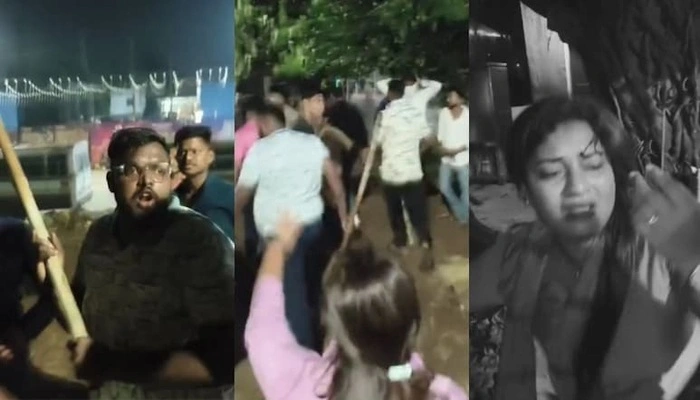
Case Summary
In Mohane village, Kalyan, an armed mob of around 60 to 70 individuals launched a violent attack over a dispute related to Diwali stalls, targeting several people, including Hindu women. Nine to ten people were gravely injured in the attack. Among the victims was Sandhya Sathe, a Hindu and an official of the Nationalist Congress Party (Ajit Pawar faction). Sathe recounted that members of the mob struck her on the head with an iron rod, leaving her injured. She also described witnessing the group vandalising Hindu homes and pelting stones at residents and even at the police, who were present at the scene. "They hit my head with a rod," the Hindu woman said. "They destroyed houses, hit someone in the chest with a stone, and struck me on the thigh. We tried to rescue people, but there were too many attackers. They were throwing stones and beating everyone. It was terrifying." The incident originated from a dispute over the purchase of firecrackers on October 22, 2022. An argument broke out when two men from Lahuji Nagar went to buy firecrackers from a stall near Mohane police station. The matter was later resolved. Around midnight, the goons from Mohane entered Lahuji Nagar with swords, iron rods, knives and other lethal weapons, vandalised homes, assaulted women, and pelted stones, injuring nine to ten people. The violence continued even in the presence of Khadkapada police at the scene. Hundreds of people continued pelting stones, vandalising properties and beating the Hindu women. Several people sustained injuries as the attackers hurled stones indiscriminately, some even targeting the police. Video footage from the site showed Sathe bleeding and another man with visible bruises on his back, illustrating the severity of the assault and the chaos that unfolded despite the police presence.
Why it is Hate Crime ?
This case has been added to the 'Undecided' database of the Hinduphobia Tracker, due to the absence of conclusive evidence establishing a clear religious motive, even though the circumstances surrounding the attack strongly resemble recurring patterns of violence against Hindus during religious festivals. Across India, targeted violence during Hindu festivals such as Diwali, Holi, Navratri, and Ram Navami has become increasingly common. These incidents often begin with seemingly minor disagreements over firecrackers, religious processions, or public celebrations, and then escalate into full-blown assaults on Hindu individuals or localities. In several documented cases, such conflicts have been weaponised to disrupt Hindu religious observances and intimidate Hindus from expressing their faith publicly. The Mohane incident follows this familiar trajectory, occurring during Diwali-related activities and resulting in disproportionate violence against Hindus. The scale and organisation of the attack in Mohane village further indicate a degree of premeditation. A mob of 60–70 individuals assembled armed with swords, rods, and other lethal weapons, and proceeded to vandalise Hindu homes, assault women, and hurl stones even in the presence of police. The use of such weapons, the coordinated movement of attackers into the Hindu-majority locality of Lahuji Nagar, and the persistence of violence despite police intervention all point to planning rather than a spontaneous clash. These factors mirror multiple documented cases where Hindu localities were systematically attacked during religious events under the guise of minor disputes. However, despite the setting and scale of the violence, there is no conclusive evidence to prove that the attack was religiously motivated. The religion of the perpetrators has not been identified, and there are no reported instances of religious slogans, threats, or statements that would confirm communal intent. Therefore, while the victims were predominantly Hindu and attacked during a religious occasion, the motivation behind the assault cannot be definitively categorised as communal or faith-driven. In light of these uncertainties, the case has been provisionally classified under the “Undecided” database. This classification recognises the serious and disproportionate nature of the attack, the clear targeting of Hindus during a festival, and the organised nature of the violence, while acknowledging that the absence of confirmed religious identity and motive prevents its categorisation as a hate crime at this stage. Should further verified information emerge, particularly regarding the background or intent of the perpetrators, this entry will be reviewed and reclassified accordingly. Disclaimer: The reports do not specify the exact number of victims and their gender composition, only stating that 9 to 10 people, including women, were injured. Hence, the victim count has been considered as 10, and we have evenly divided the count, recording 5 male and 5 female victims for the sake of consistency in documentation. Disclaimer: Reports stated that 60-100 men were involved in the attack, but do not provide an exact number. For documentation purposes, we have recorded 100 perpetrators in the database.
Victim Details
Total Victim
10
Deceased
0
Gender
- Male 5
- Female 5
- Third Gender 0
- Unknown 0
Caste
- SC/ST 0
- OBC 0
- General 0
- Unknown 10
Age Group
- Minor 0
- Adult 0
- Senior Citizen 0
- Unknown 10


Case Status
Complaint filed


Perpetrators Details
Perpetrators
Unknown
Perpetrators Range
From 10 to 100
Perpetrators Gender
male
 Sources




