Hindus attacked with sharp weapons for bursting firecrackers during Diwali in Sonepur’s Binika town
 Sonepur, Odisha, India
  19 October, 2025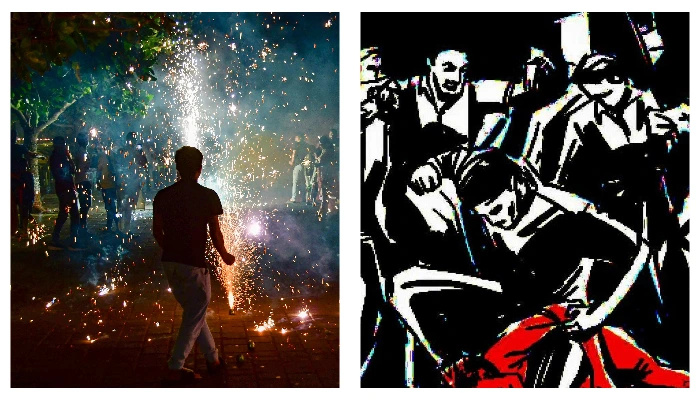
Case Summary
Diwali celebrations in Binika town of Sonepur district, Odisha, were marred with violence when on October 20th (Monday) night, Hindus were seriously attacked for bursting firecrackers. The altercation began when residents of Patikarpada attacked Hindu residents of Manoharpada, who were celebrating Diwali, leading to multiple injuries. According to reports, the attackers from Patikarpada used sharp weapons such as knives, axes, machetes, and stones, assaulting several Hindu residents, Kalia Mallik, Anamu Mallik, Raju Mallik, Bablu Mallik, and Hasina Mallik, all belonging to the Manoharpada locality. The victims sustained serious injuries and were first taken to the Binika Community Health Centre before being shifted to Burla Hospital as their condition worsened. Upon receiving information, the Binika police arrived at the scene and tried to calm the situation. However, tension continued through the night, prompting the deployment of additional police forces to prevent further escalation. Sonepur SDPO Pratap Tripathy also visited the area late October 20 (Monday) night to assess the situation, after which more personnel were stationed to restore order. By late night, the situation was brought under control, though fear and tension remained in the locality.
Why it is Hate Crime ?
The primary category selected in this case is- Attack not resulting in death. The subcategory selected is- Attacked for Hindu identity. In several cases, Hindus are attacked merely for their Hindu identity without any perceived provocation. A classic example of this category of religiously motivated hate crime is a murder in 2016. 7 ISIS terrorists were convicted for shooting a school principal in Kanpur because they got ‘triggered’ seeing the Kalava on his wrist and tilak that he had put. In this, the Hindu victim had offered no provocation except for his Hindu religious identity. The motivation for the murder was purely religious, driven by religious supremacy. Such cases where Hindus are targeted merely for their religious identity would be documented as a hate crime under this category. The other subcategory selected is- Communal Clash/Attack. Communal clash is a form of collective violence that involves clashes between groups belonging to different religious identities. For a communal clash between Hindus and non-Hindus to qualify as a religiously motivated hate crime, the trigger of the violence itself would have to be anti-Hindu in essence. For example, if there is a Hindu religious procession that comes under attack from a non-Hindu mob and after the initial attack, Hindus retaliate in self-defence, leading to a communal clash between the two religious communities. While at a later stage, both communities are involved in the clash/violence, the initial trigger of the violence was by the non-Hindu mob against the Hindus and therefore, it could safely be termed as an anti-Hindu violence. Further, the trigger would also have to be religiously motivated. In the cited example, the attack by the non-Hindu mob was against religious processions and therefore, can be concluded to be religiously motivated. In some cases, the trigger may be non-religious, however, it develops into religious violence against Hindus at a later stage. In such cases too, the foundational animosity towards Hindus becomes the motivating factor of the crime and therefore, it would be classified as a religiously motivated hate crime against Hindus under this category. This case has been added to the Hinduphobia Tracker as a clear instance of faith-based violence targeting Hindus during a religious celebration. The attack occurred on Diwali night, when Hindus from the Manoharpada locality were assaulted by residents from the nearby Patikarpada area following a dispute over bursting firecrackers. The Hindu victims were celebrating Diwali in their neighbourhood when a confrontation erupted. The accused attacked them with knives, axes, machetes, and stones.. The violence was disproportionate and unprovoked, targeting individuals who were simply observing their faith through traditional Diwali customs. The timing and context of the assault make its communal nature unmistakable. The victims were not engaged in any act of aggression or provocation; they were performing a symbolic ritual of Hindu devotion, bursting firecrackers and lighting lamps. Yet, this act of faith was met with coordinated violence, revealing a deep-seated hostility toward Hindu religious expression. The use of deadly weapons and the scale of injuries show that the intent extended beyond personal anger, but was an attempt to assert dominance and intimidate Hindus for celebrating their festival openly. Such incidents are increasingly observed in areas with heightened communal sensitivities, where Hindu celebrations become flashpoints for aggression. The unprovoked nature of the attack, the targeting of festival participants, and the collective assault by members of another community together expose the religious animosity at play, and for these reasons, the incident warrants inclusion in the tracker.
Victim Details
Total Victim
5
Deceased
0
Gender
- Male 5
- Female 0
- Third Gender 0
- Unknown 0
Caste
- SC/ST 0
- OBC 0
- General 0
- Unknown 5
Age Group
- Minor 0
- Adult 5
- Senior Citizen 0
- Unknown 0


Case Status
Complaint filed


Perpetrators Details
Perpetrators
Unknown
Perpetrators Range
Unknown
Perpetrators Gender
unknown
 Sources




