Hindu brothers brutally attacked, subjected to anti-Hindu slurs by Muslims for bursting crackers during Diwali
 Noida, Uttar Pradesh, India
  19 October, 2025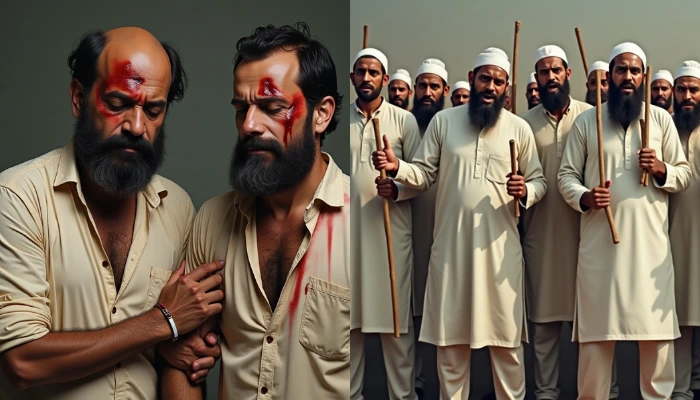
Case Summary
In Sector-9, Noida, Uttar Pradesh, two Hindu brothers, Babu Pradhan and Alla Rakha, were brutally attacked by a group of Muslim men over bursting firecrackers during the Diwali celebration. According to media reports, Babu Pradhan, who ran a dairy, said that the attack occurred around 10 p.m. On 20th October 2025, he and his associate, Kattu, were cleaning the shop, while his brother, Alla Rakha, was bursting crackers nearby. One of the firecrackers accidentally fell near a neighbouring shop belonging to a Muslim man named Ghulam Rasool. Soon after, a group of Muslim men arrived and began shouting. They opposed the fireworks and the decoration of the shop. They also hurled abuses and made derogatory religious remarks at Babu Pradhan and his family. When Pradhan tried to reason with them, the Muslim perpetrators attacked him and his brother with sticks, iron rods, and sharp weapons. Following the incident, the police were alerted, and Babu lodged a complaint against nearly twelve Muslim men on 21st October 2025. The accused were identified as Amar, Anees, Gulfam, Saddam, Mehraj, Yunus, and Munish. The police subsequently arrested five men—Gulfam, Saddam, Mehraj, Yunus, and Munish on 23rd October 2025. The police stated that several others involved in the assault had been identified, and efforts were underway to trace and arrest them.
Why it is Hate Crime ?
The primary category selected in this case is- Attack not resulting in death. The subcategory selected is- Attacked for Hindu identity. In several cases, Hindus are attacked merely for their Hindu identity without any perceived provocation. A classic example of this category of religiously motivated hate crime is a murder in 2016. 7 ISIS terrorists were convicted for shooting a school principal in Kanpur because they got ‘triggered’ seeing the Kalava on his wrist and tilak that he had put. In this, the Hindu victim had offered no provocation except for his Hindu religious identity. The motivation for the murder was purely religious, driven by religious supremacy. Such cases where Hindus are targeted merely for their religious identity would be documented as a hate crime under this category. The other subcategory selected is- Communal Clash/Attack. Communal clash is a form of collective violence that involves clashes between groups belonging to different religious identities. For a communal clash between Hindus and non-Hindus to qualify as a religiously motivated hate crime, the trigger of the violence itself would have to be anti-Hindu in essence. For example, if there is a Hindu religious procession that comes under attack from a non-Hindu mob and after the initial attack, Hindus retaliate in self-defence, leading to a communal clash between the two religious communities. While at a later stage, both communities are involved in the clash/violence, the initial trigger of the violence was by the non-Hindu mob against the Hindus and therefore, it could safely be termed as an anti-Hindu violence. Further, the trigger would also have to be religiously motivated. In the cited example, the attack by the non-Hindu mob was against religious processions and therefore, can be concluded to be religiously motivated. In some cases, the trigger may be non-religious, however, it develops into religious violence against Hindus at a later stage. In such cases too, the foundational animosity towards Hindus becomes the motivating factor of the crime and therefore, it would be classified as a religiously motivated hate crime against Hindus under this category. Another primary category selected is- Hate Speech against Hindus. The subcategory selected is- Anti-Hindu slurs, mocking faith. Anti-Hindu slurs and the deliberate mocking of the Hindu faith owing to religious animosity involve the usage of derogatory terms, stereotypes, or offensive references to religious practices, symbols, or figures. One of the common anti-Hindu slurs used against Hindus is “cow-worshipper” and “cow piss drinker”. The intention of using this term is to demean and mock Hindus as a group and their religious beliefs since Hindus consider the cow holy. Additionally, some symbols and the slurs attached to them have a historical context that exacerbates the insult, hate, stereotyping, dehumanisation and oppression against Hindus. Cow worship has been used for centuries to denigrate Hindus, insult their faith and oppress Hindus specifically as a religious group. There has been overwhelming documentation about how cow slaughter has been used to persecute Hindus with cow meat being thrown in temples and places of worship. There has also been overwhelming documentation where cow meat (beef) has been force-fed to Hindus to either forcefully convert them to Islam or denigrate their faith. Apart from cow worship, the Swastika – which holds deep religious significance for the Hindus – has also been misinterpreted and distorted to use as a slur against Hindus. Similarly, the worship of the Shivling has been used by supremacist ideologies and religions to denigrate Hindus owing to religious animosity. Such slurs and denigration stem out of inherent animosity and hate towards Hindus and their faith, therefore, it is categorised as hate speech targeted at Hindus specifically owing to their religious identity. This case has been added to the tracker as it represented a clear instance of targeted violence against Hindu brothers Babu Pradhan and Alla Rakha due to their religious identity. They were assaulted solely for observing a traditional Diwali custom—bursting firecrackers, an age-old practice symbolising joy, light, and devotion. Some may attempt to argue that the attack stemmed from a firecracker accidentally landing in the shop of the Muslim accused. Yet, if that had genuinely been the cause, the situation could have been resolved through dialogue. Instead, the Muslim accused chose to escalate the matter by mobilising a Muslim mob to assault the Hindu victims, revealing clear religious hostility. The violence arose not from an accident but from prejudice directed against an innocent religious act. The attack represented religious profiling and direct targeting of Hindus for their customs and faith. Such assaults on Hindus for practising their religion stand as clear examples of religiously motivated hate crimes. The assault was brutal, deliberate, and communal in nature. When Hindus are attacked solely for their identity, it exposes deep contempt for their faith, symbols of worship, and cultural traditions such as Diwali and the ritual of bursting firecrackers. The timing of the assault during Diwali—the Festival of Lights, one of the most sacred Hindu observances—showed that the intent went beyond physical aggression. It was meant to humiliate, intimidate, and terrorise Hindus during their celebration of faith and light. The fact that this attack occurred on such a sacred occasion revealed a calculated attempt to desecrate a moment of joy and devotion. It was not a trivial neighbourhood quarrel but an act of deliberate intimidation and religiously charged aggression against Hindus. Moreover, the perpetrators arrived armed with sticks, rods, and sharp weapons, proving that the attack was premeditated rather than spontaneous. Their preparation and coordinated violence showed an organised effort aimed at inflicting both physical and psychological harm. The aggression was grossly disproportionate to the situation—an accidental firecracker landing nearby—and made the motive unmistakably clear: hatred of Hindus and intolerance of their religious practices. The brutality of the attack turned a peaceful festival into a violent episode of hate and aggression, reflecting ingrained hostility towards the Hindu faith and traditions. The Muslim assailants objected not only to the firecrackers but also to the Diwali decorations at the victims’ shop—expressions of faith central to Hindu religious and cultural life. Attempting to prevent Hindus from performing such customs was a deliberate act to suppress their religious freedom and public expression. The violence was therefore not random; it was an attack on their Hindu identity and their right to practise their religion openly. The perpetrators further reinforced their religious bias by hurling anti-Hindu slurs and using derogatory language against Hinduism during the assault. Such verbal abuse exposed the deep-rooted animosity and intolerance the assailants held towards Hindus, serving as a motivating factor behind the violence. The attack was not provoked by a random or accidental incident involving a firecracker but was driven by pre-existing hatred towards the Hindu faith. Both victims, Babu Pradhan and his brother Alla Rakha, were specifically targeted for being Hindus and for visibly practising their religion during Diwali. Given that this incident met the parameters of a religiously motivated crime, it has been added to the hate crime database of the Hinduphobia Tracker.
Victim Details
Total Victim
2
Deceased
0
Gender
- Male 2
- Female 0
- Third Gender 0
- Unknown 0
Caste
- SC/ST 0
- OBC 0
- General 0
- Unknown 2
Age Group
- Minor 0
- Adult 2
- Senior Citizen 0
- Unknown 0


Case Status
Case sub-judice


Perpetrators Details
Perpetrators
Muslim Extremists
Perpetrators Range
From 10 to 100
Perpetrators Gender
male
 Sources




