Hindu youths brutally attacked by Muslims for celebrating Diwali with firecrackers near a madrasa in Shamli, Uttar Pradesh
 Shamli, Uttar Pradesh, India
  19 October, 2025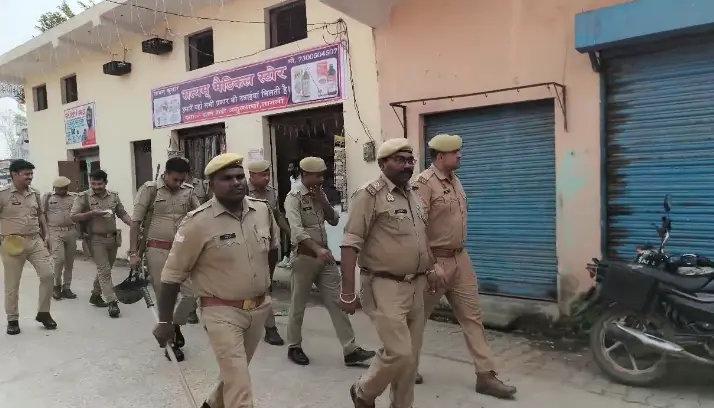
Case Summary
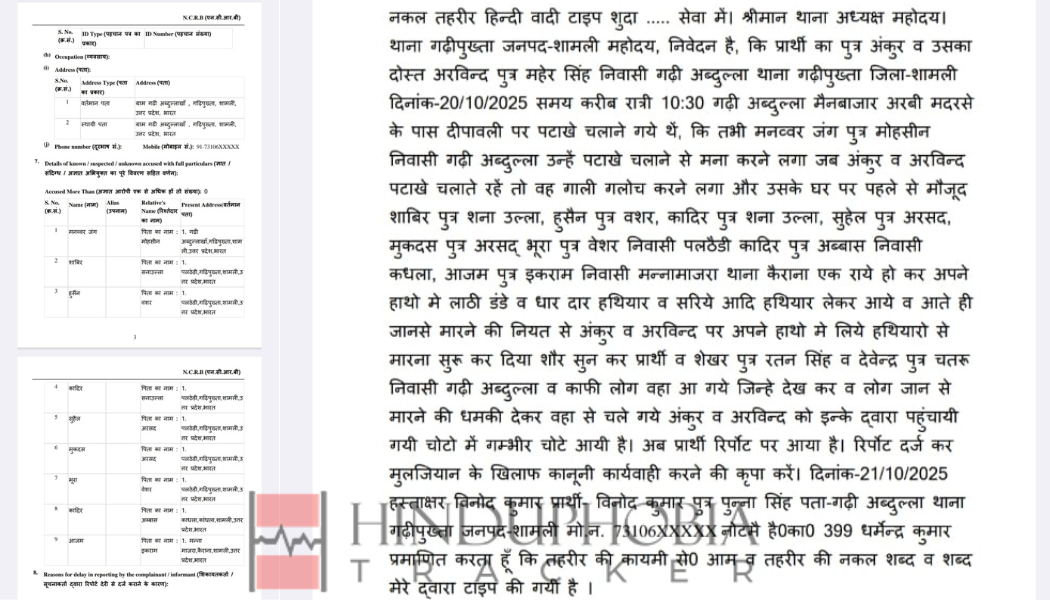
Hindus were attacked in Garhi Abdullah village under Garhi Pukhta police station in Shamli district on the night of Diwali (20 October 2025) for bursting firecrackers. The violent incident occurred around 10:30 p.m. near the Arabic madrasa in the village market when Ankur, son of Vinod Kumar, and his friend Arvind, son of Maher Singh, were celebrating the festival by lighting firecrackers. According to the complaint filed by Vinod Kumar, a local resident, a man named Manvvar Jung, son of Mohsin, objected to the firecrackers and began abusing the Hindu youths. When they continued to celebrate, several men from the Muslim community — identified as Shabir, Hussain, Kadir, Suhail, Mukkadas, Bhura, Kadir (son of Abbas), and Azam — arrived armed with sticks, iron rods, and sharp weapons. The group attacked Ankur and Arvind with the intent to kill them, inflicting serious injuries. Hearing the noise, villagers, including Vinod Kumar, Shekhar (son of Ratan Singh), and Devendra (son of Chatru), rushed to the spot. The attackers fled after threatening the witnesses with death. Both victims sustained multiple injuries and required medical attention. Following the assault, a heavy police force and PAC personnel were deployed in Garhi Abdullah to prevent escalation and maintain peace. Residents accused the local police outpost of failing to act in time despite rising tensions. The police registered a case against 9 Muslim accused under serious sections of the IPC, including attempted murder and assault, and began investigations into the communal attack that took place during the Diwali festival. The Hinduphobia Tracker team accessed the FIR, and the same has been attached.
Case Images
Why it is Hate Crime ?
The primary category in this case is: Attack not resulting in death. The subcategory under this is: Attacked for Hindu identity. In several cases, Hindus are attacked merely for their Hindu identity without any perceived provocation. A classic example of this category of religiously motivated hate crime is a murder in 2016. 7 ISIS terrorists were convicted for shooting a school principal in Kanpur because they got ‘triggered’ seeing the Kalava on his wrist and tilak that he had put. In this, the Hindu victim had offered no provocation except for his Hindu religious identity. The motivation for the murder was purely religious, driven by religious supremacy. Such cases where Hindus are targeted merely for their religious identity would be documented as a hate crime under this category. Another subcategory under this is: Attacked for crossing 'Muslim area'. One of the reasons that Hindus get attacked unprovoked specifically by Islamists is for crossing ‘Muslim areas’. Essentially, Muslim mobs often attack Hindus crossing or present in certain areas which have a majority Muslim population. It has often been cited as one of the reasons to blame Hindus for attacks against themselves, signalling that Hindus displaying religious symbols, taking our religious processions or crossing any area which is dominated by Muslim residents is a provocation in and of itself. These areas are mostly ghettoized areas where mobs mobilize quickly to attack Hindus for a variety of reasons like playing music during a religious procession, crossing a mosque, wearing a tilak or any other religious symbol in a Muslim-dominated area, praying at a local temple in that area etc. There have been cases where the few local Hindus of that area have been attacked on their way to the Temple for prayers as well, simply because the area is considered a Muslim-dominated area. Several times, it is entirely possible that the immediate trigger for the violence against Hindus was non-religious in nature, however, the violence became religiously motivated in nature because the area was Muslim dominated and the residents on the whole harboured animosity towards Hindus, evidenced from the actions of the mob, the slogans, and the nature of the attack. Such crimes are motivated by the religious identity of the victims and are therefore classified as hate crimes under this category. Another primary category in this case is: Attack on Hindu religious representations. The subcategory under this is: Defiling religious customs. Sanatan Dharma is not a religion of one book, which is to say that while it has religious scriptures that form the central tenets of the faith, there are several traditions followed through thousands of years, mostly passed from generation to generation orally. There are several such customs and traditions that are followed by various Hindus and Hindu sects. Defiling of these traditions and customs is a breach of an individual or group’s religious practices. Such practices can range from dietary restrictions like not eating non-vegetarian food for a certain period of the year, not eating non-vegetarian food at all, not eating beef since the cow is considered holy in Hinduism, the sanctity of religious customs followed in the house (like many ISCKON devotees), etc. Any malicious action leading to the breach of such traditions or defilement of these traditions owing to animosity towards the faith or for the sake of activism stems not only from the lack of faith in the religion itself but also from disregard for the faith of the devotees who follow the customs/traditions and implicit bias against the faith, the tradition itself. Since these specific traditions are central to the faith of the devotees of that specific sect of Hindus, any non-compliance with these traditional rules would be considered a religiously motivated hate crime. This case has been included in the Hinduphobia Tracker because it demonstrates a clear instance of targeted violence against Hindus for practising their religious customs and celebrating a sacred Hindu festival. The incident took place on the night of Diwali, one of the most auspicious and widely celebrated festivals in Hindu tradition, symbolising the triumph of light over darkness and dharma over adharma. The Hindu youths, Ankur and Arvind, were merely engaging in the customary act of bursting firecrackers, a ritual deeply embedded in Diwali celebrations, when they were attacked. The trigger for the assault was not any provocation or dispute of a personal nature but the expression of a Hindu religious tradition in proximity to a madrasa, a religious institution of another faith. The attackers’ objection to the bursting of firecrackers during Diwali, followed by verbal abuse and a coordinated physical attack using sticks, iron rods, and sharp-edged weapons, indicates not an accidental altercation but a deliberate act of religious hostility. Their opposition to a legitimate Hindu ritual near a Muslim religious site exposes the undercurrent of religious intolerance that often manifests as anti-Hindu violence. This attack, therefore, represents not just physical aggression but an assault on Hindu identity and religious freedom. By objecting to and violently suppressing a harmless and sacred Hindu custom, the perpetrators effectively sought to impose dominance and dictate the terms of permissible cultural expression in the area. Such acts reflect a pattern wherein Hindus are targeted for publicly celebrating or displaying their faith in or around Muslim-dominated localities. The violence also fits within the broader framework of communal animosity, where Hindu traditions, symbols, and practices are treated as provocations rather than expressions of faith. Bursting firecrackers during Diwali is not a secular pastime but a religious act symbolising the welcoming of Lord Rama and the celebration of divine victory. The attackers’ insistence that it should not be performed near the madrasa implies a deliberate attempt to restrict Hindu religious expression, thereby defiling the sanctity of Diwali observance. In addition, this case underscores how areas near religious establishments such as madrasas often become flashpoints for anti-Hindu hostility when Hindus perform rituals or festivals that visibly affirm their identity. The presence of armed assailants, the coordinated nature of the attack, and the communal undertone of the threats further reinforce that the motive was rooted in religious animus rather than a spontaneous neighbourhood dispute. For these reasons, this case has been classified under three interconnected categories of religiously motivated hate crimes: Attack not resulting in death (Attacked for Hindu identity), Attack not resulting in death (Attacked for crossing ‘Muslim area’), and Attack on Hindu religious representations (Defiling religious customs). It highlights how even the simplest expression of Hindu devotion, such as lighting firecrackers on Diwali, can become grounds for targeted violence in environments marked by intolerance and religious bias.
Victim Details
Total Victim
2
Deceased
0
Gender
- Male 2
- Female 0
- Third Gender 0
- Unknown 0
Caste
- SC/ST 0
- OBC 0
- General 0
- Unknown 2
Age Group
- Minor 0
- Adult 0
- Senior Citizen 0
- Unknown 2


Case Status
Arrested


Perpetrators Details
Perpetrators
Muslim Extremists
Perpetrators Range
From 5 to 10
Perpetrators Gender
male
 Sources




