Hindus face religious coercion under the guise of healing prayers and incentives by Church in Fatehpur, Uttar Pradesh
 Fatehpur, Uttar Pradesh, India
  27 December, 2025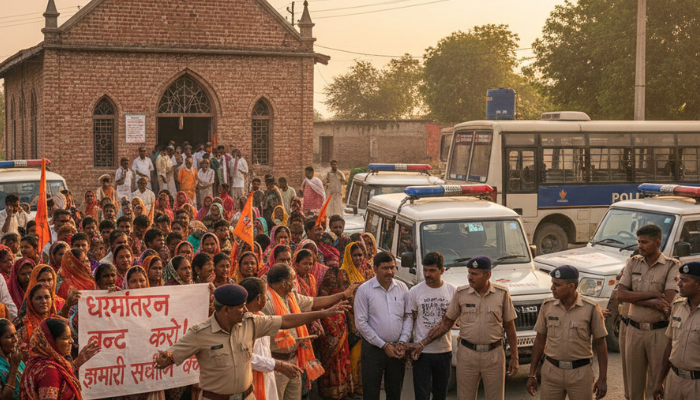
Case Summary
Hindus in the Devganj area of Fatehpur, Uttar Pradesh, raised complaints over conversion-related activities conducted at a local church. The incident came to light when Hindu men and women attended a prayer gathering and later expressed unease over the nature and direction of the religious discourse inside the premises. Hindu participants present at the church described a setting where prayer sessions and sermons focused heavily on faith, illness and personal hardship. During the programme, discussions encouraged attendees to distance themselves from their existing religious beliefs and adopt Christianity as a solution to social and economic difficulties. This caused discomfort among those who had entered the church seeking prayers or community support. Hindu residents in the surrounding area raised objections after learning that assurances connected to financial assistance, employment opportunities and education for children were discussed during the gathering. These assurances were seen as influencing individuals facing economic stress, prompting concerns about whether participation was truly voluntary. Hindu organisations reached the church after these concerns spread locally, leading to a confrontation at the site. Police teams were deployed to prevent further escalation and to restore order. Around 150 people were taken out of the church for questioning, and the pastor, along with his son, was taken into custody. A case was registered under the laws governing unlawful religious conversion against 10 people, and an investigation was initiated to examine the conduct of the programme. Hindu attendees later spoke of confusion, emotional distress and fear of social repercussions. Some said they felt singled out because of their religious identity and unsettled by the pressure they experienced within a religious setting unfamiliar to them. The incident generated anxiety among Hindu families in the locality, many of whom expressed concern over religious vulnerability. Police officials stated that the situation remained under control and confirmed that further action would depend on the findings of the ongoing investigation. Authorities appealed for restraint and emphasised the need to maintain communal harmony while the legal process continued.
Why it is Hate Crime ?
This case had been documented under the selected primary category: Predatory proselytisation. Under this, the selected secondary category is: Proselytisation by grooming, brainwashing, manipulation or subtle indoctrination. Under this, the selected tertiary category is: Victim says brainwashed/groomed. Religious brainwashing essentially means the often subtle and forcible indoctrination to induce someone to give up their religious beliefs to accept contrasting regimented ideas. Religious grooming or brainwashing also involves propaganda and manipulation. It involves the systematic effort, driven by religious malice and indoctrination, to persuade “non-believers’ to accept allegiance, command, or doctrine to and of a contrasting faith. Cases of such grooming or brainwashing are far more nuanced than direct threats, coercion, inducement and violence. In such cases, it is often seen that there is repeated, subtle and continual manipulation of the victim to induce disaffection towards their own faith and acceptance of the contrasting faith of the perpetrator. While subtle indoctrination is widely acknowledged as predatory, an element which is often understated in such conversions or the attempts of such conversion is the role of loyalty and trust which might develop between the perpetrator and the victim. Fiduciary relationships are often abused to affect such religious conversion. For example, an educator transmitting religious doctrine of a competing faith to a Hindu student. The Hindu student is likely to accept what the teacher is transmitting owing to existence of the fiduciary relationship. The exploitation of the fiduciary relationship to religiously indoctrinate victims would also be included in this category. Since the underlying animosity towards the victim’s faith forms the basis of predatory proselytization, such cases are considered religiously motivated hate crimes. Another selected secondary category is: Conversion/attempts to convert by inducement Predatory Proselytisation is not just limited to threat, harassment, force and violence, but it also has contours of stealth. In several cases, the Hindu victim is exploited to convert, with non-Hindus taking advantage of their poverty. In such cases, the Hindu victim who is suffering financially is offered monetary benefits, including lucrative offers for jobs, health treatment, education, etc, to induce the victim into changing his/her religion. In such cases, the religious identity of the victim and the aim to disenfranchise him from his faith form the heart of the crime. Also, taking advantage of and exploiting an individual’s economic vulnerabilities is widely acknowledged as exploitation, forms of which are often penalised by law. Such cases therefore are considered religiously motivated hate crimes since the victim’s religious identity forms the very heart of the crime itself. The incident qualified as a religiously motivated hate crime because the actions were directed at individuals specifically on the basis of their religious identity. Hindu men and women were selected, approached and engaged in a setting where their faith was not only questioned but systematically undermined. The focus remained on persuading members of one religious community to abandon their beliefs, which placed Hindus in a position of targeted vulnerability. The conduct went beyond the expression of religious belief and entered the realm of coercion. By linking spiritual acceptance to promises of financial assistance, employment and education, the activity exploited social and economic distress that disproportionately affected Hindu participants. This created pressure rather than choice, stripping individuals of genuine consent and turning religion into an instrument of control against a particular group. The emotional and psychological harm inflicted on Hindu participants further reinforced the nature of the crime. Many experienced fear, confusion and humiliation after being subjected to sustained persuasion in an enclosed religious environment. The distress arose not from interfaith dialogue but from being singled out and placed under pressure because of their existing faith. The organised and structured nature of the activity demonstrated intent. The repeated targeting of Hindus, the use of inducements and the effort to weaken religious identity showed hostility towards one community’s beliefs. Such actions affected not only individuals present at the gathering but also sent a message of insecurity to the wider Hindu community. Taken together, the targeted selection, coercive methods, psychological harm and clear religious focus established that the act was motivated by hostility towards a specific religion. This met the threshold of a religiously motivated hate crime, as it sought to erode dignity, autonomy and the right to practise faith freely and without fear. Thus, it is added to the tracker. Disclaimer: The Hinduphobia Tracker records incident dates based on when the crime occurred, rather than when the media reports it. However, in this case, media reports have not specified the exact date when the victim's ordeal began. Therefore, for documentation purposes, 28th December 2025, the date of media reporting, has been selected as the indicative incident date.
Victim Details
Total Victim
150
Deceased
0
Gender
- Male 0
- Female 0
- Third Gender 0
- Unknown 150
Caste
- SC/ST 0
- OBC 0
- General 0
- Unknown 150
Age Group
- Minor 0
- Adult 0
- Senior Citizen 0
- Unknown 150


Case Status
Complaint filed


Perpetrators Details
Perpetrators
Christian Extremists
Perpetrators Range
From 5 to 10
Perpetrators Gender
both
 Sources




