Hindu ancient text Manusmriti burnt publicly by Bhim army chief in Gwalior, Madhya Pradesh
 Gwalior, Madhya Pradesh, India
  24 December, 2025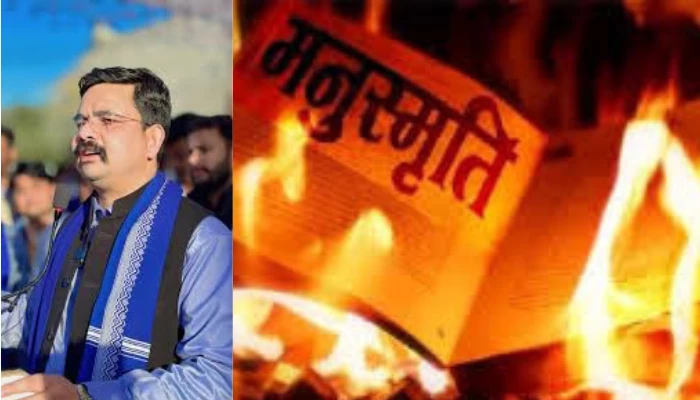
Case Summary
On 25 December 2025, Bhim Army chief Vinay Ratan publicly burned the Hindu ancient text Manusmriti during a large public gathering in Gwalior, Madhya Pradesh. The act took place in the presence of a crowd exceeding one lakh people. Visual recordings of the incident circulated widely, showing Vinay Ratan deliberately setting fire to the Manusmriti on stage while addressing the gathering. The act was performed openly, symbolically, and before a massive audience, ensuring maximum public visibility and impact. The incident triggered widespread outrage, with demands for strict legal action. Rohini Ghawari publicly called for action under the National Security Act (NSA), citing the deliberate provocation and potential to inflame communal tensions.
Why it is Hate Crime ?
There are two primary categories selected in this case. The first primary category is Hate speech against Hindus. The sub- category selected under it is: subversion of scriptures Subverting the religious scriptures of Hindus has particularly devastating consequences. Subversion of the scriptures of Hindus is often done to justify or promote hatred, discrimination, or violence against specific individuals or groups of Hindus. Religious scriptures are often nuanced and those who harbour religious animosity towards Hindus often misquote or misrepresent the scripture to legitimise their animosity and hate towards the faith and its adherents. Any such misquoting of scriptures or subversion to justify hate, violence and discrimination against Hindus owing to religious animosity is hate speech and is categorised as such. The other primary category selected is Attack on Hindu religious representation, under this, the sub-category selected is- Desecration of Hindu religious symbol Icons and symbols or a religious representation of a spiritual ideal are widely revered in Hinduism. Iconography is of vital significance in the Hindu milieu. It helps connect people’s spiritual beliefs with the real world. Iconography within the Hindu faith takes several shapes and forms. Murtis are of most significance to Hindus, to which daily rituals, prayers and offerings are done. Besides the murtis, there are several other symbols which have deep significance in the Hindu faith – the Om and Swastika for example. Since these Hindu religious symbols hold paramount importance in Hinduism, any desecration of symbols, icons, murtis, religious representations and manifestations, is driven by animosity towards the faith itself which manifests itself through these murtis, icons and symbols. Therefore, any desecration of these Hindu religious symbols and representations is considered a religiously motivated hate crimes under this category. The Manusmriti is a foundational text within Hinduism, traditionally attributed to the sage Manu. It functions as a dharmaśāstra, guiding morality, law, social order, and religious conduct. It represents an important symbol of Hindu religious and cultural heritage. The public burning of this sacred text constitutes a direct affront to Hinduism and its adherents. The act of burning the Manusmriti by the Bhim Army chief was carried out with the clear intent to incite hostility toward Hindus and to provoke animosity against the Hindu faith. The incident was designed to outrage religious sentiments and to deliberately provoke the Hindu community, thereby risking disruption of public peace and communal harmony. By targeting a core Hindu religious symbol in a public setting, the act sought to inflame tensions and create conditions conducive to disorder. No alternate or benign explanation exists for the public desecration of a Hindu religious text before a large gathering. The deliberate nature, symbolism, and public execution of the act establish inherent animosity toward Hinduism as the motivating factor. Such incidents have been documented by the Hinduphobia Tracker in the past, demonstrating that this is not an isolated or one-off occurrence. Multiple similar cases have taken place in which the Manusmriti has been deliberately denigrated with the sole objective of hurting the religious sentiments of Hindus. These repeated acts reflect a recurring pattern of targeted hostility toward Hindu religious symbols rather than isolated expressions or spontaneous acts. Since contempt for the Hindu religion was the central purpose of this incident, the case has been documented in the Hinduphobia Tracker. It is important to mention here that the accused was a member of the Bhim Army. The Bhim Army’s ideological positioning, which frequently aligns with narratives that portray Hindu religious traditions as inherently illegitimate or oppressive, provides critical context for understanding this incident. Within such frameworks, Hindu symbols are treated as acceptable targets for public denigration, and acts like the burning of religious texts are normalised as political expression. In this context, the disrespect shown toward Manusmriti was not incidental but stemmed from a broader pattern of anti-Hindu hostility. The involvement of an individual associated with an organisation known for such antagonism further supports the conclusion that contempt for Hinduism was the central motivating factor behind the act. This reinforces the classification of the incident as a religiously motivated hate incident and justifies its inclusion in the Hinduphobia Tracker.


Case Status
Unknown


Perpetrators Details
Perpetrators
Others
Perpetrators Range
From 10 to 100
Perpetrators Gender
male
 Sources




