Hindu community targeted with 'bhagwa love trap' hate rhetoric by Muslim preacher
 Central Delhi, Delhi, India
  19 December, 2025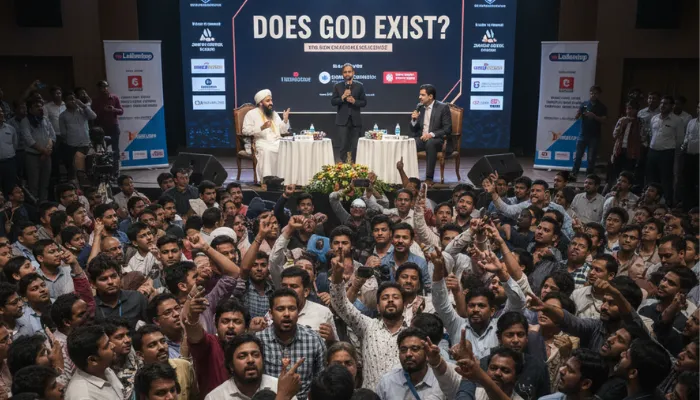
Case Summary
Hindu citizens experienced heightened social unease after Islamic preacher Mufti Shamail Nadwi became the subject of national attention following a high-profile public debate and the circulation of his earlier speeches online. This debate gained traction, drawing attention to Nadwi’s earlier statements, particularly his promotion of the fabricated conspiracy narrative known as "Bhagwa Love Trap." Nadwi came into the public spotlight after participating in a debate titled Does God exist? at the Constitution Club of India in New Delhi on 20 December 2025. The two-hour event was moderated by journalist Saurabh Dwivedi of The Lallantop and featured Nadwi opposite poet and lyricist Javed Akhtar. The debate drew a full audience and spread widely on digital platforms. During the discussion, Nadwi presented a philosophical argument for the existence of God and stated that scientific explanation did not eliminate the need for divine causation. Following the debate’s circulation, several earlier videos and speeches by Nadwi resurfaced and reached a wider audience. In these recordings, directed at Muslim audiences, Nadwi discouraged marriages between Muslim women and Hindu men, portraying such relationships as spiritually corrupting and socially dangerous. Hindu men were collectively depicted as untrustworthy, while Hindu society was framed as hostile to Islam. These remarks framed interfaith relationships as moral deviation and positioned Hindu identity itself as a threat, contributing to fear-driven narratives that place Hindu men under suspicion and social hostility. Besides, several of Nadwi’s other videos and speeches resurfaced and reached a wider audience. In these recordings, he rejected secularism and questioned democracy as a governing system. He criticised the idea of placing constitutional values or national identity above religious belief and dismissed judicial and civic authority whenever it conflicted with religious doctrine, asserting the primacy of Islamic law over constitutional processes. Further speeches delivered by Nadwi in Kolkata reinforced this exclusionary ideological posture. In these addresses, he emphasised the absolute authority of Sharia, asserted that Islam could not be erased from the land, and glorified religious sacrifice and martyrdom. He presented Islam as the only true religion, dismissed other belief systems, and described cultural expressions such as music as forbidden.
Why it is Hate Crime ?
This case had been documented under the selected primary category: Hate speech against Hindus. Under this, the selected secondary category is: Anti Hindu subversion and prejudice. Under this, the selected teritary categories are: Anti Hindu fake news or downplaying, Mislabelling/Misrepresentation of perpetrator's religion as Hindu. Hate speech is defined as any speech, gesture, conduct, writing, or display that is prejudicial against a specific individual and/or group of people, which is leading to or may lead to violence, prejudicial action or hate against that individual and/or group. Media plays a specific and overarching reach in perpetuating prejudicial attitudes towards a community owing to unfair, untrue coverage and/or misrepresentation/misinterpretation, selective coverage and/or omission of facts of/pertaining to issues affecting a specific religious group. This type of bias can dehumanise the victim group, making it easier for others to justify harmful actions against them, which aligns with the objectives of hate speech laws aimed at preventing such harm. It is often observed that the media takes a prejudicial stand against the Hindu community driven by their need to shield the aggressor community which happens to be a numeric minority, however, is the one perpetrating violence against Hindus. For example, the media is often quick to contextualise religiously motivated crimes against Hindus, omit or misrepresent facts that point towards religiously motivated hate crimes, justify and/or downplay religiously motivated hate crimes or simply present fake news to stereotype Hindus. Such media bias leads to the denial of persecution and is often used to dehumanise Hindus, leading to justification for violence against them. For example, the media covered several fake allegations of Hindus targeting Muslims and forcing them to chant Jai Shree Ram. Most of these cases were proved false and fabricated after police investigation. These fake news reports were subsequently never retracted or clarified. Such fake news led to the justification of violence and dehumanisation of Hindus based on the argument that since Hindus targeted Muslims and forced them to chant Jai Shree Ram, the dehumanisation of Hindus and violence against them was par for the course and merely a retaliation. Such media bias leads to prejudicial portrayal of Hindus and offers a justification for violence against them and therefore, is considered hate speech under this category. This case qualifies as a religiously motivated hate crime because the actions and messaging of Mufti Shamail Nadwi were explicitly directed against Hindus as a religious community, causing tangible social and psychological harm grounded in faith-based targeting. Firstly, targeting was based on religion. The discourse singled out Hindus, particularly Hindu men, and attributed harmful intent solely on the basis of their religious identity. Nadwi’s statements framed Hindus as untrustworthy and morally corrupt, reducing individuals to a collective stereotype. Hindu women were absent from these narratives, with the discourse focusing on controlling relationships through fear. This collective targeting based on religion meets the primary criterion for a hate crime. Secondly, there was dehumanisation and social harm. Hindu men were depicted as inherently dangerous, while Hindu society was presented as hostile to Islam. By portraying Hindus as a threat to Muslim families and faith, the messaging dehumanised them and normalised social exclusion. Ordinary interfaith interactions were recast as immoral or unsafe, directly interfering with Hindus’ ability to participate in social and familial life without fear or stigma. Thirdly, there was a clear psychological and community impact. The wide circulation of speeches and videos amplified the threat perception, causing Hindu families and young adults in workplaces, universities, and public spaces to experience fear, anxiety, and social pressure. The harm extended beyond words; it created an environment where Hindu identity was perceived as hostile, reinforcing social alienation and communal tension. Fourthly, the ideological exclusion of civic protection was evident. Nadwi’s rejection of secularism, democracy, and constitutional processes further reinforced the targeting. By prioritising religious law over civic authority, he denied Hindus equal moral and civic standing, signalling that their rights and safety were subordinate to ideological prescriptions. This strengthened the communal hostility and reinforced systemic exclusion. Finally, the pattern and intent were clear. The sustained promotion of the “Bhagwa Love Trap” narrative, repeated speeches in multiple cities, and the ideological framing of Hindus as a threat indicated deliberate intent to instil fear and other them based on religion. This was not a matter of personal disagreement or theological debate; it was a campaign targeting a religious community, creating real-world harm and insecurity. Taken together, the religious basis of targeting, the collective stereotyping, interference with social life, measurable psychological harm, and deliberate ideological intent establish this as a case of religiously motivated hate crime. It is thus, added to the tracker.


Case Status
Unknown


Perpetrators Details
Perpetrators
Muslim Extremists
Perpetrators Range
One Person
Perpetrators Gender
male
 Sources




