Hindu community threatened by Muslims who put out posters planning genocide of Hindus in Bangladesh
 Chittagong District, Bangladesh
  21 December, 2025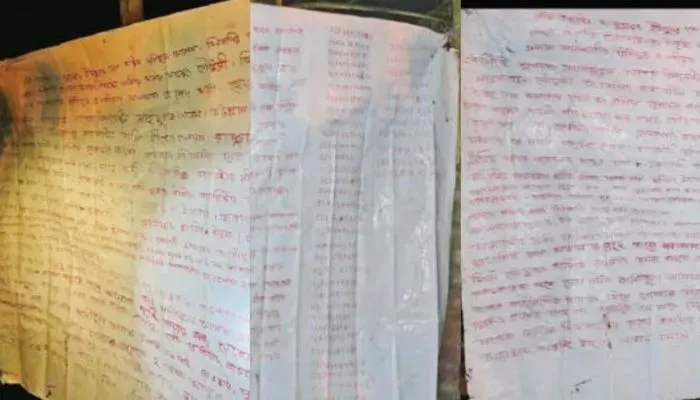
Case Summary
In Chattogram, Bangladesh, Hindus were threatened with genocide by Muslim extremists who put out posters planning mass killings of Hindus. The posters also called for the mass killings of Buddhists. According to reports, the poster stated that a plan had been made to kill nearly two lakh people from the Hindu and Buddhist communities on 13 December 2025. The poster also said that funds had been arranged to carry out the mass killings, suggesting a well-organised and pre-planned conspiracy. Kushal Barun Chakraborty, a representative of the Bangladeshi Sammilita Sanatani Jagran Jote, said the banner had been removed by the police after it was discovered. Quoting the contents of the poster, Chakraborty said, “The police took the banner with them.” The poster read: "On 13 December 2025, a plan was hatched and funding was provided to implement this plan. The plan and funding were aimed at killing a total of two lakh followers of the Hindu and Buddhist communities in the Raozan Sub-district, Chittagong. No trace of the Hindu and Buddhist communities will be left in Raozan; they will not be allowed to remain." The banner also accused Hindus of taking part in activities that went against Islam and warned them to stop immediately or face serious consequences. The banner read, “This is to inform the Hindu residents of this area that you are being closely observed. You are accused of engaging in activities against Islam and the Muslim community. You are hereby warned to stop your movements, meetings, and activities immediately. If you fail to comply, you will face severe consequences.” Chakraborty said the language of the poster clearly showed an intention to systematically target Hindus and Buddhists. He also stressed the need for a fair and independent investigation into the matter. Police had seized the poster and other materials and had begun an investigation to verify the claims and identify those behind the conspiracy. The incident had sparked fear among minority communities in the region, who were then demanding strong action and protection from the authorities as the probe continued. A fresh wave of anti-Hindu violence prevailed across Bangladesh following the death of Sharif Osman Bin Hadi. This escalation occurred against the backdrop of ongoing anti-Hindu violence that had persisted since the ouster of the Sheikh Hasina government in August 2024, during which Hindu homes, temples, and religious spaces were repeatedly attacked, and the Hindu community faced intimidation, arson, and mob attacks. In the aftermath of Hadi’s death, Hindu homes were selectively targeted and set ablaze in multiple localities by Muslim mobs, forcing families to flee and rendering many homeless. The violence was not sporadic but patterned, with Muslim mobs targeting Hindu neighbourhoods, properties, and religious symbols with impunity. One of the many victims of this wave of violence was a Hindu man named Dipu Chandra Das, who was brutally lynched by a Muslim mob over false allegations of blasphemy. Such targeting of innocent Hindus over fabricated charges illustrated the vulnerability of the Hindu minority under conditions of rising communal hostility. Posters and written materials calling for the extermination of Hindus were displayed in public spaces, signalling an alarming normalisation of genocidal rhetoric. Combined with acts of physical violence, arson, and vandalism, these developments demonstrated a coordinated campaign designed to terrorise the Hindu community and assert Islamic dominance. Notably, Sharif Osman Bin Hadi was a Muslim political activist and student leader known for his anti-Hindu and anti-India stance. He was actively involved in the political unrest that followed the fall of Sheikh Hasina’s government and was killed in Dhaka in December 2025 during clashes, after which Hindus were blamed and subsequently targeted.
Why it is Hate Crime ?
This case has been added to the tracker under the primary category- Hate Speech against Hindus. The subcategory selected is- Violent Threats. Violent threats, explicit, implicit or implied, is the most dangerous form of hate speech since it goes beyond discriminatory and prejudicial language to express the intent of causing harm to an individual or a group of people based on their religious identity and faith. There could be several different kinds of threats that are issued to Hindus based on religious animosity. An explicit threat would mean the direct threat of violence towards an individual Hindu, a group of Hindus or Hindus at large. Physical violence, death threats, threats of destruction of property belonging to Hindus and threats of genocide would mean explicit threats against Hindus for their religious identity. Implicit threats may not be a direct threat but implied through the use of symbols of actions – for example – in the Nupur Sharma case, other than explicit threats, there were also implicit threats when Islamists took to the streets to burn and beat her effigies. It implies that they want to do the same to Nupur Sharma – thereby is considered an implicit threat. Violent threats can be delivered in person, through letters, phone calls, graffiti, or increasingly through social media and other online platforms. It would be important to understand that a threat – explicit or implicit, online or offline – to an individual who happens to be a Hindu does not qualify as a religiously motivated threat. Such a threat, while vile and dangerous, could be owing to non-religious reasons and/or personal animosity. To qualify as a religiously motivated threat, it would need to exhibit an indication that the individual is being targeted for religious reasons and/or owing to his/her religious identity as a Hindu. This incident in Chattogram, Bangladesh, stands as a clear instance of an anti-Hindu hate crime, where Muslim perpetrators threatened to kill all two lakh Hindus in the area. It constitutes religiously motivated hate speech, as violent threats of genocide targeted the Hindu community directly. Such threats of genocide against Hindus have long resulted in large-scale killings in Bangladesh, particularly after the political exile of Sheikh Hasina, when Muslim extremists brutally persecuted Hindus through targeted killings, mob attacks, temple desecrations, and religiously motivated sexual violence against Hindu women. All this amounts to a clear instance of Hindu genocide and ethnic cleansing, with the Muslim perpetrators' vow to kill every Hindu in the area revealing their deep-seated religious animosity towards the Hindu community. These violent threats left Hindus feeling scared, intimidated, and profoundly vulnerable about their existence and faith, cementing this as religiously motivated hate speech. Threatening Hindus with mass slaughter solely for their religious identity showcases the deep-seated hatred that Muslim perpetrators harbour towards Hindus. Following this, the Muslim perpetrators accused Hindus of being anti-Islam and anti-Muslim, using it as justification to issue such violent threats of mass slaughter and genocide against Hindus, despite Hindus remaining a vulnerable minority in Bangladesh, subjected to ongoing religious persecution. This represents a clear tactic to mobilise mobs and unleash violent rampages against Hindus. Hence, this case exemplifies religiously motivated hate speech. Notably, this incident occurred just days after a Hindu man, Dipu Chandra Das, was brutally murdered and his body set ablaze by Muslim radicals over a false allegation of blasphemy against Islam in Bhaluka town, Bangladesh, on 18 December 2025. Such instances of religiously motivated targeting of Hindus demonstrated that this incident was not an isolated event but a pattern of selective attacks on Hindus with impunity. Given that this case meets the parameters of a religiously motivated offence, it is being added to the hate crime database of the Hinduphobia Tracker.


Case Status
Complaint filed


Perpetrators Details
Perpetrators
Muslim Extremists
Perpetrators Range
Unknown
Perpetrators Gender
unknown
 Sources




