Hindu woman subjected to rape, blackmail and religious coercion by Muslim man, forced to remove Hindu marital identities
 Vadgaon, Maharashtra, India
  25 December, 2025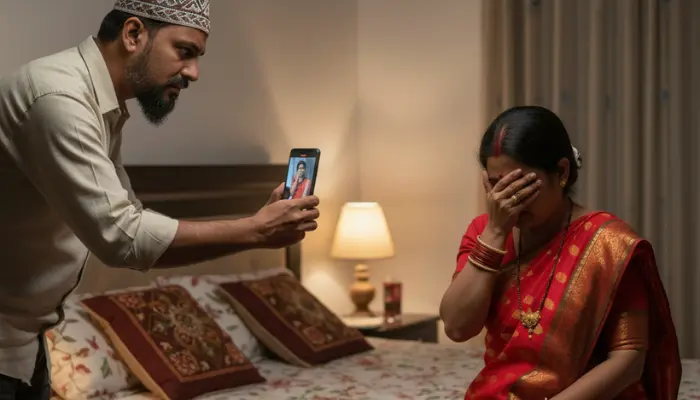
Case Summary
A Hindu woman was subjected to rape, prolonged blackmail and religious coercion by a Muslim man identified as Javed Khattik in Vadgaon Budruk, Pune, Maharashtra. The woman ran a restaurant and came into contact with him through her professional work. Over time, he gained access to her personal life and recorded obscene photographs and videos of her without her consent. These recordings were later used to threaten her with public exposure and disclosure to her family, after which she was repeatedly sexually assaulted. The intimidation extended to the woman’s family. During this period, both her children (minors) were threatened with a firearm, creating an atmosphere of constant fear and psychological pressure. He also confiscated the woman’s jewellery and cash, retaining them as a means of pressure and coercion. The violence further included acts of religious humiliation. The woman was taken to a dargah where she was forced to remove visible symbols of her Hindu marital identity, including her mangalsutra and kumkum. She was compelled to participate in Islamic religious practices against her will, directly violating her personal liberty and freedom of belief. After enduring sustained abuse, threats to her family and the erosion of her religious autonomy, the woman approached the police and filed a formal complaint. The police registered the case and arrested the accused. At the time of reporting, the investigation was ongoing.
Why it is Hate Crime ?
This case has been documented under the selected primary category: Crimes against women in relationships and other sexual crimes. Under this, the selected secondary category is: Brainwashed and/or groomed. Under this, the selected tertiary category is: Rape and sexual assault/harassment. In our database, we have not added incidents where women have converted to another religion of their free will and no allegations of forced/involuntary conversion have been made. However, there are certain cases of conversion where the consent itself is a result of the brainwashing or grooming of a minor by the non-Hindu perpetrator trying to victimise a woman for her Hindu religious identity. The phenomenon of grooming points to non-Hindu perpetrators identifying their Hindu victims’ vulnerabilities and exploiting them over months and sometimes years, to extract the supposed ‘consent’ in order to convert their religion. In most cases of grooming, the victims are minors or the grooming started when the victim was a minor. In other cases of grooming, the non-Hindu perpetrator brainwashes and grooms a minor victim to extract their trust and then proceeds to rape them repeatedly with the intent of converting them to their faith. It is pertinent to understand here that when the victim is a minor, the ‘consent’ to convert or enter into a romantic relationship with an adult itself is redundant – addressed by POCSO. While every case of conversion of a minor and incidents of establishing a physical relationship with a minor by an adult is a crime, for the purpose of this database, a case would be considered a hate crime only if there is a distinct religious angle to the grooming. For example, in the UK, if a Hindu minor is targeted by Pakistani grooming gangs, it would be considered a hate crime because the victims are specifically targeted owing to their non-Muslim religious identity with the perpetrators being Muslim. In other cases, if a Hindu minor is brainwashed into entering a physical relationship with the non-Hindu adult perpetrator and the family alleges grooming/brainwashing of the minor to convert her religion, it would form a part of this database. If the victim is a Hindu adult, the case would form a part of this database only if the victim herself says that she was brainwashed/groomed to convert her religion. However, if the victim is deceased (murdered or otherwise), the case would form a part of this database if her family/friends provided testimony that the victim was brainwashed/groomed to convert her religion. Since these crimes have a distinct religious angle where the victim is being targeted owing to her Hindu religious identity, these cases are considered a hate crime. Another selected secondary category is: Assault or threat upon refusal to convert. When Hindu women are in a relationship with non-Hindu men, there are cases where the woman faces threats or assault after she refuses to convert and change her religious identity owing to pressure/force by the non-Hindu man. Such relationships may be consensual with the religious identity of the non-Hindu man known to the victim. Somewhere along the relationship, the non-Hindu man starts pressurizing the Hindu woman to convert to Islam and upon her refusal, assaults or threatens the victim. Such cases are driven by specific religious motivations and against the religious identity of the victim and are therefore qualified as hate crimes. Cases where the Hindu woman converts to Islam and does not file a complaint about the force or threat, are not considered a part of the hate tracker, even though, it may be argued that the woman was brainwashed or threatened to convert to Islam. Another selected secondary category is: Rape for refusal to convert. When Hindu women are in a relationship with non-Hindu men, there are cases where the woman faces pressure/threats/violence to convert and change her religious identity by the non-Hindu man. Such relationships may be consensual with the religious identity of the non-Hindu man known to the victim. Somewhere along the relationship, the non-Hindu man starts pressuring the Hindu woman to convert. In some of these cases, the association could be non-consensual as well or, the religious identity of the non-Muslim man could be previously unknown to the Hindu victim. As the case may be, in such cases, the non-Hindu man forces himself sexually on the Hindu woman when she refuses his advances and pressures to convert her religion. The rape of the woman is often seen as either a punishment for the woman refusing to convert. Such cases are driven by specific religious motivations and against the religious identity of the victim and are therefore qualified as hate crimes. Another selected secondary category is: Torture of family to force woman to convert. When Hindu women are in a relationship with non-Hindu men, there are cases where the woman is forced to convert her religion. Several methods are used for such forced conversion. The non-Hindu man is often documented to issue threats and even employ violence. One of the ways used by such perpetrators is threatening and/or torturing the family members of the Hindu woman to pressure her to convert. The perpetrators in such cases issue threats to harm or torture the family of the woman. In some cases, there is also violence directed towards the family to force the Hindu woman to convert. Such crimes aim to blackmail the victim into changing her religion by inducing fear of harm to her family. Such cases are driven by specific religious motivations and against the religious identity of the victim and are therefore qualified as hate crimes. Another selected secondary category is: Blackmailed to convert When Hindu women are in a relationship with non-Hindu men, there are cases where the woman is blackmailed to convert her religion, owing to her religious identity of being a Hindu. Such relationships may be consensual with the religious identity of the non-Hindu man known to the victim, however, there could be cases where the relationship is not consensual and the non-Hindu man starts blackmailing a Hindu woman to convert her religion. In these cases, it is often seen that the Hindu woman is blackmailed with intimate photos and/or videos, threats of harm to her or her family, threats of violence etc. Such cases are driven by specific religious motivations and against the religious identity of the victim and are therefore qualified as hate crimes. Another selected sub-category is: Desecration of Hindu symbols in relationship. When Hindu women are in a relationship with non-Hindu men, there are cases where the woman faces insult and desecration of her faith (Hinduism) and its symbol because of the inherent disregard for polytheism of the non-Hindu partner. Such relationships may be consensual with the religious identity of the non-Hindu man known to the victim. Somewhere along the relationship, the non-Hindu man starts desecrating the religious symbols of the Hindu partner out of spite for her faith. Such cases are driven by specific religious motivations and against the religious identity of the victim and are therefore qualified as hate crimes. This case clearly constitutes a religiously motivated hate crime because the perpetrator’s actions were directed not only at the individual but at her identity as a Hindu woman. The violence was multidimensional, encompassing sexual assault, psychological coercion, and religious humiliation, all of which were inseparable from the victim’s faith and social standing. The woman was repeatedly sexually assaulted, and obscene photographs and videos of her were recorded without her consent. These recordings were then used as a tool of intimidation and blackmail, threatening her with public exposure and disclosure to her family. Such actions go beyond personal exploitation or opportunistic criminal behaviour; they were strategically designed to enforce submission and control, exploiting her vulnerability as a Hindu woman operating within a culturally sensitive social context. The perpetrator extended the violence to her family, threatening both her children with a firearm. This created an atmosphere of constant fear and psychological pressure, ensuring that the victim’s resistance was undermined and that the abuse could continue unchallenged. The targeting of her family intensified the impact of the crime, as it attacked not only the individual’s personal security but also her familial and social honour, which in a Hindu cultural context carries significant weight. A defining element of the hate crime was the religious coercion and humiliation inflicted upon the woman. She was forcibly taken to a dargah, where she was compelled to remove visible symbols of her Hindu marital identity, including her mangalsutra and kumkum. Additionally, she was forced to participate in religious practices against her will. These acts were not incidental; they were deliberate attempts to erode her faith, violate her religious autonomy, and impose the perpetrator’s ideological agenda on her personal and spiritual life. The combination of physical, psychological, and religious abuse demonstrates a conscious effort to target her specifically for being Hindu, rather than merely for personal or material reasons. The sustained nature of the abuse, the targeted threats to her children, and the deliberate attacks on her religious symbols and autonomy collectively show that the violence was ideologically driven. The perpetrator’s methods were designed to dominate, humiliate, and control the victim by exploiting her religious and cultural identity, making this a textbook example of a faith-based, religiously motivated hate crime. The crime was not isolated to personal grievances or financial gain; it was a systematic and targeted attempt to intimidate, subjugate, and undermine a Hindu woman and her family through the interplay of sexual violence, blackmail, and religious coercion. It is thus added to the tracker. Disclaimer: The Hinduphobia Tracker records incident dates based on when the crime occurred, rather than when the media reports it. However, in this case, media reports have not specified the exact date when the victim's ordeal began. Therefore, for documentation purposes, 26th December 2025, the date of media reporting, has been selected as the indicative incident date.
Victim Details
Total Victim
3
Deceased
0
Gender
- Male 0
- Female 1
- Third Gender 0
- Unknown 2
Caste
- SC/ST 0
- OBC 0
- General 0
- Unknown 3
Age Group
- Minor 2
- Adult 1
- Senior Citizen 0
- Unknown 0


Case Status
Complaint filed


Perpetrators Details
Perpetrators
Muslim Extremists
Perpetrators Range
One Person
Perpetrators Gender
male
 Sources




