Anti-Hindu propaganda: Leftist journalist denies and whitewashes religious persecution of Hindus in Bangladesh
 India
India  20 December, 2025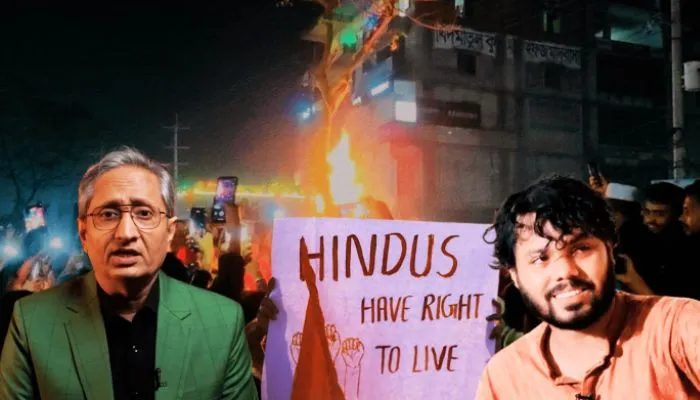
Case Summary
The faith-based persecution and genocide of Bangladeshi Hindus was denied, whitewashed and downplayed by a left-wing anti-Hindu journalist, Ravish Kumar. According to reports, Ravish Kumar released a video on 21st December 2025 on his YouTube channel in which he denied the persecution of Hindus in Bangladesh. In his latest video, he questioned the atrocities reported during the violence that happened after the fall of Sheikh Hasina’s government and accused the media of circulating false information. Ravish Kumar, in his 18-minute piece on the violence that erupted in Bangladesh following the death of anti-India Islamist leader Osman Hadi, attempted to present himself as neutral. He claimed, “When reports of atrocities against Hindus surfaced around the time of Sheikh Hasina’s removal, the mainstream media began circulating baseless and false news, which sparked protests in Bangladesh, and the public there became increasingly concerned about the safety of Hindus.” Ravish Kumar whitewashed the widespread attacks on Hindus since the fall of Sheikh Hasina’s government in August 2024, including temple vandalism, arson of homes and shops, and the rape and murder of women, as false and fake news. Moving forward, he described Osman Hadi, an anti-India figure, as a “rising student leader”. But he made no mention of the fact that this same Hadi had also shared a map showing the northeastern states as part of Bangladesh. By describing Osman Hadi as a “student leader,” he also portrayed him as a “true patriot” who fought corruption and championed legitimate issues in his country. The two killings, of Hindu youth Dipu Chandra Das and Osman Hadi, were treated in the same light. However, these two killings are distinct. The brutal killing of Dipu Chandra Das formed part of a series of communal atrocities against Hindus, aimed at signalling to the Hindu community that raising their voices in Bangladesh could invite the same fate. While Osman Hadi’s murder was not an act of communal violence, the identity of his killer remained untraced. Bangladesh police had already dismissed claims that Hadi’s killers were involved in India or that he had fled to India. Reports confirmed that Ravish Kumar had previously acknowledged that violence occurred during the protests to topple Sheikh Hasina’s government and had even defended these protesters. However, he rejected the notion that the violence was clearly anti-Hindu. In contrast to Ravish Kumar's claims, the United Nations Office of the High Commissioner for Human Rights (UN OHCHR) report stated that the anti-Hindu violence occurred during a procession of people celebrating the ouster of Sheikh Hasina from power in Bangladesh. The attackers were radical leaders of the Bangladesh Nationalist Party (BNP) and Jamaat-e-Islami. Even the Hinduphobia Tracker had previously documented several instances of targeted faith-based persecution of Hindus in Bangladesh at the hands of radical Islamic extremists. For example, on 5th August 2024, in the Pirojpur district, Hindus were brutally attacked by a Muslim mob. Hindu homes were selectively targeted, attacked, and looted. A Hindu woman was also brutally gang-raped by members of the Muslim mob. In another instance, Jhenaidah saw extensive violence with ongoing attacks, vandalism, and looting at the homes of 10 Hindu families in Chaklapara municipality. Hindu shops in Kotchandpur were also attacked and looted. In Tilpatti, Bargola, 5-7 Hindu shops were attacked, vandalised, and looted. Similarly, the house of Dr Gautam Kumar Mondal in Sahapukur village, Dupchanchia Upazila, was attacked and looted. The house of Sahadev Roy in Sonadia, Hatiya, Noakhali, was attacked and looted. In Thakurgaon, Hindu homes in the Sadar were attacked, vandalised, and looted. Additionally, in ward 2 of Pirganj, the cremation temple was attacked and burnt. In Patuakhali, the Radha Govinda Temple in Kuakata was attacked and vandalised. The house of Ananta Mukherjee was attacked, vandalised, and looted. Hindu homes in wards 2 and 3 of the Sadar, Panchagarh, were attacked, vandalised, and looted.
Why it is Hate Crime ?
The primary category selected in this case is- Hate Speech against Hindus. The subcategory selected is- Anti-Hindu subversion and prejudice. The tertiary category selected is- Anti-Hindu Fake News or Downplaying. Hate speech is defined as any speech, gesture, conduct, writing, or display that is prejudicial against a specific individual and/or group of people, which is leading to or may lead to violence, prejudicial action or hate against that individual and/or group. Media plays a specific and overarching reach in perpetuating prejudicial attitudes towards a community owing to unfair, untrue coverage and/or misrepresentation/misinterpretation, selective coverage and/or omission of facts of/pertaining to issues affecting a specific religious group. This type of bias can dehumanise the victim group, making it easier for others to justify harmful actions against them, which aligns with the objectives of hate speech laws aimed at preventing such harm. It is often observed that the media takes a prejudicial stand against the Hindu community driven by their need to shield the aggressor community which happens to be a numeric minority, however, is the one perpetrating violence against Hindus. For example, the media is often quick to contextualise religiously motivated crimes against Hindus, omit or misrepresent facts that point towards religiously motivated hate crimes, justify and/or downplay religiously motivated hate crimes or simply present fake news to stereotype Hindus. Such media bias leads to the denial of persecution and is often used to dehumanise Hindus, leading to justification for violence against them. For example, the media covered several fake allegations of Hindus targeting Muslims and forcing them to chant Jai Shree Ram. Most of these cases were proved false and fabricated after police investigation. These fake news reports were subsequently never retracted or clarified. Such fake news led to the justification of violence and dehumanisation of Hindus based on the argument that since Hindus targeted Muslims and forced them to chant Jai Shree Ram, the dehumanisation of Hindus and violence against them was par for the course and merely a retaliation. Such media bias leads to prejudicial portrayal of Hindus and offers a justification for violence against them and therefore, is considered hate speech under this category. The other subcategory selected is- Denial or mocking of a genocide/large-scale persecution of Hindus. Denial or mocking of genocide/large-scale persecution/ethnic cleansing refers to the act of denying or minimizing the fact of the ethnic cleansing and/or genocide and/or religious persecution of Hindus. This often involves denying the scale, mechanisms, religious intent, or even the occurrence of the ethnic cleansing and/or genocide and/or religious persecution of Hindus. Hate speech of this kind involves the dissemination of falsehoods that deny or distort established historical facts or mock the suffering of Hindus by saying that they deserved the persecution, motivated by Hinduphobia. Denying such atrocities is not only about the denial of facts or rewriting/revising history, but it also delegitimises the religiously motivated persecution of Hindus, the religious hate/motivation/animosity that led to the persecution, and dehumanises Hindus as a religious group. Such denial of ethnic cleansing and/or genocide and/or religious persecution of Hindus not only denies the suffering but also paves the way for future/present atrocities and hate speech, inciting prejudice and violence against Hindus. It also provides a justification for violence by delinking religious animosity from religiously motivated crimes committed against Hindus. Since such denial and/or mocking of genocide/ethnic cleansing/atrocities motivated by religious animosity leads to present and future ramifications of creating more hate speech, violence, dehumanisation and delegitimisation, it would be considered hate speech under this category. In this case, the accused, Ravish Kumar, denied, whitewashed, and downplayed the persecution of Hindus in Bangladesh, particularly after the ouster of Sheikh Hasina's government. This denial exemplifies deep-seated religious animosity towards the Hindu community, rendering it a clear instance of an anti-Hindu hate crime. Hindus faced routine persecution in Bangladesh following Sheikh Hasina's removal, as meticulously recorded by the Hinduphobia Tracker, including temple vandalism, arson attacks on homes and businesses, targeted killings, and sexual violence against Hindu women perpetrated by radical Islamic extremists. By rejecting these documented atrocities, Ravish Kumar weaponised media and journalism to subvert and prejudice against Hindus, shielding an Islamic-majority nation steeped in Islamist ideology that seeks to eradicate the Hindu community entirely. Denial of a community's persecution, and the genocide it entails, reveals the profound animosity and prejudice Ravish Kumar harboured against Hindus, constituting a blatant anti-Hindu hate crime. Such negationism not only erases the suffering of victims but also actively undermines their right to recognition and justice, perpetuating a cycle of dehumanisation of Hindus. Ravish Kumar's deliberate falsehoods, disseminated to millions through his platform, amplified anti-Hindu sentiment, emboldened the Muslim perpetrators, and isolated the victims. This calculated distortion mirrors historical patterns of genocidal denial, where anti-Hindu propagandists shield Muslim aggressors while vilifying the oppressed Hindu community, directly fuelling further violence against Bangladesh's Hindus. Ravish Kumar supported anti-India activist Osman Hadi, killed in Bangladesh, by equating his death to the brutal murder of Hindu youth Dipu Chandra Das, who was savagely murdered by radical Muslim mobs over a false blasphemy allegation. This false equivalence starkly whitewashes and downplays the persecution of Dipu Chandra Das and the broader Hindu community, framing communal pogroms as mere political incidents. By honouring Hadi, a figure who shared maps claiming India's northeastern states for Bangladesh, as a patriot while ignoring Hindu temple desecrations, targeted killings, and sexual violence against Hindu women, Ravish Kumar constructed a hate-filled narrative. This comprehensive denial of atrocities cements his output as a hate crime, as it incites disregard for Hindu lives, normalises Islamist extremism, and erodes safety for the Hindu community. Given that this case meets the parameters of a religiously motivated hate speech, it is being added to the hate crime database of the Hinduphobia Tracker.


Case Status
Unknown


Perpetrators Details
Perpetrators
Others
Perpetrators Range
One Person
Perpetrators Gender
male
 Sources




