Hindu man brutally attacked by Muslim mob in Bangladesh for wearing sacred kalava on his wrist
 Jhenaidah District, Bangladesh
  18 December, 2025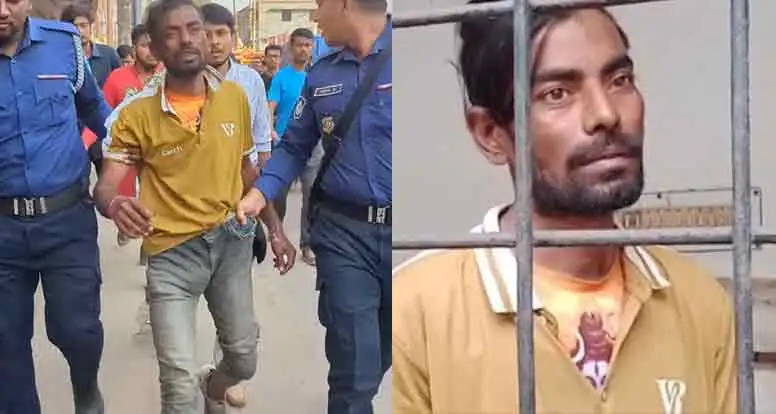
Case Summary
In Jhenaidah district in Khulna Division, Bangladesh, a Hindu man, Gobinda Biswas, was targeted and brutally attacked by a Muslim mob after the mob spotted a kalava, a sacred red thread, on his wrist. According to media reports, the victim was a rickshaw puller. On 19th December 2025, he was assaulted by a Muslim mob just because he had a kalava on his wrist. After seeing the red thread on his wrist, the Muslims circulated a rumour that he was an agent of the Indian spy agency Research and Analysis Wing (RA&W). As a result, a large group of Muslims gathered at the spot and brutally assaulted him. After beating him in front of the Jhenaidah district municipality gate, the mob handed him over to the police. Gobinda Biswas suffered injuries to his throat and chest in the assault by the Muslim mob. While being taken away by the police, Gobinda Biswas was pleading, “I am a rickshaw driver, please let me go.” But the police did not listen to him and refused to release him. He was kept at Jhenaidah Sadar police station. In a video from the police station, someone could be heard saying that there were several ‘WhatsApp transactions with Reserve Bank of India’ on his phone. The person, not seen in the video, also said that Gobinda received a call from someone named Akash from India when he was being detained. However, Gobinda clarified that Akash was a person known to him. The Officer-in-Charge of Jhenaidah police station claimed that Biswas lived in India for a long time. At the time of writing this report, the police said Biswas's links with the Indian spy agency were being probed. A fresh wave of anti-Hindu violence prevailed across Bangladesh following the death of Sharif Osman Bin Hadi. This escalation occurred against the backdrop of ongoing anti-Hindu violence that had persisted since the ouster of the Sheikh Hasina government in August 2024, during which Hindu homes, temples, and religious spaces were repeatedly attacked, and the Hindu community faced intimidation, arson, and mob attacks. In the aftermath of Hadi’s death, Hindu homes were selectively targeted and set ablaze in multiple localities by Muslim mobs, forcing families to flee and rendering many homeless. The violence was not sporadic but patterned, with Muslim mobs targeting Hindu neighbourhoods, properties, and religious symbols with impunity. One of the many victims of this wave of violence was a Hindu man named Dipu Chandra Das, who was brutally lynched by a Muslim mob over false allegations of blasphemy. Such targeting of innocent Hindus over fabricated charges illustrated the vulnerability of the Hindu minority under conditions of rising communal hostility. Posters and written materials calling for the extermination of Hindus were displayed in public spaces, signalling an alarming normalisation of genocidal rhetoric. Combined with acts of physical violence, arson, and vandalism, these developments demonstrated a coordinated campaign designed to terrorise the Hindu community and assert Islamic dominance. Notably, Sharif Osman Bin Hadi was a Muslim political activist and student leader known for his anti-Hindu and anti-India stance. He was actively involved in the political unrest that followed the fall of Sheikh Hasina’s government and was killed in Dhaka in December 2025 during clashes, after which Hindus were blamed and subsequently targeted.
Why it is Hate Crime ?
This case is being added to the tracker under the primary category- Attack not resulting in death. The subcategory selected is- Attacked for Hindu identity. In several cases, Hindus are attacked merely for their Hindu identity without any perceived provocation. A classic example of this category of religiously motivated hate crime is a murder in 2016. 7 ISIS terrorists were convicted for shooting a school principal in Kanpur because they got ‘triggered’ seeing the Kalava on his wrist and tilak that he had put. In this, the Hindu victim had offered no provocation except for his Hindu religious identity. The motivation for the murder was purely religious, driven by religious supremacy. Such cases where Hindus are targeted merely for their religious identity would be documented as a hate crime under this category. In this case, the brutal assault on the Hindu man, Gobinda Biswas, in Jhenaidah district, Bangladesh, stood as a clear instance of a religiously motivated hate crime against a Hindu man. The Muslim mob targeted and brutally attacked him solely because they spotted a kalava, a sacred red thread worn by Hindus as a symbol of faith and protection, on his wrist. This overt religious marker triggered immediate violence, with the mob circulating rumours of him being an agent of India's Research and Analysis Wing, leading to a savage beating in broad daylight. Such an attack, ignited by a visible emblem of Hindu identity, exposed deep-seated religious animosity towards the Hindu community, where even traditional adornments provoke lethal intolerance and violence from Muslims. The brutality inflicted on his throat and chest underscored the mob's intent to severely injure, punish and dehumanise him for his faith, fitting the textbook definition of a hate crime driven by religious prejudice and animosity. Some may argue that the assault occurred on the pretext of a rumour portraying him as a Research and Analysis Wing agent, essentially an Indian agent. However, this pretext revealed the Muslim attackers' perception of India as a Hindu collectivity, equating Indian identity with Hindu identity in their worldview. Calling him an Indian agent thus targeted his religious identity directly. Moreover, the rumour served merely as a hoax to justify the violence; the mob's fury ignited the moment they saw the kalava on his wrist, confirming it as the primary trigger. This attack on a Hindu man for wearing a kalava thus showcased deep-seated religious animosity towards the Hindu community, marking it as an anti-Hindu hate crime. It is also important to note that this incident occurred just a day after a Hindu man named Dipu Chandra Das was brutally murdered and his body was set ablaze by Muslim radicals over an unproven allegation of blasphemy against Islam in Bhaluka town of Mymensingh district, Bangladesh, on 18th December 2025. The fact that Hindus faced such targeted violence in quick succession during this period demonstrated that it was not an isolated event, but a pattern of selective attacks on Hindus with impunity. These back-to-back assaults highlighted a climate of religiously motivated hate crimes against the Hindu minority in Bangladesh, making it a clear example of an anti-Hindu hate crime. Given that this case meets the parameters of a religiously motivated hate crime, it is being added to the hate crime database of the Hinduphobia Tracker.
Victim Details
Total Victim
1
Deceased
0
Gender
- Male 1
- Female 0
- Third Gender 0
- Unknown 0
Caste
- SC/ST 0
- OBC 0
- General 1
- Unknown 0
Age Group
- Minor 0
- Adult 1
- Senior Citizen 0
- Unknown 0


Case Status
Unknown


Perpetrators Details
Perpetrators
Muslim Extremists
Perpetrators Range
Unknown
Perpetrators Gender
unknown
 Sources




