Idols of Goddess Durga vandalised at Hindu temple in Mirapara Bazar, Bangladesh, just before Durga Puja
 Narail District, Bangladesh
  30 September, 2024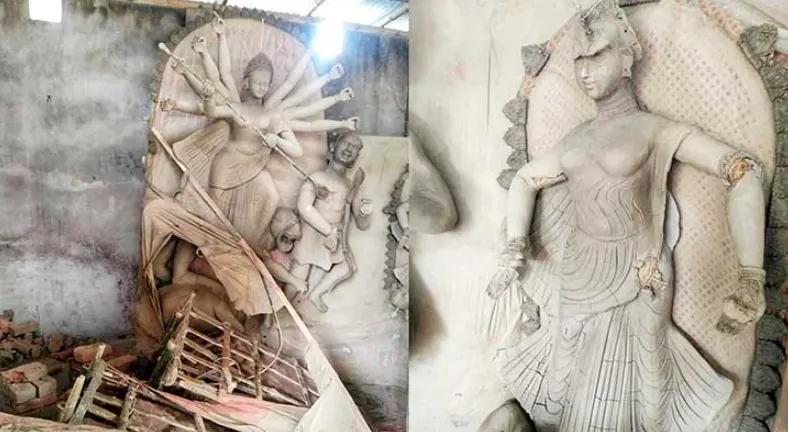
Case Summary
Miscreants vandalised idols at the public Durga temple in Mirapara Bazar, Narail, including the idol of Goddess Durga. Members of the puja committee had lit the temple lights the previous night and left, only for the damage to be discovered the next morning when craftsmen arrived to paint the idols. They immediately alerted the temple committee. Pradeep Roy, president of the Mirapara Bazar Public Durga Temple, confirmed that the vandalism occurred overnight and spread panic in the area. He expressed deep shock, stating that the idols were found broken when the craftsmen reached the temple for work. Babulal Bhattacharya, acting general secretary of the District Puja Udjapan Parishad, condemned the incident as tragic and called upon the authorities to take strict action against those responsible for disrupting communal harmony. It remains unclear whether a formal complaint has been filed in connection with the case. Since the fall of Sheikh Hasina’s Awami League government on August 5, 2024, Bangladesh has plunged into chaos as Islamist extremists have taken advantage of the political turmoil to unleash a wave of terror and violence against the Hindu community. The Islamist mobs have attacked Hindu homes, burned them to the ground, and abducted women in a horrific descent into anarchy. Several temples have been destroyed in the area in a major crackdown on Hindus.
Why it is Hate Crime ?
This case has been added to the tracker under the primary category of - Attack on Hindu religious representations. Within it, the sub-category selected is - Desecration of Hindu religious symbol. Icons and symbols or a religious representation of a spiritual ideal are widely revered in Hinduism. Iconography is of vital significance in the Hindu milieu. It helps connect people’s spiritual beliefs with the real world. Iconography within the Hindu faith takes several shapes and forms. Murtis are of most significance to Hindus, to which daily rituals, prayers and offerings are done. Besides the murtis, there are several other symbols which have deep significance in the Hindu faith – the Om and Swastika for example. Since these Hindu religious symbols hold paramount importance in Hinduism, any desecration of symbols, icons, murtis, religious representations and manifestations, is driven by animosity towards the faith itself which manifests itself through these murtis, icons and symbols. Therefore, any desecration of these Hindu religious symbols and representations is considered religiously motivated hate crimes under this category. The other sub-category selected is - Attak on Temples. In Hinduism, a temple is the abode of the Deity. The Deity in the Temple is consecrated, thereby, making it a real, breathing entity. Hindus believe that not just the Deity but the temple premises itself are sacred to Hindus since Hindus hold the faith that the entire Temple space is an amalgamation of the divine energy of the deity. Given the central significance of Temples in Hindu Dharma, any attack against a Hindu Temple or its peripheral premises is an attack on the faith itself and is born out of animosity towards the faith, of which, the Temple is a central tenet. Any manner of attack against a Temple and/or its premises would therefore be considered a religiously motivated hate crime. The vandalism of murtis at the Durga temple directly constitutes desecration of Hindu religious symbols. In Hinduism, murtis are not mere objects but sacred embodiments of divinity, to which devotees offer daily prayers, rituals, and devotion. By targeting and breaking these idols, the perpetrators directly attacked the spiritual core of Hindu worship. Such desecration reflects hostility not only toward the physical representation but toward the faith itself, as these sacred symbols embody the presence of the divine. The deliberate destruction of murtis, especially of Goddess Durga, therefore amounts to a religiously motivated hate crime against Hindus, intended to insult and undermine their religious identity. A temple in Hindu belief is the abode of the deity, and the consecrated deity is considered a living entity. The temple premises are regarded as sacred spaces imbued with divine energy, making them central to Hindu religious life. By vandalising idols within the temple, the perpetrators violated not just property but the sanctity of a sacred space revered by the community. Such an attack reflects animosity toward the Hindu faith itself, striking at one of its most vital institutions. Consequently, the assault on the temple premises is a direct expression of religious hatred and is classified as a hate crime against Hindus. These kinds of attacks are not isolated but are part of a recurring pattern of religious hostility towards Hindu minorities in Bangladesh. Time and again, Hindu religious sites and symbols have been destroyed and desecrated by members of the Muslim community. This stems from religious animosity that exists in Islam against idol worshippers like Hindus, as idol worship is forbidden in Islam. This results in Hindus being frequently targeted and attacked just for practising their own faith. These attacks on temples and temple idols are not just acts of vandalism; they are direct assaults on the religious identity of Hindus. It highlights an atmosphere of religious intolerance where Hindu minority communities live under constant threat to their faith and dignity.


Case Status
Complaint not filed


Perpetrators Details
Perpetrators
Unknown
Perpetrators Range
Unknown
Perpetrators Gender
unknown
 Sources




