Hindus celebrating folk festival labelled as 'Hindutva Terrorists' by leftist social media handle
 Himachal Pradesh, India
  13 September, 2024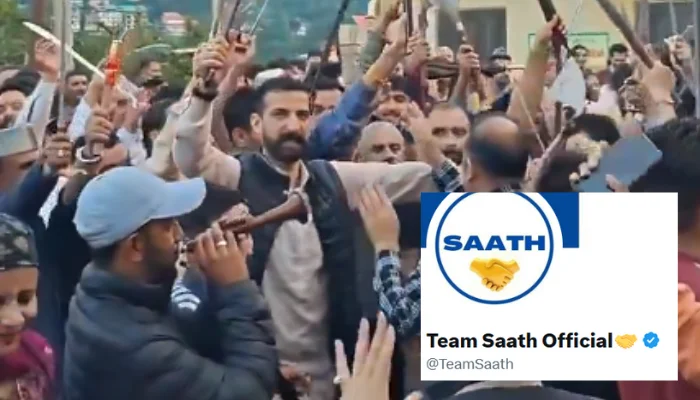
Case Summary
Hindus celebrating the Jagra festival, a folk Hindu festival of Himachal Pradesh, were labelled 'Hindutva terrorists' by a leftist social media account named 'Team Saath'. The Jagra festival is a prominent ritual event in the Jaunsar-Bawar region of Uttarakhand and Himachal Pradesh, dedicated to the worship of Mahasu Devta, a local Hindu deity, where villagers gather for night-long hymns, folk music, and cultural festivities. Traditionally held in the Hindu month of Bhadon (August–September), the festival involves processions, dances, and sacred offerings to seek blessings, protection, and prosperity from Mahasu Devta, serving as a vibrant showcase of regional folk culture and spiritual heritage. Team Saath shared a photo on its X (formerly Twitter) account depicting people celebrating the Jagra festival, with a few men carrying musical instruments and some carrying weapons. This image was misrepresented by the account to portray all Hindus as 'Hindutva terrorists'. In response to this tweet, Chetan Bragta, spokesperson and in charge of the state BJP’s IT and Social Media team, filed an official police complaint against Team Saath's account. Bragta urged the police officer to book Team Saath under Sections 153A and 295A. After submitting the complaint, Chetan Bragta tweeted, "Comparing Dev Sanskriti, Dev Samaj, Himachali Nati and Hinduism with terrorism is not only an insult to our traditions but also hurts the sentiments of crores of people. A police complaint has been filed against you." Reports also stated that ‘Team Saath’ had previously made a hit list of celebrities for taking a nationalist stand. The account also worked as a mouthpiece for Muslim extremists.
Why it is Hate Crime ?
This case has been added to the tracker under the primary category- Hate Speech against Hindus. Within this, the subcategory selected is- Anti-Hindu slurs, mocking faith. Anti-Hindu slurs and the deliberate mocking of the Hindu faith owing to religious animosity involve the usage of derogatory terms, stereotypes, or offensive references to religious practices, symbols, or figures. One of the common anti-Hindu slurs used against Hindus is “cow-worshipper” and “cow piss drinker”. The intention of using this term is to demean and mock Hindus as a group and their religious beliefs since Hindus consider the cow holy. Additionally, some symbols and the slurs attached to them have a historical context that exacerbates the insult, hate, stereotyping, dehumanisation and oppression against Hindus. Cow worship has been used for centuries to denigrate Hindus, insult their faith and oppress Hindus specifically as a religious group. There has been overwhelming documentation about how cow slaughter has been used to persecute Hindus with cow meat being thrown in temples and places of worship. There has also been overwhelming documentation where cow meat (beef) has been force-fed to Hindus to either forcefully convert them to Islam or denigrate their faith. Apart from cow worship, the Swastika – which holds deep religious significance for the Hindus – has also been misinterpreted and distorted to use as a slur against Hindus. Similarly, the worship of the Shivling has been used by supremacist ideologies and religions to denigrate Hindus owing to religious animosity. Such slurs and denigration stem out of inherent animosity and hate towards Hindus and their faith, therefore, it is categorised as hate speech targeted at Hindus specifically owing to their religious identity. This incident presented a clear instance of anti-Hindu hate speech, as the accused had misrepresented a photo and accused Hindus of Himachal Pradesh of being terrorists. Such behaviour showcased deep-seated animosity towards Hindus. This kind of misrepresentation, labelling Hindus as terrorists, created a negative stereotype, increased the risk of violence and discrimination, and stigmatised an entire community within a deeply spiritual and culturally rich region. By doing so, the accused had also denigrated Jagra, an important and sacred Hindu folk festival. The Jagra festival is a significant ritual event in Himachal Pradesh and Uttarakhand, rooted in devotion to Mahasu Devta. The act of denigrating such an esteemed festival constituted anti-Hindu hate speech because it disparaged not just a cultural event but also an expression of religious faith and local identity, directly attacking what all Hindus held sacred and celebrated each year. Notably, the accused used the term 'Hindutva' as a tool to attack Hindus in short, intentionally denigrating the broader concept. 'Hindutva' is often used as a euphemism to make the targeting of Hindus more palatable. Hindutva is essentially a unifying ideology for Hindus, which became imperative for Hindus to find and preserve their cultural identity, which was being eroded and attacked due to Islamic invasions, British colonisation, Christian theological impositions and conversions. Hindutva is not a destructive ideology, as some attempt to portray, but one that is used as a unifying edifice for Hindus. Hindutva is also often used as a euphemism to target Hindus on the whole and their religious identity and faith. It is essentially semantic jugglery to confuse Hindus into believing that their own persecution by anti-Hindu supremacists is somehow 'justified' because the specific victims espoused an ideology (Hindutva) which deserves the onslaught. The use of 'Hindutva' is merely a means to mask animosity towards Hindus became apparent during the "Dismantling Global Hindutva" conference held in the USA, where speakers openly stated that Hindutva and Hinduism were indistinguishable, and therefore, to "dismantle Hindutva" one would have to "dismantle Hinduism". Similarly, in this case, the act of targeting Hindus and their religious and cultural festival by using euphemisms such as 'Hindutva' and calling them 'terrorists' demonstrated that the perpetrator sought to target the Hindu community for their faith, making it a religiously motivated hate speech. Given that this case meets the parameters of a religiously motivated hate speech, it is being added to the hate crime database.


Case Status
Complaint filed


Perpetrators Details
Perpetrators
Others
Perpetrators Range
One Person
Perpetrators Gender
unknown
 Sources




