Hindu students punished for saying "Jai Shri Ram" on school premises
 Jhabua, Madhya Pradesh, India
  27 September, 2024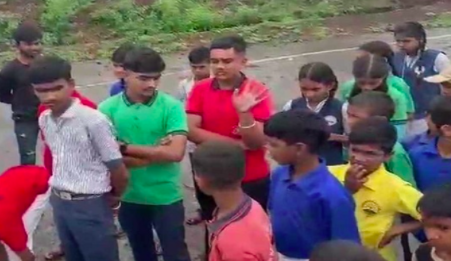
Case Summary
In a private school in the Jhabua district of Madhya Pradesh, Hindu school students were punished by the teacher for saying "Jai Shri Ram". The teacher asked the students not to chant "Jai Shri Ram", "Ram Ram", or "Radhe Shyam" inside the school campus and asked them to instead only say "Good Morning". The teacher also punished the students for the same. The matter escalated when one student went home and complained to his family. The family, thereafter, reached the school and complained to the authorities. Members of the Hindu organisation ABVP, after receiving the information, reached the school and started protesting outside the school demanding strict action against the accused teacher.
Why it is Hate Crime ?
This particular case has been classified as a religiously motivated hate crime under two prime categories of the tracker. The first is- Attack not resulting in death. Under this, the sub-category selected is- Attacked for Hindu identity. In several cases, Hindus are attacked merely for their Hindu identity without any perceived provocation. A classic example of this category of religiously motivated hate crime is a murder in 2016. 7 ISIS terrorists were convicted for shooting a school principal in Kanpur because they got ‘triggered’ seeing the Kalava on his wrist and tilak that he had put. In this, the Hindu victim had offered no provocation except for his Hindu religious identity. The motivation for the murder was purely religious, driven by religious supremacy. Such cases where Hindus are targeted merely for their religious identity would be documented as a hate crime under this category. The second prime category selected here is- Restriction/ban on Hindu religious practices. Within this, the sub-category selected is- Restriction of expression of Hindu identity. An example of the state-affected prejudicial and targeted orders against the Hindu community would be a government denying the right of a Hindu or a group of Hindus to hold a religious procession owing to the animosity of non-Hindu groups. Denial of the religious right of the Hindus to assuage the non-Hindu group which harbours animosity to a point where it could lead to violence against Hindus is not only a failure of law and order but is a prejudicial order against Hindus, denying them their fundamental rights to express their religious identity. An example of a hate crime against Hindus by a non-Hindu would be a non-Hindu institution forcing its Hindu employees to abandon religious symbols that a Hindu would wear as an expression of faith owing to inherent prejudice against the faith professed by the victim or a non-Hindu group of people restricting a Hindu group from constructing a place of worship simply because the demography of the area in which the temple is being built is dominated by non-Hindus. Such actions are driven by religious animosity and/or prejudice against Hindus and their faith and would therefore be categorized as a hate crime. The religious markers in this incident that categorise it as a religiously motivated hate crime stem from the discriminatory action taken against the Hindu students for using the holy Hindu chant "Jai Shri Ram." The teacher's punitive response directly targeted his expression of Hindu religious identity. The phrase "Jai Shri Ram" is deeply rooted in Hindu devotion and cultural ethos, making the punishment for using it an act of religious intolerance. By penalising a student for a harmless religious greeting, the administration not only infringed on his freedom of expression but also conveyed a message of disdain for Hindu traditions. This deliberate suppression of a Hindu religious expression demonstrates animosity toward the faith, highlighting the religious bias at the core of this incident. Since such actions stem from an intrinsic animosity for Hindus and their beliefs, this case has been categorised as a hate crime and included in the tracker.


Case Status
Unknown


Perpetrators Details
Perpetrators
Others
Perpetrators Range
One Person
Perpetrators Gender
unknown
 Sources




