Hindu deity idols made for upcoming festival vandalised by Muslim man
 Mymensingh, Mymensingh District, Bangladesh
  18 December, 2024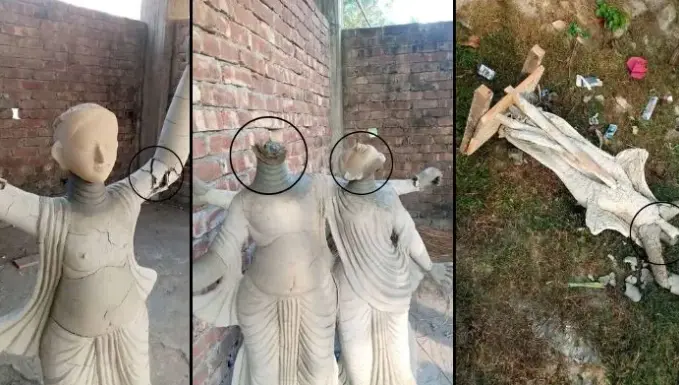
Case Summary
In Haluaghat Upazila, Mymensingh district, Bangladesh, a 37-year-old Muslim man named Azharul vandalised several idols of Hindu deities. The idols, being prepared for an upcoming Hindu festival, were located inside a temple. Visuals of the incident shared on social media showed that the accused had beheaded the idols. The act caused outrage among the local Hindu community. The Officer-in-Charge of Haluaghat Police Station, Abul Khair, confirmed the arrest of Azharul in connection with the vandalism. He stated that the accused would be presented in court for further legal proceedings. The incident occurred amid heightened chaos following the fall of Sheikh Hasina’s Awami League government on August 5, 2024. The political instability allowed Islamist extremists to escalate violence against the Hindu community. Hindu homes were attacked and burned, women were abducted, and several temples in the region were destroyed. The arrest of three Hindu priests further intensified tensions, prompting protests by Hindu minorities across Bangladesh. Protestors demanded justice and protection in the face of increasing violence and anarchy. The situation highlighted the worsening plight of Hindus under the new Islamist regime, led by Muhammad Yunus, as attacks on their communities continued unabated.
Why it is Hate Crime ?
This case has been added to the tracker under the prime category of- Attack on Hindu religious representations. Under this, the first sub-category selected is- Attack on Temples. In Hinduism, a temple is the abode of the Deity. The Deity in the Temple is consecrated, thereby, making it a real, breathing entity. Hindus believe that not just the Deity but the temple premises itself are sacred to Hindus since Hindus hold the faith that the entire Temple space is an amalgamation of the divine energy of the deity. Given the central significance of Temples in Hindu Dharma, any attack against a Hindu Temple or its peripheral premises is an attack on the faith itself and is born out of animosity towards the faith, of which, the Temple is a central tenet. Any manner of attack against a Temple and/or its premises would therefore be considered a religiously motivated hate crime. The second sub-category selected here is- Desecration of Hindu religious symbol. Icons and symbols or a religious representation of a spiritual ideal are widely revered in Hinduism. Iconography is of vital significance in the Hindu milieu. It helps connect people’s spiritual beliefs with the real world. Iconography within the Hindu faith takes several shapes and forms. Murtis are of most significance to Hindus, to which daily rituals, prayers and offerings are done. Besides the murtis, there are several other symbols which have deep significance in the Hindu faith – the Om and Swastika for example. Since these Hindu religious symbols hold paramount importance in Hinduism, any desecration of symbols, icons, murtis, religious representations and manifestations, is driven by animosity towards the faith itself which manifests itself through these murtis, icons and symbols. Therefore, any desecration of these Hindu religious symbols and representations is considered religiously motivated hate crimes under this category. The removal of Sheikh Hasina from power in Bangladesh on August 5, 2024, escalated the persecution and marginalisation of the Hindu minority in the predominantly Islamic nation, intensifying what can be described as a silent genocide. Since her ouster, Islamists have carried out unchecked atrocities against Hindus, including physical violence, the destruction of temples and religious symbols, and the systematic displacement of Hindus from their ancestral lands. Over 205 attacks on Hindu temples, shops, and businesses have been recorded following Sheikh Hasina's removal as Prime Minister. Many Hindus have been brutally murdered or injured in these assaults. Amid this, this report indicates that the Muslim man vandalised several idols of Hindu deities. Hinduism holds its deities in deep reverence, considering them sacrosanct. The deliberate desecration of Hindu idols, as seen in this case, is viewed as sacrilegious. Such actions are often driven by deep-seated animosity and deliberate intent to insult Hinduism. This offence against religious sentiments qualifies as a clear example of hate, warranting its inclusion in the tracker.


Case Status
Arrested


Perpetrators Details
Perpetrators
Muslim Extremists
Perpetrators Range
One Person
Perpetrators Gender
male
 Sources




