54 ISKCON members stopped by Bangladesh immigration officials from travelling to India for religious event despite valid documents
 Bangladesh
  29 November, 2024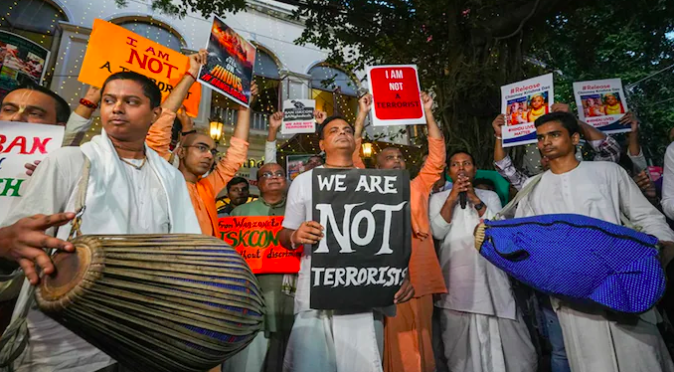
Case Summary
Bangladesh border authorities denied entry to 54 members of the Hindu spiritual organisation ISKCON, preventing them from crossing into India despite their possession of valid passports and visas. The group, comprising of devotees from various districts, had arrived at the Benapole border on November 30 and December 1 2024 morning to attend a religious ceremony in India. After hours of waiting, they were informed that their travel was not authorised due to the absence of specific government permission. Immigration officials cited instructions from higher authorities as the reason for the denial. Imtiaz Ahsanul Quader Bhuiyan, a Benapole Immigration Police officer, confirmed that the group was barred from crossing the border after consultations with the special branch of police. The members, including Saurabh Tapandar Cheli, expressed disappointment, emphasising that they had prepared for the religious event but were stopped due to government restrictions. This incident occurred amid increasing scrutiny of ISKCON in Bangladesh, where the organisation faced several actions from authorities. Notably, the arrest of Hindu monk and former ISKCON member Chinmoy Krishna Das on sedition charges escalated tensions. His arrest, subsequent denial of bail, and imprisonment triggered violent protests, resulting in the death of a lawyer. Additionally, two more Hindu priests, Rudraproti Kesab Das and Ranga Nath Syama Sundor Das, were arrested during the unrest. Bangladeshi authorities had also frozen the bank accounts of 17 ISKCON affiliates, including those linked to Chinmoy Krishna Das, for 30 days.
Why it is Hate Crime ?
The first sub-category relevant in this case is 'Administration restricting religious practice' under the prime category, 'Restriction/ban on Hindu practices' of the Hinduphobia tracker. In several cases, it is seen that the administration/state disallows a religious practice owing to prejudicial orders and concerns, targeted specifically against the Hindu community. Such restriction/prohibition would be considered documented as a hate crime because the orders are often a result of pressure by groups that harbour animosity towards Hinduism and Hindus. Often, the restriction by the authorities is driven by bias, hostility, or prejudice against the specific community being stopped from holding a religious practice, by pressure groups that harbour animosity towards Hindus, intrinsic to their faith. Since practices are intrinsic to the faith of the Hindus, such prejudicial restriction is considered a curtailing of the fundamental rights of the Hindu community. In several cases, for example, the authorities ban a Hindu religious practice due to pressure from groups opposed to the religion. In other instances the prohibition is selectively enforced against one religious group (Hindus) while others are allowed to proceed. There are still other cases where the authorities preemptively restrict a religious practice by Hindus because those who hold animosity towards Hindus may get “provoked” leading to them being violent, thereby assuaging the sentiments of those who hold animosity towards Hindus by curtailing the religious rights of Hindus. Such acts and orders are prejudiced, indicating discriminatory motives owing to the capitulation to groups that harbour animosity towards Hindus and therefore, would be categorized as a religiously motivated hate crime since the original pressure leading to the order itself is a result of hatred/bias/prejudice/religious hate against Hindus. The second sub-category relevant in this case is 'Attacked for Hindu identity' under the prime category, 'Attack not resulting in death' of the hate tracker. In several cases, Hindus are attacked merely for their Hindu identity without any perceived provocation. A classic example of this category of religiously motivated hate crime is a murder in 2016. 7 ISIS terrorists were convicted for shooting a school principal in Kanpur because they got ‘triggered’ seeing the Kalava on his wrist and tilak that he had put. In this, the Hindu victim had offered no provocation except for his Hindu religious identity. The motivation for the murder was purely religious, driven by religious supremacy. Such cases where Hindus are targeted merely for their religious identity would be documented as a hate crime under this category. The removal of Sheikh Hasina from power in Bangladesh on August 5 escalated the persecution and marginalisation of the Hindu minority in the predominantly Islamic nation, intensifying what can be described as a silent genocide. Since her ouster, Islamists have carried out unchecked atrocities against Hindus, including physical violence, the destruction of temples and religious symbols, and the systematic displacement of Hindus from their ancestral lands. Over 205 attacks on Hindu temples, shops, and businesses have been recorded following Sheikh Hasina's removal as Prime Minister. Many Hindus have been brutally murdered or injured in these assaults. Amidst this ongoing large-scale persecution of Hindus in Bangladesh, 54 members of the International Society for Krishna Consciousness (ISKCON) were reportedly stopped by Bangladeshi immigration authorities while attempting to travel to India. The members, many of whom were seeking to participate in religious activities and meet with ISKCON counterparts in India, were abruptly denied permission to cross the border. This denial of their right to travel, without reasonable justification, signals an effort to suppress their religious expression. This targeted action underscores the animosity toward Hindu faith practitioners in a climate already marked by violence, harassment, and socio-economic marginalization of Hindus. Since the arbitrary action taken against the ISCKON members was prejudicial to the rights of Hindus and stems from animosity and prejudice against Hindu beliefs, this case is being categorised as a religiously motivated hate crime.
Victim Details
Total Victim
54
Deceased
0
Gender
- Male 0
- Female 0
- Third Gender 0
- Unknown 54
Caste
- SC/ST 0
- OBC 0
- General 0
- Unknown 54
Age Group
- Minor 0
- Adult 54
- Senior Citizen 0
- Unknown 0


Case Status
Unknown


Perpetrators Details
Perpetrators
State and Establishment
Perpetrators Range
Unknown
Perpetrators Gender
unknown
 Sources




