Bus passing through Bangladesh attacked by mob, Indian passengers threatened
 Brahmanbaria District, Bangladesh
  29 November, 2024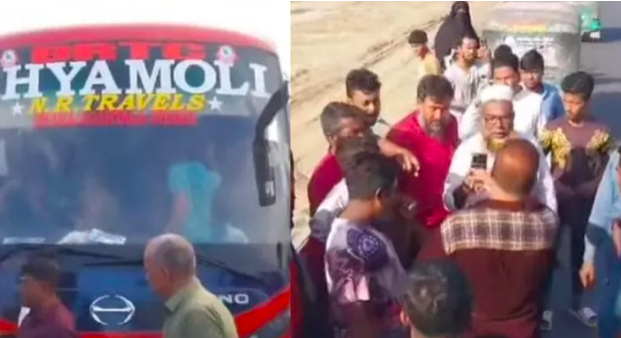
Case Summary
A bus travelling from Agartala, Tripura, to Kolkata, West Bengal, via Bangladesh was attacked in Brahmanbaria district. The incident began when the bus was struck from behind by a goods-laden truck on Bishwa Road, causing it to crash into an auto-rickshaw. Witnesses and passengers said the collision was deliberate and intended to create a hostile situation for the Indian passengers aboard. Following the crash, locals quickly gathered at the site, chanting anti-India slogans and targeting the passengers with derogatory comments. Many of the remarks were threatening, with some locals vowing to kill the passengers. The coordinated nature of the attack, as suggested by the passengers, raised suspicions of premeditation. Tripura Transport Minister Sushanta Chowdhury voiced concerns in a social media statement, where he said that the truck deliberately caused the accident, triggering the subsequent threats and abuses. He described the fear experienced by the passengers and urged the Bangladeshi administration to intervene promptly to prevent such incidents from recurring.
Why it is Hate Crime ?
This case has been added to the primary category 'Attack not resulting in death' under the secondary category 'Attacked for Hindu identity'. In several cases, Hindus are attacked merely for their Hindu identity without any perceived provocation. A classic example of this category of religiously motivated hate crime is a murder in 2016. 7 ISIS terrorists were convicted for shooting a school principal in Kanpur because they got ‘triggered’ seeing the Kalava on his wrist and tilak that he had put. In this, the Hindu victim had offered no provocation except for his Hindu religious identity. The motivation for the murder was purely religious, driven by religious supremacy. Such cases where Hindus are targeted merely for their religious identity would be documented as a hate crime under this category. In this case, there was victim testimonies that have detailed how the accident was a deliberate one - essentially - a goods carrier deliberately rammed into the bus to ensure the bus, travelling from and to India, passing my Bangladesh, was incapacitated. Thereafter, a Muslim mob attacked the bus, hurled anti-India slogans and threatened the Indian passengers with death. It could be said in this case that the Bangladeshi mob was essentially against Hindus and not specifically Hindus, which is why this case should not be added to the hate crime database. It is pertinent to note that Muslim extremists harbour specific animosity towards Hindus and their faith and also view India as a Hindu collectivity. The very basis of the partition of India was that the Muslims believed that Islam was a nation unto itself, which could not survive with a Hindu collectivity like India. Further, Muslims often believe in transnational unity - or the Ummah - which is a belief that all Muslims across the world are a nation unto themselves and therefore, loyalty as far as the nation-state is concerned lies with the Muslim collectivity and not with a Hindu collectivity like India. This would also mean that Bangladesh Muslims, when they attack India, raise slogans against India or attack a bus with Indian passengers, as in this case, it is an expression of animosity towards India as a Hindu collectivity and not India as a bordering nation alone. On August 5th, Bangladesh plunged into chaos after a successful coup ousted Prime Minister Sheikh Hasina, forcing her to flee the country as an enraged mob approached her residence. In the wake of the coup, Islamists exploited the unrest to launch violent attacks on the Hindu community, leading to numerous deaths, rapes, and the destruction of Hindu homes, shops, and temples, many of which were set on fire. In Shayestaganj Bazaar, Habiganj, there was a violent attack, vandalism, and looting at the shop of Asit Baran Das, the president of the Upazila Unity Council. Minority homes in Lohagara, Narail, were subjected to an attack that included vandalism, looting, and harassment, causing significant distress and damage. Further, when there is an ongoing ethnic cleansing based on religious identity, every crime in and of itself is assumed to be motivated by the same religious animosity even if there is a lack of specific religious marker in the immediate crime. During an ongoing ethnic cleansing of Hindus in Bangladesh, the dehumanisation of a people based on their religious identity and the normalisation of religious hostility drives the crimes committed against them even when there is a lack of stated religious motive. For the purpose of documenting the 2024 ethnic cleansing of Hindus in Bangladesh, the Hinduphobia Tracker is assuming religious motivation ab initio. If a case is specifically and beyond reasonable doubt proven to be driven by motivations other than religious hostility, it will post-facto be removed from the hate crime database.


Case Status
Unknown


Perpetrators Details
Perpetrators
Muslim Extremists
Perpetrators Range
Unknown
Perpetrators Gender
unknown
 Sources




