Attack on Hindu sentiments: Muslim boy hails Islamic tyrant and denigrates revered Hindu king on social media
 Bhiwandi, Maharashtra, India
  4 May, 2023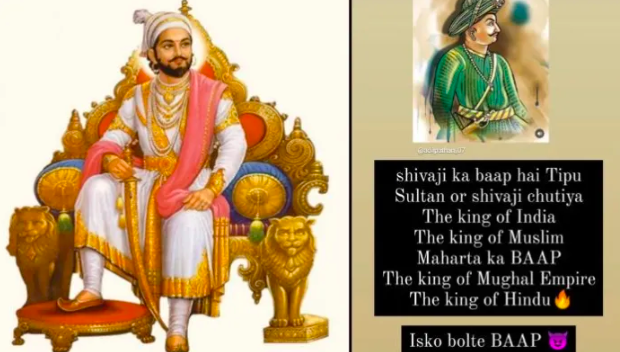
Case Summary
In Bhiwandi, Maharashtra, the sentiments of the Hindu community were deliberately hurt by a Muslim boy named Avesh Sheikh. The accused, on his Instagram, hailed Tipu Sultan, a brutal Islamic ruler known for massacring numerous Hindus and destroying Hindu temples. Additionally, the accused denigrated and abused the revered Hindu king, Chhatrapati Shivaji Maharaj of the Maratha Empire. According to media reports, the accused, a 16-year-old boy, was detained by Bhiwandi police for posting objectionable content against Shivaji Maharaj on Instagram. The accused had posted an Instagram story that belittled Shivaji Maharaj and praised Tipu Sultan, stating that Shivaji's father was Tipu Sultan and that Shivaji was insignificant. He stated, “Shivaji ka baap hai Tipu Sultan or Shivaji chu*iya.” He further added, “The king of the Mughal empire…The king of Hindu…Isko bolte baap." The accused was implying that Aurangzeb was the true father figure and Shivaji Maharaj was inferior. The post provoked public outrage and was reported by Hindu rights activist Trupti Garg, who sought intervention from Mumbai police. A First Information Report was filed under charges of outraging religious sentiments and creating enmity between communities based on a complaint from a Bhiwandi resident and members of the Bajrang Dal. The complainant, an autorickshaw driver named Uday Pawar, noticed the Instagram post and lodged a complaint with Bajrang Dal activists. Police investigations led to the accused's arrest. In accordance with the law, the Muslim boy was sent to the Bhiwandi Children’s Home.
Why it is Hate Crime ?
This case has been added to the tracker under the primary category- Hate Speech against Hindus. The subcategory selected is- Anti-Hindu slurs, mocking faith. Anti-Hindu slurs and the deliberate mocking of the Hindu faith owing to religious animosity involve the usage of derogatory terms, stereotypes, or offensive references to religious practices, symbols, or figures. One of the common anti-Hindu slurs used against Hindus is “cow-worshipper” and “cow piss drinker”. The intention of using this term is to demean and mock Hindus as a group and their religious beliefs since Hindus consider the cow holy. Additionally, some symbols and the slurs attached to them have a historical context that exacerbates the insult, hate, stereotyping, dehumanisation and oppression against Hindus. Cow worship has been used for centuries to denigrate Hindus, insult their faith and oppress Hindus specifically as a religious group. There has been overwhelming documentation about how cow slaughter has been used to persecute Hindus with cow meat being thrown in temples and places of worship. There has also been overwhelming documentation where cow meat (beef) has been force-fed to Hindus to either forcefully convert them to Islam or denigrate their faith. Apart from cow worship, the Swastika – which holds deep religious significance for the Hindus – has also been misinterpreted and distorted to use as a slur against Hindus. Similarly, the worship of the Shivling has been used by supremacist ideologies and religions to denigrate Hindus owing to religious animosity. Such slurs and denigration stem out of inherent animosity and hate towards Hindus and their faith, therefore, it is categorised as hate speech targeted at Hindus specifically owing to their religious identity. The other subcategory selected is- Mocking/denigrating Hindu leaders. Hate speech is defined as any speech, gesture, conduct, writing, or display that is prejudicial against a specific individual and/or group of people, which is leading to or may lead to violence, prejudicial action or hate against that individual and/or group. Religious leaders are often seen as representatives of the community, especially, the community’s religious faith and beliefs. Mocking or denigrating a religious leader specifically owing to his religious identity and/or the religious rituals he observes can be considered hate speech because the motivating factor of the speech is animosity and/or dislike for what he represents – the religious beliefs and faith of the community. It is important to note that mere insulting words against an individual do not constitute hate speech. It is entirely possible that insulting words are used for an individual, however, the specific speech is not the result of religious hate and/or animosity towards the professed faith of the religious leader, but the individual himself. For the speech to be considered hate speech, the speech itself or the motivating factor behind the speech has to be religious in nature. Such speech which denigrates Hindu religious leaders specifically owing to animosity towards the faith they profess and the community faith they represent will be treated as hate speech under this category. The incident was a direct case of anti-Hindu hate speech. By glorifying Tipu Sultan, the Muslim accused invoked a historical figure remembered for massacring Hindus, forcibly converting lakhs of them, and destroying temples. Elevating such a tyrant was not an act of historical discourse; it was a deliberate endorsement of persecution and genocide against Hindus due to their faith. To praise a figure synonymous with violence and oppression against a religious community was to express open hostility towards that community. This action represented clear religious animosity, intended not only to provoke but also to offend Hindus by recalling their historical suffering. The offence did not end there. The accused further attempted to humiliate the Hindu community by denigrating and abusing Chhatrapati Shivaji Maharaj, one of the most revered kings in Hindu history. Shivaji Maharaj is widely respected as a protector of the Hindu faith, the Maratha kingdom, and a resolute leader who fought against the Islamic tyrants of his time. By portraying him in a subservient posture before Tipu Sultan and abusing him with slurs, the accused mocked his legacy and insulted the collective pride of the Hindu community. This deliberate distortion was intended to wound religious feelings, belittle a religious icon, and ridicule a figure venerated as a symbol of Hindu resistance and sovereignty. Both these actions, when taken together, established a pattern of deliberate hate expression. On one hand, the accused glorified a figure who represented the persecution of Hindus, and on the other, he humiliated and abused a king revered for defending Hindu civilisation. Such speech was not benign provocation, but rather a calculated insult aimed squarely at the Hindu community, its beliefs, and its icons. This incident was not just offensive content on social media; it was religiously motivated hate speech against Hindus. Therefore, this case is being added to the hate crime database. Disclaimer: The Hinduphobia Tracker records the dates of incidents based on when a crime occurs rather than when the media reports it. However, in this particular case, media reports did not state the exact date when the crime occurred; they only highlighted when screenshots of the accused abusing Chhatrapati Shivaji Maharaj went viral on social media—5 May 2023. Henceforth, this date is being selected as the indicative date of the incident for documentation purposes.


Case Status
Arrested


Perpetrators Details
Perpetrators
Muslim Extremists
Perpetrators Range
One Person
Perpetrators Gender
male
 Sources




