Educator formerly with Unacademy subverts scriptures, denigrates Lord Ram and Ramayan
 India
India  4 May, 2023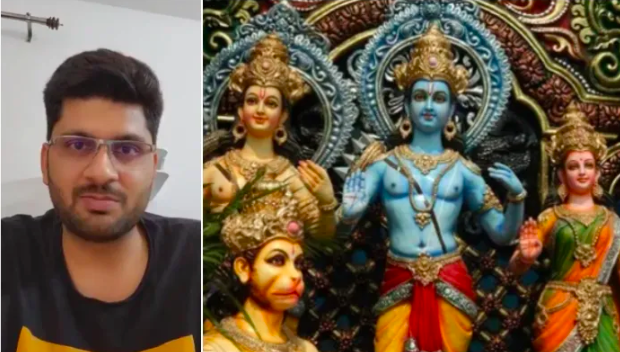
Case Summary
Aman Vashishth, a former English teacher at Unacademy, used derogatory language against Lord Ram and mocking the Ramayan in a video that resurfaced on social media. In the video, he made fun of King Dashrath and his wives, questioning the paternity of their children and making disparaging remarks about Lord Ram's loss of Goddess Sita. “Lord Ram had also lost his only source of entertainment and time pass- Goddess Sita, after she was abducted by Ravan”, said Aman. Vashishth, who had faced action by Jaipur police earlier, attributed his comments to a five-year-old video, expressing regret and acknowledging the impact of his words. He claimed that he had been on anti-depressants for the past two years, stopped teaching for a period, and recently resumed teaching on the 'Careerwill App.' Notably, he owns an English teaching mobile application named AVS which stands for ‘Aman Vashishth Sir’, last updated in 2022.
Why it is Hate Crime ?
This case has been added to the hate tracker under the primary category 'Hate speech against Hindus'. Under this, two sub-categories have been selected. The first is- 'subversion of scriptures'. Misquoting the religious scriptures of Hindus has particularly devastating consequences. Misquoting the scriptures of Hindus is often done to justify or promote hatred, discrimination, or violence against specific individuals or groups of Hindus. Religious scriptures are often nuanced and those who harbour religious animosity towards Hindus often misquote or misrepresent the scripture to legitimise their animosity and hate towards the faith and its adherents. Religious scriptures have often been misquoted to present stereotypical lies about Hinduism being “oppressive” and therefore, legitimising the violence against Hindus by extremist and supremacist ideologies. Any such misquoting of scriptures to justify hate, violence and discrimination against Hindus owing to religious animosity is hate speech and is categorised as such. The second sub-category selected under the above-mentioned prime category is 'Anti-Hindu slurs, mocking faith'. Anti-Hindu slurs and the deliberate mocking of the Hindu faith owing to religious animosity involve the usage of derogatory terms, stereotypes, or offensive references to religious practices, symbols, or figures. One of the common anti-Hindu slurs used against Hindus is “cow-worshipper” and “cow piss drinker”. The intention of using this term is to demean and mock Hindus as a group and their religious beliefs since Hindus consider the cow holy. Additionally, some symbols and the slurs attached to them have a historical context that exacerbates the insult, hate, stereotyping, dehumanisation and oppression against Hindus. Cow worship has been used for centuries to denigrate Hindus, insult their faith and oppress Hindus specifically as a religious group. There has been overwhelming documentation about how cow slaughter has been used to persecute Hindus with cow meat being thrown in temples and places of worship. There has also been overwhelming documentation where cow meat (beef) has been force-fed to Hindus to either forcefully convert them to Islam or denigrate their faith. Apart from cow worship, the Swastika – which holds deep religious significance for the Hindus – has also been misinterpreted and distorted to use as a slur against Hindus. Similarly, the worship of the Shivling has been used by supremacist ideologies and religions to denigrate Hindus owing to religious animosity. Such slurs and denigration stem out of inherent animosity and hate towards Hindus and their faith, therefore, it is categorised as hate speech targeted at Hindus specifically owing to their religious identity. Aman Vashishth's derogatory remarks about Lord Ram and the Ramayana constitute a clear case of overt mockery of the faith. His offensive comments about King Dashrath, Lord Ram, and Goddess Sita not only distort the revered Hindu epic but also denigrate figures deeply respected within the religion. By questioning the paternity of King Dashrath's children and trivializing Goddess Sita’s abduction as Lord Ram losing his "source of entertainment," Vashishth reduces sacred religious narratives to mere objects of ridicule. This act goes beyond mere irreverence; it reflects a deeper animosity towards Hinduism and its beliefs, aiming to discredit and insult the values it upholds. The mockery of these deities symbolizes a lack of respect for the sentiments of millions of Hindus who revere these divine figures, and it perpetuates a dismissive attitude toward their spiritual and cultural heritage. This incident highlights how such expressions are rooted in deep disdain for the Hindu religion. There could be no other reason than an inherent animosity against Hinduism that led them to commit the offence. Since disrespect for the Hindu religion is the primary purpose behind this incident, this case has been added to the tracker under the following category.


Case Status
Unknown


Perpetrators Details
Perpetrators
Others
Perpetrators Range
One Person
Perpetrators Gender
male
 Sources




