Hindu man brutally murdered for his religious identity by Muslim attackers in Khatima, Uttarakhand
 Udham Singh Nagar, Uttarakhand, India
  11 December, 2025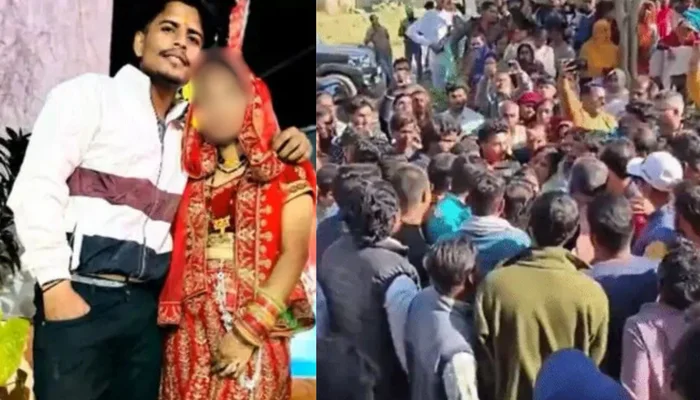
Case Summary
In the Khatima town of Udham Singh Nagar district, Uttarakhand, a 24-year-old Hindu man named Tushar Sharma was brutally murdered by a Muslim mob because of his Hindu identity. The incident took place on 12 December 2025 between 9:30 and 10:00 pm near the roadways bus stand, where Tushar, along with his friends Salman and Abhay, was standing at a tea stall. During this time, an argument broke out with a group of Muslim men from Gotiya Islamnagar, due to an old rivalry, which rapidly escalated into a one-sided violent attack by the Muslim men. The Muslim attackers drew knives and, according to eyewitnesses, shouted “He is a Hindu, stab him with the knife” before repeatedly stabbing Tushar. Salman and Abhay were also attacked and sustained injuries. All three were rushed to the hospital, where Tushar succumbed to his injuries, while the other two were referred to another hospital for further treatment. The attackers fled the scene immediately after the brutal attack. Tushar worked at a transport company on Pilibhit Road and had been married only a year and a half earlier. His father, Manoj Sharma, earned a living as a knife and scissors sharpener. The killing of the Hindu man triggered widespread outrage among the victim’s family and local residents, who gathered outside the Khatima police station, staged protests, and demanded the immediate arrest of those responsible. Communal tensions escalated in the town, prompting heavy police deployment and the formation of multiple teams to trace the attackers. In the aftermath, protests and a local shutdown were reported, during which the shop belonging to the father of one of the accused was set on fire by angry locals. To prevent further escalation, police resorted to a lathi-charge to disperse crowds. Subsequently, the local administration carried out bulldozer action against illegal encroachments on Public Works Department land in the area, including the shop linked to the family of one of the accused, stating that the location had become a hub for antisocial activities and that complaints had been pending for a long time.
Why it is Hate Crime ?
This case has been added to the tracker under the primary category of - Attack resulting in death. Within it, the sub-category selected is - Attacked for Hindu identity. In several cases, Hindus are attacked merely for their Hindu identity without any perceived provocation. A classic example of this category of religiously motivated hate crime is a murder in 2016. 7 ISIS terrorists were convicted for shooting a school principal in Kanpur because they got ‘triggered’ seeing the Kalava on his wrist and tilak that he had put. In this, the Hindu victim had offered no provocation except for his Hindu religious identity. The motivation for the murder was purely religious, driven by religious supremacy. Such cases where Hindus are targeted merely for their religious identity would be documented as a hate crime. Under this category, cases where the attack led to the death of the Hindu victim/s would be documented. The other sub-category selected is - Communal clash/attack. Communal clash is a form of collective violence that involves clashes between groups belonging to different religious identities. For a communal clash between Hindus and non-Hindus to qualify as a religiously motivated hate crime, the trigger of the violence itself would have to be anti-Hindu in essence. For example, if there is a Hindu religious procession that comes under attack from a non-Hindu mob, and after the initial attack, Hindus retaliate in self-defence, leading to a communal clash between the two religious communities. While at a later stage, both communities are involved in the clash/violence, the initial trigger of the violence was by the non-Hindu mob against the Hindus and therefore, it could safely be termed as an anti-Hindu violence. Further, the trigger would also have to be religiously motivated. In the cited example, the attack by the non-Hindu mob was against a religious procession and therefore, can be concluded to be religiously motivated. In some cases, the trigger may be non-religious, however, it develops into religious violence against Hindus at a later stage. In such cases too, the foundational animosity towards Hindus becomes the motivating factor of the crime and therefore, it would be classified as a religiously motivated hate crime against Hindus. Under this category, cases where the attack led to the death of the Hindu victim/s would be documented. This case has been added to the tracker because it demonstrated a clear instance of religion-based targeting where the victim’s Hindu identity became the decisive trigger for lethal violence. The killing of Tushar Sharma did not remain confined to an interpersonal dispute or an ordinary rivalry that escalated rapidly. While the initial confrontation may have stemmed from an old rivalry, the character of the violence changed decisively when the Muslim attackers explicitly declared, “He is a Hindu, stab him with the knife,” before stabbing him to death. This clearly indicated the communal nature of the whole attack, rooted in religious hostility rather than momentary anger or spontaneous aggression. At that point, the act ceased to be a fight and became an assertion of Muslim dominance over a Hindu individual. The sheer severity of the attack in response to a minor argument or rivalry highlights the underlying animosity the members of the Muslim community hold against Hindus. These actions reflect a dangerous mindset of religious supremacy that demands dominance and submission through violence. In such cases, even minor, non-religious provocations are met with aggressive retaliation when the victim is Hindu, revealing an alarming pattern of identity-driven hostility that defines such hate crimes. This pattern of disproportionate retaliation, driven by identity-based hostility, is what qualifies the incident as a hate crime. This disproportionate reaction is rooted in a mindset of Islamic supremacy, wherein Muslims view Hindus as socially and religiously inferior. This supremacist attitude fosters disdain and aggression, especially when a Hindu does not submit or “yield” in a dispute or an argument. The belief that Hindus lack equal standing leads to violent enforcement of dominance, often under the pretext of minor disagreements. The readiness to use violence under the pretext of minor issues exposes the continuing threat Hindu communities face, as these incidents are not isolated or spontaneous but part of an ongoing pattern of religiously motivated violence. In this light, the murder of Tushar Sharma must be understood as a hate crime against Hindus, where religious identity functioned as the justification for extreme violence. The old rivalry served merely as a pretext, while the religious identity of the victim was the real target. When a mob invokes a victim’s faith to legitimise killing him in a public space, the crime cannot be considered a personal dispute; it was rather a one-sided communal attack against a Hindu man. This case, therefore, fit squarely within a pattern of targeted hostility where Hindus were attacked not for what they had done in that moment, but because of their religion. Thus, this case has been added to the tracker. Disclaimer: Hinduphobia Tracker documents incidents of violence against Hindus perpetrated by non-Hindu actors. Accordingly, only Tushar Sharma and his friend Abhay have been included in the victim count in this case. Although Salman was also injured in the attack, his assault occurred due to his association with the victims, whereas Tushar was targeted specifically on account of his Hindu religious identity.
Victim Details
Total Victim
2
Deceased
1
Gender
- Male 2
- Female 0
- Third Gender 0
- Unknown 0
Caste
- SC/ST 0
- OBC 0
- General 1
- Unknown 1
Age Group
- Minor 0
- Adult 1
- Senior Citizen 0
- Unknown 1


Case Status
Unknown


Perpetrators Details
Perpetrators
Muslim Extremists
Perpetrators Range
Unknown
Perpetrators Gender
male
 Sources




