Hindu man faces death threats from Muslim wife's family over their consensual interfaith marriage
 Greater Noida, Uttar Pradesh, India
  7 December, 2025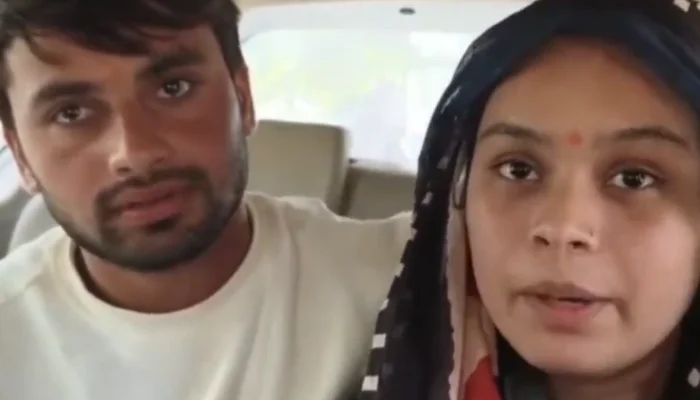
Case Summary
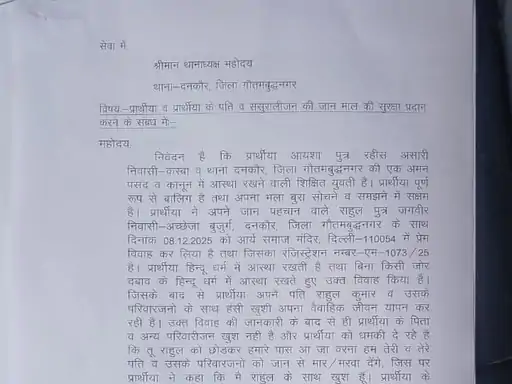
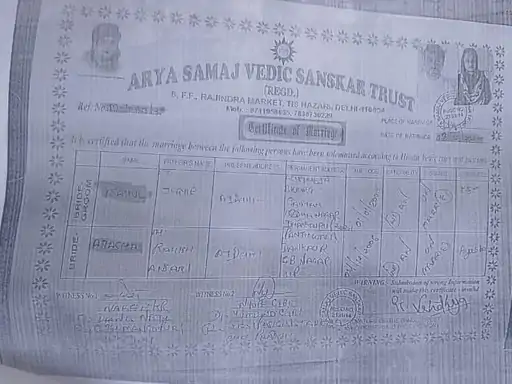
In Dankaur, Greater Noida, Uttar Pradesh, a Hindu man named Rahul faced death threats from his Muslim wife's family over his interfaith relationship and subsequent marriage to the Muslim woman named Aisha. This incident came to light when a video of Aisha and Rahul surfaced on social media in which Aisha gave testimony citing threats to her and her husband's lives from her family. She appealed to the police for protection. Aisha stated that, as an adult, she married Rahul, a resident of Dankaur, according to Hindu rituals at a temple in Delhi on 8th December 2025, without any pressure. She reiterated that she married of her own free will. In the video, Aisha said her family, particularly her father Raees Ansari, her uncles, Saleem and Azad, were upset with the relationship and that she and her husband were in danger. Due to threats from her family, they lived in fear and in hiding. Therefore, she sent a request for protection to the Gautam Buddha Nagar Police Commissioner through the Dankaur police. She also expressed fear that her family members could harm her at any time. In the viral video, she appealed to the police administration to provide her and her husband with adequate security so that they could begin their married life without fear. She also stated that she was an adult and the law gave her the right to marry the partner of her choice. Dankaur police stated they had not yet received any formal complaint in this matter. The police station confirmed that an investigation would begin upon receiving a written complaint, and legal action would be taken as needed.
Case Images
Why it is Hate Crime ?
This case has been added to the tracker under the first primary category- Men attacked for being associated with non-Hindu women. Within this, the subcategory selected is- Attacked/killed for being associated or suspicion of being associated with Muslim woman. There have been several cases documented of Hindu men/boys being attacked specifically by Muslim groups/mobs for merely being associated, or suspicion of being associated or being seen with a Muslim woman in public. In most of such cases, the Hindu man is not in a relationship with the Muslim woman; however, the mob proceeds to threaten and/or assault the Hindu man for merely being associated with the Muslim woman in any capacity. The rise of such crimes stems from a particularly sinister campaign run by several Muslim ideologues and activists. The campaign claims that Hindu men are attempting to ‘lure’ Muslim women into relationships to ensure that Muslim women leave their faith and follow Hinduism. The propaganda has been spearheaded with the help of WhatsApp groups and the extensive use of social media, sans evidence of the same. In many cases, pamphlets were fabricated to lend credence to this campaign. The root of this campaign lies in the fact that several cases of sectarian crimes against Hindu women in relationships with Muslim men have been documented. In such cases, Hindu women have often been forced/pressured to convert to Islam, assaulted, threatened and even murdered owing specifically to their religious identity and their refusal to give up that religious identity to adopt Islam. To delegitimize the suffering of Hindu women when such sectarian crimes are committed against them, the theory of ‘Bhagwa Love Trap’ was floated by sections of the Muslim community. As this theory gained traction, Muslim mobs started targeting Hindu men who were seen with Muslim women. In several such cases, the Hindu man was assaulted merely for offering to drop a Muslim woman off in his vehicle or for being friends. The differentiating factor between such cases and legitimate cases of Hindu women being targeted while in a relationship with Muslim men is that there is no sectarian violence, and force/pressure to convert. The nature of sectarian violence against Hindu women is not about two adults in a consensual relationship, working together, studying together, or even marrying each other, where religious considerations are declared. In this category of crimes, it is pertinent to remember that in none of the cases is there an element of the Hindu man masking his identity or forced religious conversion. Such cases are driven by specific religious motivations and against the religious identity of the victim and are therefore qualified as hate crimes. The other subcategory selected is- Attacked by non-Hindu partner or/and her family. When Hindu men are in a relationship with non-Hindu women, there are cases where the man is forced to convert his religion and upon his refusal to do so, the partner or/and her family attacks the victim. Such relationships may be consensual with the religious identity of the non-Hindu woman known to the victim. Somewhere along the relationship, the non-Hindu woman or her family starts forcing/pressurizing the Hindu man to convert. In some of these cases, the association could be non-consensual as well or, the religious identity of the non-Hindu woman could be previously unknown to the Hindu victim. In such cases, the Hindu man is first forced/pressurized to change his religion by the non-Hindu woman or her family. The force/pressure could involve threats. The trigger for directing violence against the Hindu man is in these cases his refusal to comply and change his religion under threat and/or force. In other cases that have been documented, it is also seen that the Hindu partner is assaulted by the non-Hindu woman or her family simply for his relationship with the non-Hindu woman and by virtue of him following the Hindu faith and not the religion of the non-Hindu woman. In such cases, the relationship is consensual in most cases and the religion of both partners is known to the other. Often, in such cases, there is no direct force/pressure to convert either, however, the attack is a result of the Hindu man being in a relationship with the non-Hindu partner and not following her religion/following Hinduism specifically. Such cases are driven by specific religious motivations and against the religious identity of the victim and are therefore qualified as hate crimes. The second primary category selected is- Hate speech against Hindus. Within this, the subcategory selected is- Violent threats. Violent threats, explicit, implicit or implied, is the most dangerous form of hate speech since it goes beyond discriminatory and prejudicial language to express the intent of causing harm to an individual or a group of people based on their religious identity and faith. There could be several different kinds of threats that are issued to Hindus based on religious animosity. An explicit threat would mean the direct threat of violence towards an individual Hindu, a group of Hindus or Hindus at large. Physical violence, death threats, threats of destruction of property belonging to Hindus and threats of genocide would mean explicit threats against Hindus for their religious identity. Implicit threats may not be a direct threat but implied through the use of symbols of actions – for example, in the Nupur Sharma case, other than explicit threats, there were also implicit threats when Islamists took to the streets to burn and beat her effigies. It implies that they want to do the same to Nupur Sharma, thereby is considered an implicit threat. Violent threats can be delivered in person, through letters, phone calls, graffiti, or increasingly through social media and other online platforms. It would be important to understand that a threat – explicit or implicit, online or offline – to an individual who happens to be a Hindu does not qualify as a religiously motivated threat. Such a threat, while vile and dangerous, could be owing to non-religious reasons and/or personal animosity. To qualify as a religiously motivated threat, it would need to exhibit an indication that the individual is being targeted for religious reasons and/or owing to his/her religious identity as a Hindu. This case illustrates a distinct pattern of religiously motivated aggression against Hindu men for associations with non-Hindu women. The threats issued against Rahul by Aisha's family derive exclusively from his Hindu identity and his intention to marry a Muslim woman without converting to Islam. Such conduct fulfils the criteria for a religious hate crime, as the hostility is directed not toward the individual per se, but toward the religious community he represents. In the Islamic faith, a marriage is deemed illegitimate if the non-Muslim partner does not convert to Islam. For those who practice the faith, when their daughter marries a Hindu man without the man converting to Islam, the difference in religions followed becomes the main point of disapproval for the family of the Muslim woman. Because of the ingrained element of religious supremacy in Islam, even if the motivations are not explicit, it can reasonably be concluded as one of the determining factors of the attack committed by the Muslim family against the Hindu man. This case is a clear instance of religiously motivated violence targeting a Hindu man for being in a consensual interfaith relationship with a Muslim woman. It is important to note here that both the man and the woman involved in the relationship were adults and capable of making their own decisions and life choices. In fact, the Muslim woman released a video confirming the consensual nature of the relationship. Despite this, they were given death threats by the Muslim woman's family. Such actions go far beyond personal outrage and reflect a deeper religious hostility. This incident falls into a broader and disturbing pattern where Hindu men are targeted specifically for being in relationships with Muslim women. These assaults are often framed as matters of "honour," but the underlying motivation is deeply religious. In many such cases, the religious identity of the Hindu male partner, or his family, becomes the key trigger for violence, especially when there is no conversion to Islam. Even if conversion is not directly demanded in every case, the death threats or violence are often aimed at punishing the Hindu man for not adhering to Islamic norms in the context of a relationship with a Muslim woman. In this case, the death threats issued by Aisha's family were clearly rooted in religious animosity against Rahul's Hindu identity. Their actions were not driven by concern for the woman's well-being, who had, anyway, consented to the marriage, but by anger over a Muslim woman marrying a Hindu man without religious conversion. This makes it not just a case of familial opposition, but a hate crime motivated by religious bigotry against Rahul for his Hindu identity. Since this case involves the targeting of a Hindu man over his interfaith marriage with a Muslim woman, rooted in religious animosity, this incident is added to the hate crime database of the Hinduphobia Tracker. Disclaimer: In this case, it remains unclear whether the Muslim woman Aisha converted to Hinduism after marriage or identifies as a Hindu. The Hinduphobia Tracker records cases involving Hindu victims. Due to the lack of information on Aisha's current religious status, this crime is documented with a victim count of '1', referring solely to Rahul. His religious identity as a Hindu directly triggered the violent threats from the Muslim woman's family.
Victim Details
Total Victim
1
Deceased
0
Gender
- Male 1
- Female 0
- Third Gender 0
- Unknown 0
Caste
- SC/ST 0
- OBC 0
- General 0
- Unknown 1
Age Group
- Minor 0
- Adult 1
- Senior Citizen 0
- Unknown 0


Case Status
Complaint not filed


Perpetrators Details
Perpetrators
Muslim Extremists
Perpetrators Range
From 2 To 5
Perpetrators Gender
male
 Sources




