Anti-Hindu hate speech: Indian politician makes objectionable remark on Hindu proponents of Bhagavad Gita
 Karnataka, India
  5 December, 2025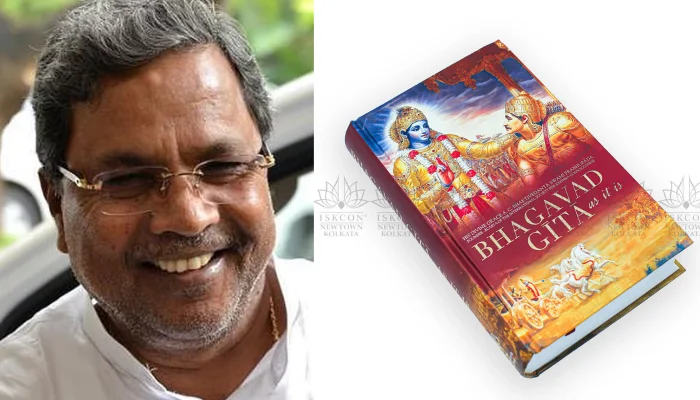
Case Summary
An anti-Hindu remark targeting Hindus and their sacred scripture Bhagavad Gita, was made by Congress politician and Karnataka Chief Minister Siddaramaiah. The accused called Hindus reading and promoting the Bhagavad Gita, 'Manuvadis', a term used as an insult to portray Hindus as casteist oppressors. According to reports, Karnataka Chief Minister Siddaramaiah, on 6th December 2025, took a dig at Union Minister H.D. Kumaraswamy by calling him a "Manuvadi" after his alliance with the Bharatiya Janata Party for seeking the inclusion of the Bhagavad Gita in the curriculum for students. The Chief Minister's remark came in response to Kumaraswamy's recent letter to Union Minister for Education Dharmendra Pradhan requesting the inclusion of the Bhagavad Gita in students' curriculum. In response to a request for the inclusion of the Bhagavad Gita, the accused mockingly said, "After Kumaraswamy joined hands with the Bharatiya Janata Party for elections, he became a Manuvadi." Siddaramaiah told this to reporters after paying tributes to Dr B.R. Ambedkar on his 69th death anniversary. Remembering Ambedkar, Siddaramaiah highlighted his contribution to the Constitution and his relentless fight to provide social justice. The accused stated that, fed up with the social and caste system in Hinduism and unable to reform it, Ambedkar accepted Buddhism. He said, "Ambedkar, towards the end of his life, quit Hinduism and joined Buddhism. He was born in Hinduism, but could not die in Hinduism because he could not reform Hinduism despite several efforts, so he accepted Buddhism." Following this, former Minister K.S. Eshwarappa strongly condemned Siddaramaiah for his statements on the Bhagavad Gita. Addressing reporters in Shivamogga, Eshwarappa stated that he was deeply hurt and angered by Siddaramaiah's comments labelling those who study the Bhagavad Gita as "Manuvadis." Calling the remarks unacceptable, he demanded that the Chief Minister issue an unconditional public apology. Eshwarappa strongly defended the spiritual and intellectual significance of the Gita. "The Bhagavad Gita shaped the lives of crores around the world. Even Mahatma Gandhi drew strength from it," he said. He further added, "A man occupying the highest seat in Karnataka should respect such a sacred text, not insult it by calling its readers 'Manuvadis'." He further challenged Siddaramaiah's selective criticism by saying, "Let him show the courage to make such statements about the Quran or the Bible. He cannot remain in office even for a minute if he dares to do so." Additionally, Eshwarappa also stated that the Chief Minister only targeted Hindu scriptures to please his Muslim vote bank.
Why it is Hate Crime ?
This case is being added to the tracker under the primary category- Hate Speech against Hindus. The subcategory selected is- Anti-Hindu slurs, mocking faith. Anti-Hindu slurs and the deliberate mocking of the Hindu faith owing to religious animosity involve the usage of derogatory terms, stereotypes, or offensive references to religious practices, symbols, or figures. One of the common anti-Hindu slurs used against Hindus is “cow-worshipper” and “cow piss drinker”. The intention of using this term is to demean and mock Hindus as a group and their religious beliefs since Hindus consider the cow holy. Additionally, some symbols and the slurs attached to them have a historical context that exacerbates the insult, hate, stereotyping, dehumanisation and oppression against Hindus. Cow worship has been used for centuries to denigrate Hindus, insult their faith and oppress Hindus specifically as a religious group. There has been overwhelming documentation about how cow slaughter has been used to persecute Hindus with cow meat being thrown in temples and places of worship. There has also been overwhelming documentation where cow meat (beef) has been force-fed to Hindus to either forcefully convert them to Islam or denigrate their faith. Apart from cow worship, the Swastika – which holds deep religious significance for the Hindus – has also been misinterpreted and distorted to use as a slur against Hindus. Similarly, the worship of the Shivling has been used by supremacist ideologies and religions to denigrate Hindus owing to religious animosity. Such slurs and denigration stem out of inherent animosity and hate towards Hindus and their faith, therefore, it is categorised as hate speech targeted at Hindus specifically owing to their religious identity. In this case, it is first important to state that the Bhagavad Gita holds unparalleled significance in Hinduism as a sacred scripture that encapsulates profound philosophical teachings, moral guidance, and spiritual wisdom delivered by Lord Krishna to Arjuna on the battlefield of Kurukshetra. Revered by Hindus worldwide, it serves as a cornerstone for ethical living, dharma (righteous duty), and devotion (bhakti), transcending caste, class, or regional boundaries to inspire millions through its verses on self-realisation, karma yoga, and surrender to the divine. In this case, Karnataka Chief Minister Siddaramaiah denigrated this revered text by labelling Hindus who advocate its study—such as Union Minister H.D. Kumaraswamy—as "Manuvadis," a pejorative term equating them with casteist oppressors. This direct assault on the revered scripture and its proponents showcased deep-seated religious animosity towards the Hindu community and their faith, transforming a constructive proposal for including the Gita in school curriculum into an opportunity for vilification. When H.D. Kumaraswamy wrote to the Union Education Minister requesting the Bhagavad Gita's inclusion in student curriculum to promote its timeless values, Siddaramaiah responded by mocking him as a "Manuvadi" post his alliance with the Bharatiya Janata Party. This retort explicitly linked reading or promoting the Gita with casteism, insinuating that Hindus supporting their sacred text perpetuate social and caste hierarchy. Such rhetoric weaponised a devotional scripture against the Hindu community, portraying its practice as inherently discriminatory and unworthy. By framing educational advocacy for the Gita as "Manuvadi" ideology, the accused demonstrated calculated prejudice, aiming to stigmatise Hindu religious expression in public discourse and marking this as a blatant instance of anti-Hindu hate speech. The term "Manuvadi" functions as a loaded slur deployed by anti-Hindu elements to invoke Manusmriti, a text selectively quoted out of context to depict Hindus as caste-obsessed followers of an allegedly oppressive code, despite Manusmriti not being a central or authoritative scripture in mainstream Hinduism like the Vedas, Upanishads, or Gita. Politicians like Siddaramaiah, alongside leftist and anti-Hindu Ambedkarite groups, routinely apply this label to smear all Hindus as casteists, fostering a divisive narrative that pits communities against each other under the guise of social justice. This tactic erodes Hindu unity by creating false binaries—upper caste oppressors versus others—while collectively targeting Hindus regardless of caste, as evidenced by the broad-brush attack on Gita proponents. The misuse of "Manuvadi" here reveals not genuine reformism but entrenched hostility towards Hindu identity, constituting clear anti-Hindu hate speech designed to demean and isolate the community. It is also important to note that anti-Hindu elements often weaponise the Manusmriti to portray Hinduism as regressive, casteist, or anti-women, but this argument collapses under even basic scrutiny. Hinduism is not a religion centred around one book, prophet, or fixed law. The Manusmriti is not the Hindu equivalent of the Bible or Quran; it is one among many Dharmashastras written for specific times and circumstances. Texts like the Yajnavalkya Smriti, Narada Smriti, and Parashara Smriti often contradict Manusmriti, showing that Hindu thought was never rigid or dogmatic but pluralistic and adaptable. To hold Hindus accountable for verses in the Manusmriti is deeply unfair and reflects a bias against Hinduism itself. No other faith is judged by selectively quoting its ancient or contextual texts, yet Hinduism alone is targeted in this way. Expecting modern Hindus to answer for verses written thousands of years ago, in an entirely different era, is utterly irrational. Will Muslims be comfortable if they are held responsible for obscure hadiths, or Christians if they are blamed for verses in the Old Testament? Furthermore, no modern Hindu derives their moral or spiritual life from the Manusmriti. Hindu rituals, festivals, and everyday ethics are guided by the Bhagavad Gita, Upanishads, Ramayana, and the living tradition — texts that emphasise duty, equality, and the divinity of all beings. In essence, the Manusmriti is a historical text, not a religious scripture that defines or governs Hindu life today. To use it as a weapon to vilify Hindus is intellectually dishonest and driven by prejudice rather than scholarship. It is a distortion that ignores both the pluralism of Hindu thought and the fact that Hindu society long ago moved beyond any literal reading of such ancient codes. Similarly, in this instance, Siddaramaiah’s use of the term “Manuvadi” was intended to humiliate Hindus and hurt their religious sentiments. Furthermore, Siddaramaiah's invocation of Dr B.R. Ambedkar's conversion to Buddhism, where he portrayed Hinduism as irredeemably caste-ridden and Ambedkar's departure as validation of that view, further reinforces the assault on Hindu scriptures and faith. By juxtaposing Ambedkar's life choices with Gita criticism, the accused spun a narrative that equates Hindu practice with failure and inferiority, showcasing religious prejudice and animosity. Such selective historical revisionism fuels prejudice, portraying Hindus and their texts as obstacles to progress. The deliberate denigration of the Bhagavad Gita proponents as "Manuvadi" thus exemplifies deep prejudice against the Hindu faith, scripting a broader agenda to target the Hindu community. Given that this incident satisfies all markers of anti-Hindu hate speech—denigration of sacred texts, stereotyping of adherents, and divisive rhetoric—it warrants documentation in the Hinduphobia Tracker's hate crime database.
Victim Details
Total Victim
1
Deceased
0
Gender
- Male 1
- Female 0
- Third Gender 0
- Unknown 0
Caste
- SC/ST 0
- OBC 1
- General 0
- Unknown 0
Age Group
- Minor 0
- Adult 1
- Senior Citizen 0
- Unknown 0


Case Status
Unknown


Perpetrators Details
Perpetrators
State and Establishment
Perpetrators Range
One Person
Perpetrators Gender
male
 Sources




